Last updated 2026-08-19
TL;DR
Tuckpointing is cutting out failed mortar and packing a new joint so brick or stone can shed water again. Most U.S. crews use the word for repointing. True historic tuckpointing adds a thin lime ribbon. Start on a low-risk wall with a shrouded grinder, a mortar softer than the brick, and a license check at your local board. There is no national tuckpointing license.
What is tuckpointing?
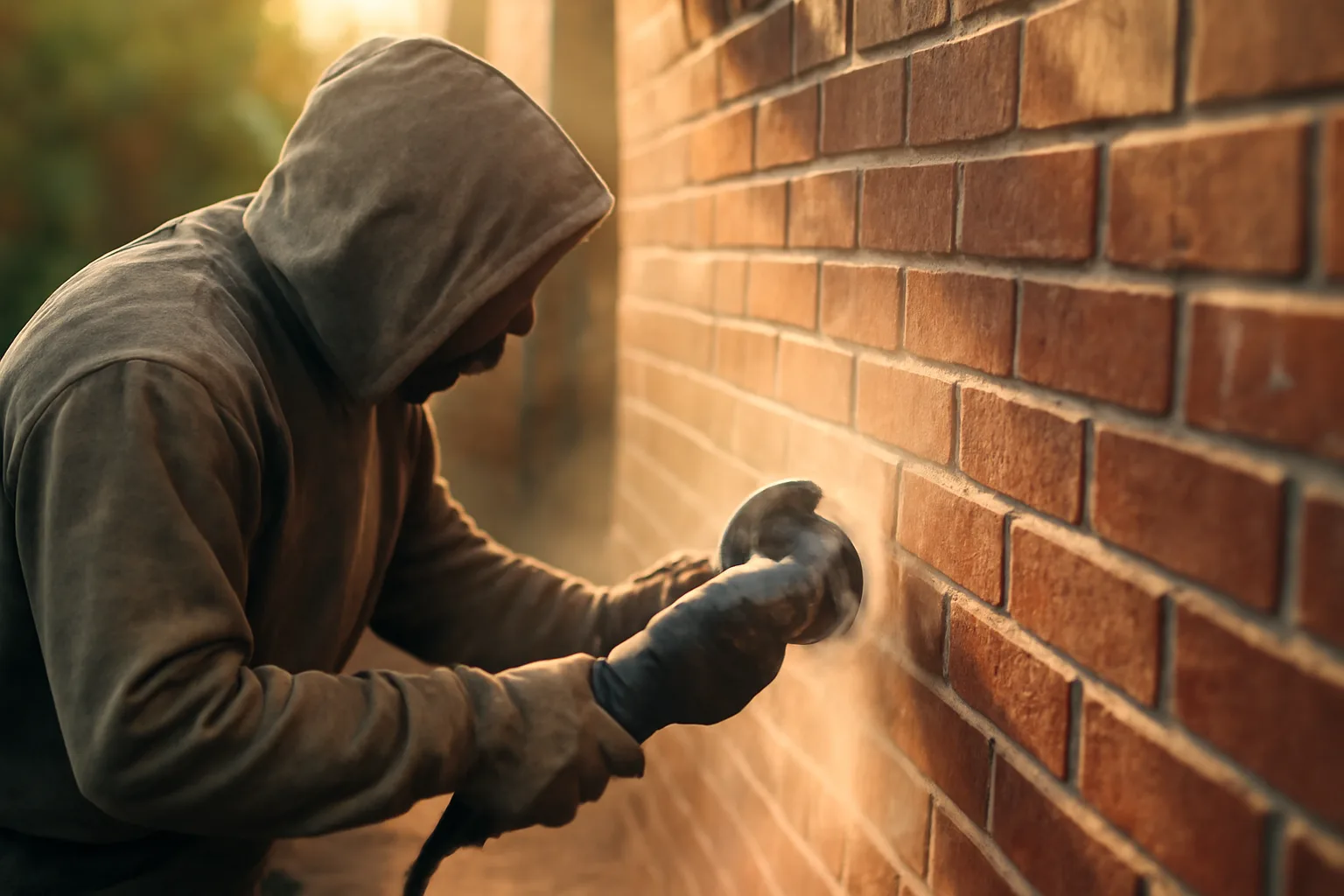
Tuckpointing is cutting failed mortar out of brick or stone joints and packing new mortar so the wall can shed water again. In most U.S. yards the word means ordinary joint repair. Historic shops use a narrower meaning: fill the joint to match the brick, then cut a groove and lay a thin lime ribbon that fakes a fine joint.[1]
That ribbon is the tuck. English masons used it to make cheap brick look like expensive gauged work. You almost never need it on a 1970s ranch. You might need it if a conservator can already see that finish on the facade.
The job is simple to say and easy to botch. You remove unsound mortar. You keep dust out of your lungs. You dampen the joint. You pack mortar in thin lifts. You tool it to the existing profile. You keep the new mortar from flashing dry.
NPS Preservation Brief 2 is the document I would read before you touch old brick. It files the repair method under repointing, and it is blunt about hard modern mixes wrecking soft units.[1]
A homeowner who says tuckpointing means the joints look shot. Price the wall they have. Do not charge extra for winning a vocabulary fight.
How is tuckpointing different from repointing?
They overlap so hard that many specs treat the words as synonyms. Repointing is the conservation term for cutting out unsound mortar and replacing it. Tuckpointing, when a preservation architect uses it, means the two-color ribbon finish. On a production bid in most states, both words mean grind, fill, and tool.[1]
NPS does not treat decorative tuckpointing as the default repair. The Brief walks through color, texture, and strength. It cares more about not breaking the brick than about a pretty pin stripe.
A clean line from Preservation Brief 2: "In general, the mortar used for repointing should be softer or more permeable than the masonry units and no harder or more impermeable than the historic mortar to prevent damage to the masonry units."[1]
I write repointing on a historic spec and tuckpointing on a neighborhood flyer. Then I do the same physical work unless the existing finish is actually two-tone.
| Term | What most crews mean on a bid | What preservation texts mean |
|---|---|---|
| Tuckpointing | Grind and refill failed joints | Two-tone joint with a thin lime ribbon |
| Repointing | Same work as tuckpointing | Cut out and replace mortar only |
| Pointing | First finish on a new wall | Original joint finish, not a repair |
How do you start tuckpointing?
You start by learning joints on a wall nobody will cry over, with dust controls already bolted to the tool. Then you sort licensing in the city where you will bid. There is no federal tuckpointing card and no national waiting list.
A sane first-year path is boring. Get on a masonry crew or a registered bricklayer apprenticeship so you watch mixing, bonding, flashing, and scaffolding under people who have already wrecked a wall.[8] Buy or borrow an angle grinder with a real tuckpointing shroud that can meet OSHA's 25 cfm per inch of wheel diameter rule.[2] Practice raking to a uniform depth. Mix small batches. Photograph every test panel in shade and in sun.
Do not start on a soft 1890s storefront. Start on a painted garage, a garden wall, or new brick with obvious cement mortar. Historic arrises chip once. Owners remember.
Skill start and business start are different jobs. Register the entity your state wants. Get general liability that names masonry and scaffolding. Confirm contractor thresholds with the board that writes citations in your county. Some places let small residential jobs run under a dollar cap with no contractor card. Some do not. I will not invent that cap. Call the board and ask for the rule number.
Skip the crew years and go straight to Instagram samples, and you will underprice depth and overgrind corners. That is how first-year operators disappear after one bad winter.
Do you need a license to tuckpoint?
Sometimes. It depends on the state, the city, the contract size, and whether you hold yourself out as a contractor. There is no national tuckpointing license. Confirm every classification and fee with the board that can fine you.
California is a clear paper example, not a national model. The Contractors State License Board Description of Classifications lists C-29 Masonry for masonry construction on brick and similar systems. If your jobs sit over the state's contractor threshold, you need that card or another classification that legally covers the scope. Read the pamphlet, not a forum thread.[9]
Other states fold this work into a general building license, a home improvement registration, or a city trades card. Reciprocity is rare. A California classification does not travel. If you already hold something and you are moving, read the actual renewal path for tuckpointing renewal in california, tuckpointing renewal in florida, and tuckpointing renewal in georgia instead of assuming one process.
I would not buy a national masonry certificate from a random site. Boards do not care. They care about their statute, their exam vendor, their insurance minimums, and whether you pulled a permit.
Lead can add a second paper trail. Disturb painted surfaces on housing built before 1978 and EPA's Renovation, Repair and Painting rule can apply. That is 40 CFR 745 Subpart E, not a suggestion from a supply house.[7]
What tools do you need for tuckpointing?
A first kit is smaller than tool catalogs imply. You need a way to remove mortar, a way to control dust, a way to place mortar, and a way to tool the joint so it matches what is already on the wall.
Removal is a thin diamond tuckpointing blade on an angle grinder, plus hand chisels and a plugging chisel for edges. I still hand-cut the last bit near the brick face on old walls. Grinders save hours. They also chew arrises if you get greedy.
Dust control is not optional theater. OSHA Table 1 names this trade in plain text: "Handheld grinders for mortar removal (i.e., tuckpointing)." The dust collector must provide 25 cfm or greater per inch of wheel diameter, use a filter with 99 percent or greater efficiency, and have a cyclonic pre-separator or filter-cleaning mechanism.[2][11] Outdoors that setup can be enough. Indoors you often add a respirator with an APF of 10 unless you have exposure data that says otherwise.[10]
Placement tools are a hawk or mortar board, pointing trowels, a thin tuck pointer, jointers that match the existing profile, a spray bottle, a mixing tub, a paddle, buckets, and clean water. Matching the joint profile matters more than owning every specialty iron.
Access is pump jacks or frame scaffold that meets 29 CFR 1926.451. A leaning extension ladder on a two-story rake is how people fall and how joints get starved, because you cannot stay in one place.[6]
Skip the laser bundle in month one. A 4-foot level, a chalk line, and a headlamp find hollow joints fine. Spend the money on blades and vacuum filters. Those are the parts you will actually wear out.
What mortar should you use for tuckpointing?
Use mortar that is softer and more permeable than the units, and no harder than the sound mortar still in the wall.[1] That NPS rule should live on your mixer lid.
Modern Type N or Type O covers a lot of ordinary residential brick. Type S and Type M are for higher load or harsher exposure. They are also a common way to crack old clay brick. I would not put Type M into a 1910 porch pier unless an engineer wrote it down.
Match three properties, and do it in this order of harm: strength, then sand texture, then color. Color is what owners see. Strength is what keeps the brick alive. You get color from sand, pigment, and the binder. You get texture from sand gradation. A lab mortar analysis is worth the cost on true historic work. For a 1985 split-level, a few cured sample panels on spare brick usually beat a lab invoice.
Lime-forward mixes belong on soft historic units. Straight portland mixes belong on dense modern brick that already has portland joints. Mix those two worlds and faces spall two winters later.
If you want a one-time paper kit for mortar notes and district contacts, TuckpointPath sells a $149 Mortar-Match + District Kit. Treat it as a checklist you fill in. It is not a license and it does not speak to any board.
Waste of money: pre-colored bags you never sample on the actual wall. Mortar shifts as it cures. Owners judge the 30-day color, not the wet ribbon.
How deep should you grind mortar joints?
NPS Preservation Brief 2 sets a minimum rake depth of 3/4 inch for this work, and it tells you to go 2 to 2-1/2 times the joint width until you hit sound mortar.[1] If the joint is 3/8 inch wide, twice that width is 3/4 inch. That is the floor, not a trophy depth.
Hollow joints go deeper. You stop when the remaining mortar is sound and the sides of the units are clean enough for a mechanical key. Do not cut into the brick. Do not V-grind so deep you chew the beds. Leave the back of the joint rough. A polished cut and a dust film both kill bond.
Brush or rinse, then wait until the joint goes from glossy wet to damp before you pack. Pack in layers around 1/4 inch if the void is deep. One fat shove leaves voids you will not see until freeze-thaw finds them.
Tool when the mortar is thumbprint hard so the sand shows and the joint sheds water. Tool too early and you draw paste to the surface, and that paste cracks.
Nobody has good national data on failure rates by rake depth. The closest official method statement most reviewers still accept is that NPS Brief. If a city historic officer hands you a local spec, that local spec wins.
What safety rules apply to tuckpointing dust?
Silica is the rule that actually names this trade. OSHA 29 CFR 1926.1153 sets the respirable crystalline silica PEL for construction at 50 micrograms per cubic meter as an 8-hour TWA, with an action level of 25.[2][3]
Tuckpointing grinders throw that dust into your breathing zone. NIOSH has warned for decades that construction grinding can cause silicosis and death if you treat the plume like ordinary dirt.[5] OSHA printed a control sheet just for handheld grinders used for mortar removal.[11]
Follow Table 1 or run exposure monitoring. Table 1 is simpler for a small crew if you actually run the shroud, the vac, and the filter-cleaning cycle. A hardware-store bowl taped to a grinder is not a commercially available shroud.
Respirators sit on top of engineering controls, not instead of them. Fit tests are real. Facial hair breaks the seal. I would not bid indoor stairwell joints without a written silica plan and a vac I had already leak-tested.
Lead paint on old brick and wood trim is the other dust. Pre-1978 housing can trigger EPA RRP. That means firm certification, renovator training, containment, and records under 40 CFR 745 Subpart E.[7] Confirm whether your painted masonry even sits in that scope. Do not invent a lead process from a blog.
Hearing, eyes, and hands still fail people. Diamond blades throw grit. You get one set of knuckles.
How much does first-year tuckpointing work cost to set up?
Expect a few thousand dollars for tools and compliance if you already have a truck, and more if you need scaffold and a real insurance policy. I will not invent a tidy starter price. Catalogs move. Underwriters move.
The core is a shrouded grinder, a vac that can hit the cfm rule, blades, hand tools, a mixer, and PPE you will actually wear. Scaffold rental on the first two-story elevation often costs more than the grinder. General liability for masonry is not a homeowner policy. Workers' comp starts when you hire, and some boards want a certificate before they even talk to you.
BLS tracks pay for brickmasons, blockmasons, and stonemasons on the Occupational Outlook Handbook. The handbook Pay table listed a median annual wage of $60,650 from May 2023 OEWS data. That figure is employed masons, not your first six months of one-off joint jobs.[4] O*NET files the same occupation as 47-2021.00 if you need task language for an apprenticeship application.[8]
Waste of money in year one: vinyl wraps, a second dump trailer, and any certified master tuckpointer upsell. Buy blades, filters, and a better vac hose.
License application fees are local and they change. Confirm with the relevant board. I will not print a current fee here.
How long does a typical tuckpointing job take?
A single-story residential face with friendly cement joints can be days. A three-story elevation with lime mortar, rusted lintels, and a historic officer watching sample panels can be weeks. Nobody has a clean national production study I trust.
Crews quote by wall square foot or by linear foot of joint, then lose money on depth and access. My planning factors are setup time, how much mortar is actually dead, brick hardness, weather, and whether a grinder is even allowed.
Hand cutting around molded terra cotta is slow on purpose. Grind it like a ranch veneer and you own the chips.
Weather windows matter more than people admit. Mortar wants moderate temperatures and a damp cure. Hot sun skins the joint. Freezing nights blow it apart. Wet burlap looks amateur, and it works.
Give owners a range and a hold for hidden voids. If someone demands a fixed three-day promise on a wall you have not opened, walk.
Can you tuckpoint historic brick the same way as a 1980s ranch?
No. Dense modern brick with portland joints can take a harder mix and a faster grind. Soft historic clay, lime mortar, and thin arrises cannot. NPS Brief 2 exists because people used hard cement on old brick and then watched faces pop off.[1]
On historic work, cut less with the grinder and more with chisels. Test mortar on a hidden bay. Photograph existing joint profiles before you touch them. Keep portland content down unless testing says the original mix was already cement-heavy.
If the building is listed or sits in a local historic district, expect a sample panel and a written mix. Confirm with the local preservation office. A national hotline will not sign your panel.
On a 1980s ranch, match what is there, keep water out of the wythe, and do not overhard the joint relative to a soft unit. Same physics. Less paperwork.
Work across states and the trowel work can look identical while the paper does not. Skim tuckpointing renewal in arizona or tuckpointing renewal in colorado so you see how different the clocks are.
What paperwork should you confirm with the board before you bid?
Confirm the classification, the contract-value threshold, permit triggers, insurance minimums, and any city add-on. Confirm lead rules and historic district rules if they might apply. Confirm none of that with a publisher. Confirm it with the board.
Ask for the statute or rule number. If staff cannot point to a page, keep asking. Write down the name and the date. Boards change fees. I will not quote a processing time or a current application charge because those go stale.
Hold a license already? Renewal is its own calendar. See tuckpointing renewal in alabama, tuckpointing renewal in connecticut, and tuckpointing renewal in idaho for how uneven those clocks are.
Write a scope a stranger can follow: rake depth, mix, joint profile, who owns scaffolding, who owns the dumpster, and what happens when you find a rusted lintel. That last item is where first-year jobs go sideways.
TuckpointPath is an independent publisher, not a law firm and not a service company. The $149 Mortar-Match + District Kit is a paper aid. It does not file anything and it does not speed a board. If you want that checklist after you know your city, it is at /start. This guide still works if you never click it.
Frequently asked questions
What is tuckpointing?
Tuckpointing is removing failed mortar from masonry joints and packing new mortar so the wall sheds water. In U.S. trade talk it usually means the same job as repointing. In historic work it can mean a two-color finish with a thin lime ribbon. NPS Preservation Brief 2 is the method document most reviewers still accept.
How do you start tuckpointing?
Start on a low-risk wall with a shrouded grinder, hand tools, and a mortar softer than the brick. Get time on a masonry crew or a registered bricklayer apprenticeship if you can. Then confirm contractor rules with the local board. There is no national tuckpointing license. Skip historic facades until you can hold a joint line without chewing arrises.
Is tuckpointing the same as repointing?
On most residential bids, yes. Crews use both words for grind, fill, and tool. Preservation texts treat repointing as the repair method and tuckpointing as a decorative two-tone joint. Write the word the spec uses, then do the work the wall needs. NPS files the repair method under repointing.
How deep do you cut mortar joints?
NPS Preservation Brief 2 says remove mortar to a depth of 2 to 2-1/2 times the joint width, and at least 3/4 inch, until you hit sound mortar. Stop before you cut the brick. Leave the back of the joint rough so new mortar can key. Local historic specs can be stricter. Follow the stricter page.
What OSHA rule covers tuckpointing dust?
29 CFR 1926.1153 covers respirable crystalline silica in construction. Table 1 lists handheld grinders for mortar removal (i.e., tuckpointing) and requires a shroud plus a dust collector at 25 cfm or greater per inch of wheel diameter. The PEL is 50 micrograms per cubic meter as an 8-hour TWA. OSHA 3697 is the control sheet for this exact task.
Do I need a contractor license for small residential tuckpointing?
Maybe. It depends on your state, city, and contract value. Some boards exempt work under a dollar threshold. Some do not. California's C-29 Masonry classification is one example of how a state names this work. Confirm the current threshold and classification with the board that will cite you. Do not trust a national myth.
What mortar type is safest on old brick?
A mix that is softer and more permeable than the units, and no harder than the historic mortar still in the wall. That is the NPS Brief 2 rule. Type O or a lime-forward mix is often closer on soft clay. Type S and Type M are a common way to crack old brick. Sample on a hidden bay before you commit a whole elevation.
Can I tuckpoint from a ladder?
You can ruin a joint from a ladder because you cannot stay put. For anything above a short punch list, use scaffold that meets 29 CFR 1926.451. Two-story rakes, chimney breasts, and gable ends are where people fall. Price the access. Cheap access is how first-year jobs lose money and people.
Does EPA lead law apply to exterior brick joints?
It can, if you disturb painted surfaces on housing built before 1978. EPA's RRP rule lives in 40 CFR 745 Subpart E and covers renovation, repair, and painting by firms. Bare unpainted mortar may sit outside that scope. Painted masonry, windows, and trim often do not. Confirm the job with the rule text, not a supply-house summary.
How much do tuckpointing tools cost to start?
Plan on a few thousand dollars if you already have a truck, more if you need scaffold and masonry liability. I will not invent a kit total because prices move. The parts that matter are a shrouded grinder, a vac that can hit OSHA's cfm rule, blades, hand tools, and PPE. Fancy layout gear can wait.
How long is a masonry apprenticeship?
Registered bricklayer apprenticeships commonly run about three to four years of on-the-job hours plus related classroom time, but the exact term is set in the program standards. O*NET lists brickmasons and blockmasons as 47-2021.00 and points to apprenticeship as a standard path. Confirm hours and related instruction with the program sponsor, not a national rumor.
Should I grind every joint or only the failed ones?
Only the failed ones, unless a historic officer or a structural problem says otherwise. Sound mortar is part of the wall. Opening good joints wastes money and can damage arrises. Probe with a chisel or a screwdriver. Photograph hollow areas with the owner present so the scope does not creep after you start.
What is a tuck pointer tool?
A tuck pointer is a thin, flat trowel used to pack mortar into a raked joint. The trade name comes from that iron, not from a federal license. You still need jointers to match the finished profile. A $15 tuck pointer plus a matching jointer will do more for you in month one than a drawer of unused specialty tools.
Sources
- National Park Service, Preservation Brief 2: Repointing Mortar Joints in Historic Masonry Buildings: Defines repointing practice, the softer-than-unit mortar rule, and a minimum rake depth of 3/4 inch (2 to 2-1/2 times joint width) until sound mortar is reached.
- OSHA, 29 CFR 1926.1153 Respirable crystalline silica: Sets the construction silica PEL at 50 µg/m³ as an 8-hour TWA, an action level at 25 µg/m³, and Table 1 controls for handheld grinders for mortar removal (i.e., tuckpointing), including 25 cfm per inch of wheel diameter.
- OSHA Fact Sheet 3681, OSHA's Crystalline Silica Rule for Construction: States the construction silica PEL of 50 micrograms per cubic meter of air as an 8-hour time-weighted average.
- U.S. Bureau of Labor Statistics, Occupational Outlook Handbook: Brickmasons, Blockmasons, and Stonemasons: Pay table listed a median annual wage of $60,650 for brickmasons, blockmasons, and stonemasons based on May 2023 OEWS data.
- NIOSH Publication 96-112, Preventing Silicosis and Deaths in Construction Workers: Warns that construction tasks that generate silica dust, including grinding, can cause silicosis and death without dust controls.
- OSHA, 29 CFR 1926.451 Scaffolds: Sets construction scaffold capacity, platform, fall protection, and access requirements used on multi-story masonry repair.
- eCFR, 40 CFR Part 745 Subpart E (Lead Renovation, Repair and Painting): Requires firm certification, trained renovators, work-practice controls, and records for covered renovation, repair, and painting on pre-1978 housing.
- O*NET OnLine, Brickmasons and Blockmasons 47-2021.00: Identifies brickmasons and blockmasons as occupation 47-2021.00 and lists apprenticeship as a standard training path with typical masonry tasks.
- California Contractors State License Board, Description of Classifications (C-29 Masonry): Describes the C-29 Masonry contractor classification for masonry construction, including brick and related systems.
- OSHA 3902, Small Entity Compliance Guide for the Respirable Crystalline Silica Standard for Construction: Explains how construction employers can follow Table 1 or perform exposure assessment, including respirator APF expectations when Table 1 requires them.
- OSHA 3697, Controlling Silica Dust in Construction: Handheld Grinders for Mortar Removal (i.e., tuckpointing): Gives task-specific silica controls for tuckpointing grinders, matching the Table 1 shroud, vacuum, airflow, and filter requirements.