Last updated 2026-08-19
TL;DR
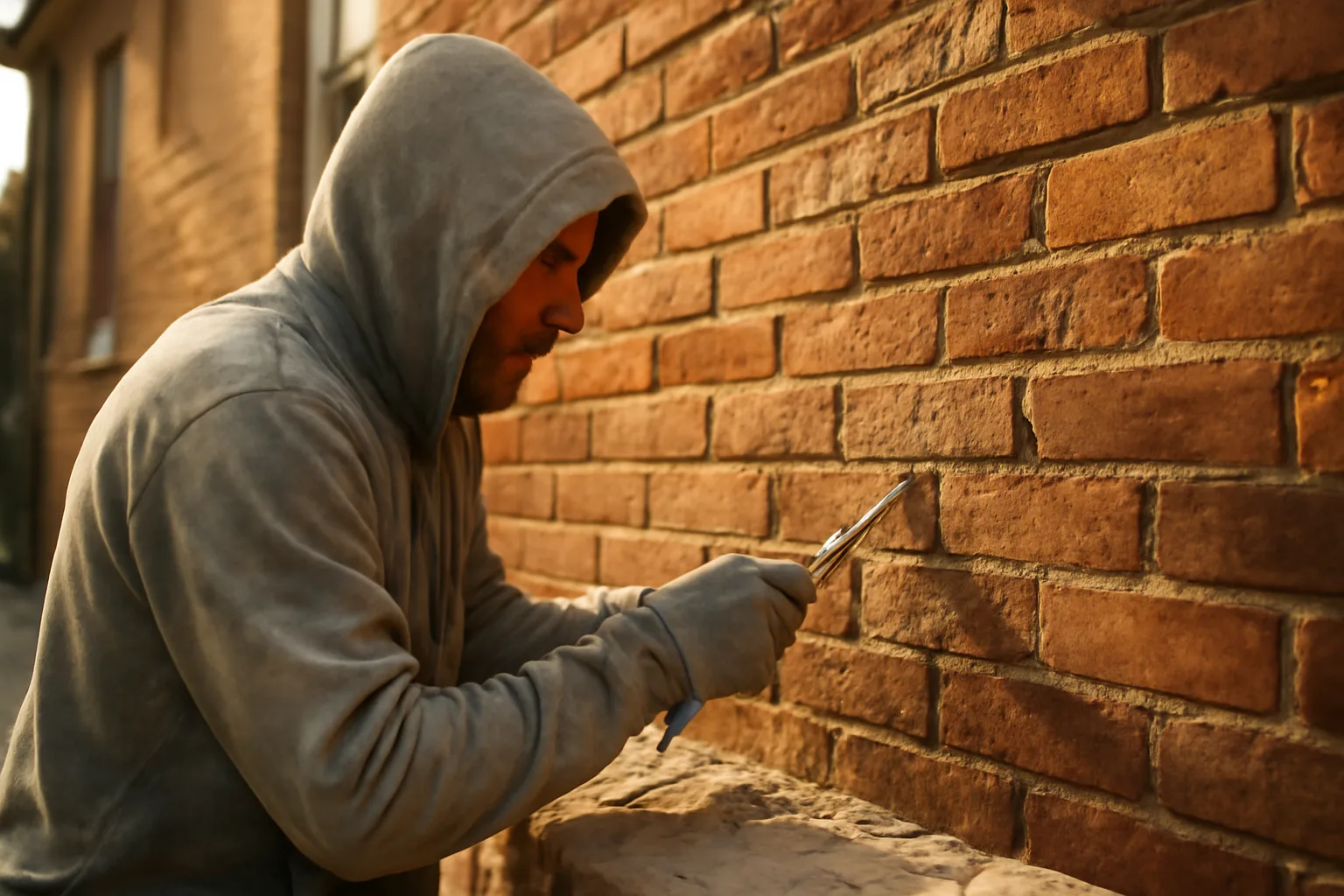
Tuckpointing is the trade work of cutting failed mortar out of brick or stone joints and packing new mortar back in. In U.S. job language that usually means repointing, not the old decorative lime-ribbon trick. You start by learning joint cutting and mortar matching under a mason, then you confirm local contractor rules, silica controls, and insurance with the board that licenses your city. There is no national tuckpointing card.
What is tuckpointing?
Tuckpointing is cutting deteriorated mortar out of a masonry joint and packing new mortar so the wall can shed water again. On U.S. jobsites that is the working meaning. You are repairing the joints that already hold the units, not laying a new wall.
Failed mortar lets water sit in the wall. Freeze cycles blow the face off brick. Soft historic brick fails even faster if you pack a hard mix that cannot move with the wall. The craft is matching color, sand, strength, and joint profile so the repair does not read as a scar from the sidewalk.
The National Park Service describes the everyday repair as "the process of removing deteriorated mortar from the joints of a masonry wall and replacing it with new mortar." [1] That sentence is the job. Depth, binder, sand, and the tool that strikes the face are how you keep the elevation honest.
Owners still type tuckpointing into every search bar I have seen. Bid sheets may say repoint, cut and point, or tuckpoint. Read the spec. If a preservation officer wants a raised lime ribbon on a flush colored joint, that is a different finish and a different price. Do not grind sound joints just to make a wall look even. Cut what has failed. Match what is left.
Is tuckpointing the same as repointing?
No. On a modern American bid they often describe the same scope, but the historic terms are not the same thing. Repointing is the repair sequence. Classic tuck pointing is a decorative finish that lays a neat lime putty line over a flush joint so the brick looks sharper than it is. [1]
If a property manager says tuckpoint the chimney, they want failed mortar cut out and new mortar packed. If a reviewer on a historic commission uses the older sense, they may want that ribbon. Ask which one they mean before you price color matching.
Historic England's guidance on repointing brick and stone walls is worth a night of reading even if you never leave your county. It keeps coming back to raking to a sound depth and using a mortar that fits the wall, not a bag chosen for speed. [2]
I treat pointing as the act of placing mortar in a joint. I treat repointing as the full repair. I treat tuckpointing as the word owners will actually say. Your contract should name cut depth, mortar, and finish tool. Words without those three start fights.
How do you start tuckpointing?
You start by standing next to someone who already cuts joints for a living, then you confirm the paper your city actually asks for. There is no national tuckpointing card. Most people who get good at this come up as masonry helpers, union apprentices, or laborers on restoration crews.
The U.S. Bureau of Labor Statistics says most brickmasons, blockmasons, and stonemasons learn through a 3 or 4 year apprenticeship. [5] O*NET lists the same occupation under SOC 47-2021.00 and treats apprenticeship as the normal path, not a four year degree. [6] That matches what you see on real walls. Joint feel takes reps. Color matching takes failed samples. Dust control takes a crew that will stop you when the shroud is starving.
If a registered apprenticeship is open in your area, take it. Paid hours beat watching videos. If the local BAC hall is not taking names, look for a restoration shop that already owns vacuums and a scaffold program. Offer to run the vac and mix for six months. The people who skip that year buy a cheap angle grinder, glaze a row of 1910 brick, and then spend the winter explaining themselves to an owner.
While you learn the hand work, start the paper in parallel. Get an EIN if you will invoice anyone. [9] Ask the contractor board, the city building department, and your insurer the same plain questions. Write down the answers. Do not trust a Facebook thread about what "everyone" does in another state. Markets do not share rules. Compare how crews talk about price in places like tuckpointing cost in alabama and tuckpointing cost in california and you will see why a national script fails.
Do you need a license to start tuckpointing?
Often yes if you bid the work yourself, and often no if you are on someone else's payroll. It depends on the state, the city, the contract value, and whether the wall is on a house or a commercial building. Confirm with the relevant board. Nobody can quote your fee, your exam, or your wait time from a national article, and anyone who pretends they can is guessing.
Some states put masonry under a specialty contractor class. Some cities require a home improvement registration on top of the state card. Some historic districts add a commission review before you touch a joint. Unincorporated counties can be quieter. The board that answers the phone for your job address is the only one that counts.
TuckpointPath is not a law firm and not a licensing agency. If a kit helps you keep mortar notes and a district checklist in one pile, the $149 one-time Mortar-Match + District Kit is the worksheet set on this site. A notebook and the board website do the same job if you actually fill them out.
Do not start marketing as a contractor while you are still a W-2 apprentice unless your agreement allows side work. That is how people lose a slot. If you are forming a shop, register the business, get the EIN, and ask the insurer about general liability and workers compensation before you hire a helper. [9] Those are boring steps. They are also the steps that keep a first claim from ending the company.
What does OSHA require for tuckpointing grinders?
If you grind mortar, OSHA treats that task by name. Table 1 of 29 CFR 1926.1153 lists "Handheld grinders for mortar removal (i.e., tuckpointing)" and tells the employer what controls to run. [3] The rule is not optional because the wall is a house, and it is not optional because you are a two person crew.
OSHA sets the respirable crystalline silica PEL for construction at 50 micrograms per cubic meter as an 8 hour TWA in 29 CFR 1926.1153. [3] The action level is 25 micrograms per cubic meter. For each Table 1 task, "the employer shall fully and properly implement the engineering controls, work practices, and respiratory protection specified for the task on Table 1." [3]
For tuckpointing grinders the table wants a commercially available shroud and dust collection system. The collector must provide 25 cfm or greater of airflow per inch of wheel diameter, with a filter at 99 percent or greater efficiency and a cyclonic pre-separator or filter-cleaning mechanism. [3] Run the tool the way the maker says. A $40 hardware store vac taped to a guard is not that system.
Table 1 also sets respirator APF by shift time on that task. At or under 4 hours the listed APF is 10. Over 4 hours the listed APF is 25. [3] NIOSH published a Workplace Solutions sheet just on tuckpointing dust because the cut is dusty even when people think they are being careful. [11] OSHA's construction silica fact sheet is the plain language version you should put in the truck. [12]
Masonry construction has its own subpart. 29 CFR 1926.706 covers limited access zones and bracing on walls under construction. [4] Existing wall repair still sits under the rest of Part 1926. If you are on a scaffold more than 6 feet up, 29 CFR 1926.501 is the fall rule most crews actually live with. [8] I would not buy a second grinder until the first one has a real shroud, a vac that keeps up, and a fall plan that is written down.
What mortar should a beginner use?
Use a mortar weaker than the masonry units and no stronger than the mortar that is still sound in the wall. That is the NPS rule of thumb, and it is the one that keeps soft brick alive. [1] On a 1920s house with lime-rich joints, a modern Type S bag is often a bad idea. On a 1990s veneer with hard units, Type N is a common starting point. Test. Do not guess from the bag art.
NPS Preservation Brief 2 walks through why laboratory analysis of the old mortar helps, and why matching sand color and grain matters more than matching a paint chip in the truck. [1] The Secretary of the Interior's Standards, codified at 36 CFR 68, push repair of historic features rather than wholesale replacement. [10] If the building is listed or in a review district, expect someone to ask how your mix relates to those standards.
A simple field table looks like this:
| Mix people reach for | Where it usually belongs | Where it gets people in trouble |
|---|---|---|
| Type M | High load modern masonry | Soft historic brick faces |
| Type S | Higher lateral load modern work | Old lime joints that need to flex |
| Type N | Many everyday veneers | Harder than some 19th century walls |
| Type O or lime-rich custom | Soft historic walls | Wet, freeze-prone ledges if misused |
I would rather lose a day making sample boards than spend a year grinding out a gray smear. Precolored bags can work on new brick. They often miss on weathered walls. Buy sand locally. Make three or four sample joints and let them dry. Owners pick color when it is dry, not when it is wet and dark.
If lead paint is on adjacent wood or on painted masonry of pre-1978 target housing, the EPA renovation, repair, and painting rule in 40 CFR 745 Subpart E can apply to the firm doing the work. [7] Confirm whether your scope disturbs that paint. Silica and lead are different rules. You can trip both on one porch.
What tools do you need to start tuckpointing?
You need a way to cut the joint without chewing the brick, a way to wet and pack mortar, and a way to control dust. That is the short list. Everything else is comfort or speed.
A grinder with a tuckpointing blade and a real shroud is the usual production tool. Hand rakers and chisels still earn their keep on edges, historic faces, and anywhere a disk will ride up on a header. Pointing trowels, a hawk, jointers that match the old profile, a spray bottle, and a stiff brush finish the kit. A mixer is optional until you have enough linear feet to justify dragging it.
Waste of money in month one: a giant tow mixer, a second ladder when you still do not own scaffold boards, and any grinder sold without a path to 25 cfm per inch of wheel. [3] Spend first on the vac, the shroud, hearing and eye protection, and gloves you will actually wear. Cheap blades wander. That wander shows up as chipped arrises the owner will photograph.
I like a small pointing iron set more than a drawer of novelty jointers. Match the existing joint. Weathered concave is common. Struck and weathered shows up on older work. Do not invent a grapevine joint because it looked good on a video.
Tool cost varies by city the same way labor does. Crews pricing work in tuckpointing cost in florida and tuckpointing cost in arizona are not buying the same scaffold days. Price the access, more than the grinder.
How much money does a first year of tuckpointing take?
Nobody has a clean national number for starting a tuckpointing shop, and I will not invent one. Your first year cost is tools, access equipment, insurance, license or registration if required, a vehicle that can carry a vac, and the idle time while you learn to estimate. Those lines move with the city.
BLS publishes current wage figures for brickmasons and blockmasons under SOC 47-2021 on both the Occupational Outlook Handbook and the OEWS tables. [5] [13] Confirm the latest median there before you build a household budget around a screenshot from three years ago. Wages are not invoices. What a mason earns on a W-2 is not what a new shop keeps after insurance and blade wear.
I would budget the safety gear and dust collection before I budget a website. A job that pays well in tuckpointing cost in colorado can still lose money if you underbid scaffold and winter shut down. The same scope in tuckpointing cost in georgia may run more days and less heat protection. Read local cost notes. Then call two suppliers and one insurer. Write the real quotes on paper.
Do not finance a truck wrap in month two. Do not hire a helper until workers compensation is actually in force. Confirm those items with the carrier and the state agency that runs the comp system. Processing times change. This site will not pretend they do not.
How long does it take to get competent at tuckpointing?
You can pack a decent joint in a few weeks if someone stands over you. You cannot read a failed wall in a few weeks. Competent, to me, means you know when to stop grinding, when the mix is too wet, and when the elevation needs a sample board instead of a confident guess.
A 3 or 4 year masonry apprenticeship is the timeline BLS still publishes for the broader trade. [5] Tuckpointing is one skill inside that trade. Restoration shops often keep people on joints for a full season before they let them talk to owners about color. That is not snobbery. Dry mortar shifts. Owners remember the shift.
If you only grind and never strike, you will stay a cutter. If you only strike bags someone else mixed, you will not know why the joint smeared. Rotate. Mix. Cut. Strike. Look at yesterday's work in the morning light. That loop is the training plan.
Speed comes last. A clean 20 feet that matches is worth more than a sloppy 80 feet you will recut. I still recut my own early work in my head when I walk past it. You will too.
What paperwork should you confirm with the board before you bid?
Confirm four piles: who may contract the work, what permit the wall needs, what historic review applies, and what insurance the owner or GC will ask to see. Then confirm silica and, if the building is older painted housing, whether 40 CFR 745 Subpart E reaches your scope. [7]
Call the contractor licensing board for the job address. Ask if masonry or home improvement registration kicks in at your contract value. Ask whether a qualifier has to be on staff. Write the person's name and the date. Boards change thresholds. A blog post from 2019 is not a license.
Call the building department about permits for chimneys, structural brick, and any scaffold in the right of way. Call the preservation office if the property is in a district. 36 CFR 68 is the federal language reviewers lean on for historic treatments. [10] Local ordinances can be stricter.
Ask your insurer for certificates that match the bid. Some GCs want additional insured language you cannot get on a cheap policy. That is a bid cost, not a surprise. If you hire, ask the state workers compensation agency how registration works. I will not quote a fee. Confirm it.
Keep SDS sheets for mortar, blades, and fuels in the truck. Keep the silica plan with the vac. OSHA does not grade handwriting, but it does expect the program to exist when the task is on Table 1. [3] [12]
What first-year tuckpointing habits waste money?
Buying production tools before you have production work. Using Type S on soft brick because the lumberyard stack was on sale. Grinding past sound mortar to make a pretty stripe. Bidding chimney caps without climbing them first. Those are the expensive habits.
The other waste is ignoring dust control until a complaint. Table 1 is cheaper than a claim, and it is cheaper than replacing a helper who will not come back. [3] [11] A vac that meets the cfm rule costs real money. Recutting a glazed brick elevation costs more.
Stop underbidding mobilization. Blades die on old lime and on clinker brick. Parking, dump fees, and water all show up. If you want a feel for how far local prices swing, read tuckpointing cost in connecticut next to a smaller market note and notice the access and wage gap. Then write your own numbers. Copying someone else's per-foot price is how first year shops work for free.
I would also skip most marketing retainers until you have ten finished elevations you are willing to show in daylight. Referral work from roofers and masons pays. Ads that promise a national method do not.
Can a homeowner do tuckpointing or should they hire?
A homeowner can rake and pack a few failed joints on a low garden wall if the brick is sound and they stay off ladders. I would hire the chimney, the third story, anything with a grinder, and any wall in a historic district. Dust, falls, and wrong mortar are the reasons, not guild mystery.
OSHA rules bind employers, not a homeowner working on their own house. The physics do not change. Silica from a dry cut is still silica. [3] [11] A fall from a roof rake is still a fall. [8] If the house is pre-1978 and the work disturbs lead paint, the RRP rule is aimed at paid firms, but the lead is still there for the family. [7]
If you hire, ask to see a mortar sample, a dust setup, and proof they may contract in your city. Ask how deep they cut. NPS talks about removing mortar to about 2 to 2.5 times the joint height so the new mortar can key. [1] If the answer is "we just hit it with the disk until it looks clean," keep calling.
TuckpointPath is an independent publisher, not a service company. If you want the start checklist after you finish this page, use /start. Confirm every fee and form with the board that actually has your address.
Frequently asked questions
What is tuckpointing?
Tuckpointing is cutting failed mortar from brick or stone joints and packing new mortar so the wall sheds water. On U.S. jobs that usually means repointing. Classic tuck pointing is a separate decorative ribbon of lime putty. Ask which one the spec writer wants before you price the elevation.
How do you start tuckpointing?
Work under a mason or in a 3 or 4 year masonry apprenticeship, which is the path BLS still describes for brickmasons. Learn cutting, mixing, and matching on real walls. In parallel, confirm contractor registration, insurance, and silica controls with the board and agencies for your city. There is no national tuckpointing license.
How deep should you cut mortar joints?
NPS Preservation Brief 2 tells crews to remove mortar to a depth of about 2 to 2.5 times the joint height so the new mortar can bond. Stop when you reach sound mortar. Do not grind brick faces to chase a pretty stripe. Hand tools belong on edges and historic arrises a disk will chip.
What mortar type do you use on old brick?
Use a mix weaker than the units and no stronger than the sound historic mortar. Soft 19th and early 20th century brick often wants a lime-rich or Type O style mix, not Type S. Make sample boards and let them dry. Confirm any review-district rules before you batch the wall.
Do you need OSHA 10 to tuckpoint?
OSHA 10 is training many GCs require. It is not a substitute for the silica rule. If you grind mortar, 29 CFR 1926.1153 Table 1 names tuckpointing and sets shroud, vac, and respirator controls. Confirm what card your contractor or owner wants. Training hours are not a license to skip Table 1.
Is a contractor license required for tuckpointing?
Sometimes. It depends on state class, city registration, contract value, and building type. Employees on a licensed shop usually do not hold the qualifier card themselves. Confirm with the relevant board for the job address. Do not copy another state's threshold. Fees and wait times change, so ask the board.
How much does a tuckpointing grinder setup cost?
Nobody publishes a stable national kit price. A grinder is the cheap line. A shroud and a vac that can hold 25 cfm per inch of wheel diameter, which OSHA Table 1 calls for, cost more than the tool. Get current quotes from two suppliers. Skip bargain vacs that collapse as soon as the filter loads.
Can you tuckpoint in winter?
You can, if you protect the fresh mortar from freezing and you can still keep dust controls running. Cold walls and hot bags both make weak joints. Many shops stop or tent the work when nights drop below the mortar maker's limit. Read the mix data sheet. Do not guess from a warm afternoon.
What is the difference between pointing and tuckpointing?
Pointing is placing mortar in a joint. Repointing is cutting out failed mortar and replacing it. Tuckpointing is the word most U.S. owners use for that repair, and it is also an older decorative finish with a thin putty line. Put the cut depth and finish in the contract so the words cannot drift.
How long do new tuckpointed joints last?
It depends on the wall, the mix, water management, and climate. A compatible mortar on a dry wall can last decades. A hard mix on wet soft brick can fail the units first. Nobody has a single national lifespan study that covers every bag and every elevation. Fix the water source or the new joint is a short story.
Do I need EPA RRP certification to tuckpoint?
If you are a paid firm working on pre-1978 target housing or a child-occupied facility and you disturb lead-based paint, 40 CFR 745 Subpart E can apply. Bare brick with no paint is a different fact pattern. Confirm the building year, the painted surfaces in the work area, and your firm status with EPA or the authorized state program.
Is tuckpointing a good trade to enter?
It is steady where brick and stone already exist, and it rewards people who like close work more than layout. It is dusty, weather-heavy, and hard on knees and shoulders. BLS tracks the broader mason group, not a separate tuckpointing census. Talk to two local shops before you buy tools. The work is real. The Instagram version is not.
What insurance do tuckpointers usually carry?
Shops that bid their own work typically carry general liability. If they have employees they need workers compensation in almost every state. GCs may ask for extra insured language and higher limits. Confirm coverages and certificates with a licensed agent. I will not invent a premium. Premiums move with claims and payroll.
Sources
- NPS Technical Preservation Services, Preservation Brief 2 (Repointing Mortar Joints): Defines repointing as removing deteriorated mortar and replacing it, and sets guidance on compatible, weaker mortar and cut depth of about 2 to 2.5 times joint height.
- Historic England, Repointing Brick and Stone Walls: Primary industry guidance on raking joints to a sound depth and choosing mortar that fits the existing wall.
- OSHA, 29 CFR 1926.1153 Respirable crystalline silica: Sets the 50 µg/m³ PEL and 25 µg/m³ action level, names handheld grinders for mortar removal (tuckpointing) on Table 1, and requires 25 cfm per inch plus listed respirator APFs.
- OSHA, 29 CFR 1926.706 Masonry construction: Masonry construction subpart covering limited access zones and bracing requirements for masonry walls.
- U.S. BLS Occupational Outlook Handbook, Brickmasons, Blockmasons, and Stonemasons: Most brickmasons, blockmasons, and stonemasons learn through a 3 or 4 year apprenticeship.
- O*NET OnLine, 47-2021.00 Brickmasons and Blockmasons: Federal occupation profile treating brickmasons and blockmasons as an apprenticeship-typical trade under SOC 47-2021.00.
- eCFR, 40 CFR Part 745 Subpart E (RRP): EPA renovation, repair, and painting rule can apply to paid firms disturbing lead-based paint in pre-1978 target housing.
- OSHA, 29 CFR 1926.501 Duty to have fall protection: Construction fall protection duties, including the common 6 foot threshold used on scaffolds and elevations.
- IRS, Apply for an Employer Identification Number (EIN) Online: Businesses that will invoice or hire use the IRS EIN application process to obtain a federal employer number.
- eCFR, 36 CFR Part 68 Secretary of the Interior's Standards: Federal historic treatment standards that favor repair of historic features rather than replacement.
- NIOSH, Workplace Solutions 2008-127 Control of Hazardous Dust When Tuckpointing: NIOSH control guidance written specifically for hazardous dust generated during tuckpointing.
- OSHA Publication OSHA3681, OSHA's Crystalline Silica Rule: Construction: Plain-language OSHA fact sheet on the construction silica rule and Table 1 implementation.
- U.S. BLS OEWS, 47-2021 Brickmasons and Blockmasons: Official wage and employment estimates for brickmasons and blockmasons, updated on the OEWS series.