Last updated 2026-08-19
TL;DR
Paid tuckpointing in Arizona is contracting work. You generally need a Registrar of Contractors license in a masonry or broader class before you bid, unless a written exemption fits. Confirm class, bond, and fees with the ROC. Price is mostly labor, access, and mortar match. A house wall can take a day or several weeks. Heat, monsoon, and OSHA silica rules slow the grind.
What does tuckpointing renewal mean in Arizona?
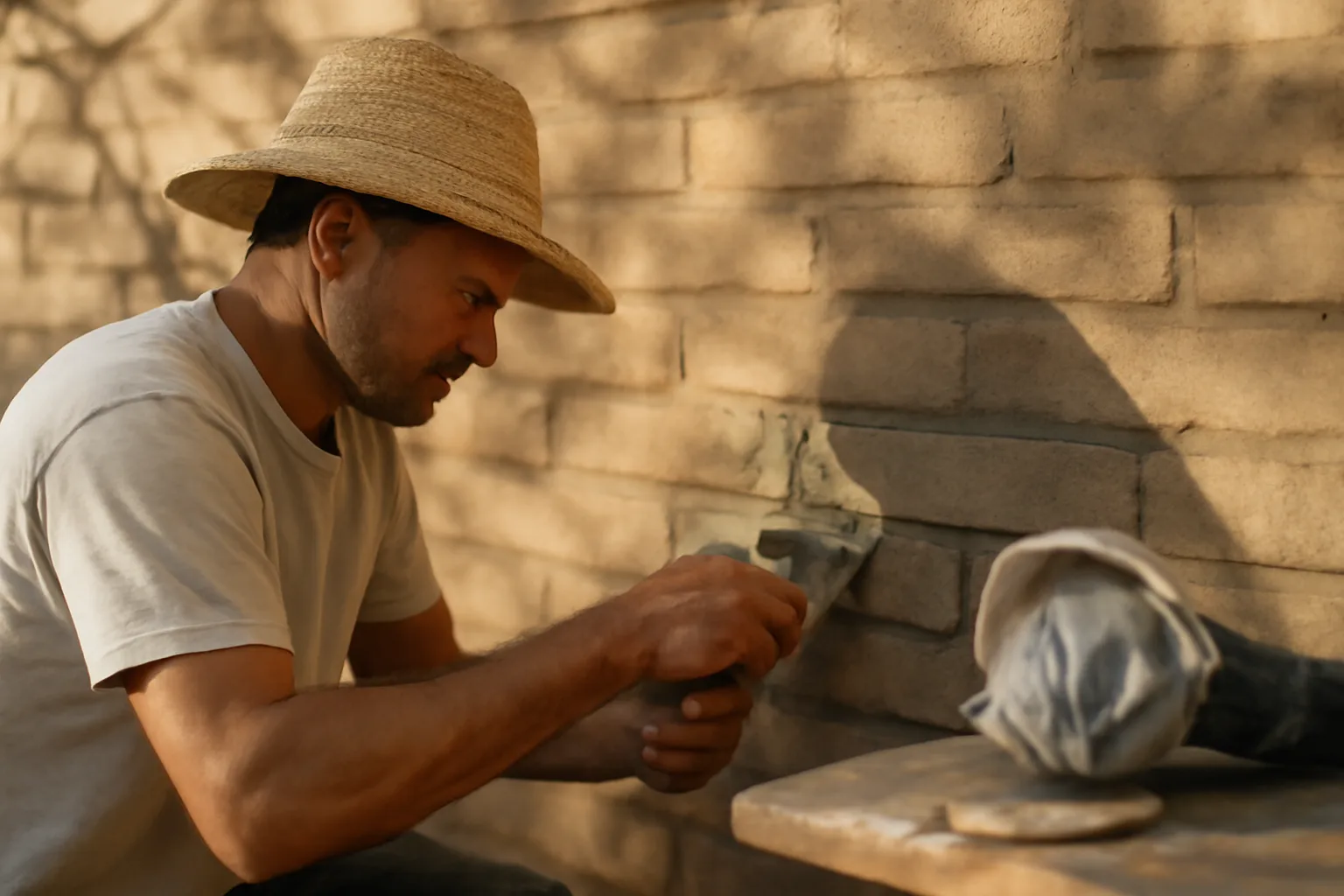
Tuckpointing renewal in Arizona is cutting failed mortar out of brick, block, or stone and packing new mortar so the wall sheds water again. People also use the same phrase for renewing the contractor license that lets you sell that work. Both meanings live on this page because both sit on the real paper path.
On old Phoenix bungalows and Tucson brick, failed joints show up as sand on the sill and open beds you can rake with a key. Shops say tuckpointing. Preservation people say repointing. The National Park Service puts it plainly in Preservation Brief 2: "Repointing mortar joints is the process of removing deteriorated mortar from the joints of a masonry wall and replacing it with new mortar." [11] Same craft. Different vocabulary.
Arizona sun cooks lime mortar until it sands out. Monsoon rain then drives water into the open bed. High country around Flagstaff adds freeze. The repair idea is the same statewide. The paper is not.
Sell the work and you step into Title 32 contracting rules. Own the house and live in it, and a written exemption may fit. Read both before you bid a neighbor's chimney. Guessing is how people work for free.
Do you need a license for tuckpointing in Arizona?
Yes. Paid tuckpointing in Arizona is usually licensed contracting under the Registrar of Contractors. Statute makes it unlawful to act as a contractor without the license required for that scope. Confirm any dollar trigger and every exemption in ARS 32-1121 and on the ROC's current licensing pages before you price a job. A Facebook rule of thumb is not law. [1][2]
ARS 32-1101 defines who counts as a contractor. The definition is broad. A person who undertakes to construct, alter, or repair a structure sits inside it. Mortar joint work on a building is repair. [3] ARS 32-1151 then makes unlicensed contracting unlawful. A city privilege tax license is not a contractor license. They are different papers. [1]
Owner-occupants have a written exemption path in ARS 32-1121, with limits if the place is for sale or rent. Employees of a licensed contractor, paid only wages, are another exemption. Handyman folklore is not an exemption. If someone tells you a job under a round number is always fine, verify that sentence on the ROC site the morning you bid. I am not printing a dollar trigger here. Boards change it, and a stale number on this page would be worse than no number. [2]
The collection risk is uglier than a citation. ARS 32-1153 says a contractor may not "commence or maintain any action in any court of the state for collection of compensation" for work that required a license unless that contractor was duly licensed when the contract was made and when the claim arose. [6] That sentence should scare you more than a fine.
A California masonry card does not replace Arizona paper. If you also bid west of the river, read tuckpointing renewal in California as a contrast, then file here.
Which Arizona license classification covers tuckpointing?
A masonry classification is the clean fit. Arizona Administrative Code Title 4, Chapter 9 lists residential and commercial contractor classes. The masonry language in that chapter covers installation and repair of brick, block, stone, and related restoration. Tuckpointing is restoration of mortar joints. Confirm the current class code on the live ROC list. Crews still say C-31. Blogs freeze old codes. The rulebook does not. [7]
General residential or commercial building licenses can also reach this work if the printed scope includes structural repair. Dual licenses exist for people who bounce between houses and commercial walls. I would not buy a broader license just to tuckpoint chimneys. More scope means more exam, more bond questions, and more recovery-fund exposure. Match the class to the bid mix you actually have.
| Path | Who it usually fits | What to confirm with the ROC |
|---|---|---|
| Residential masonry class | House walls, chimneys, garden walls | Current class code, experience proof, exam |
| Commercial masonry class | Paid work on businesses and multifamily | Separate commercial application rules |
| Dual license | Mix of house and commercial walls | Dual forms and bond questions |
| Owner doing own occupied home | DIY on a house you live in | Sale and rent limits in ARS 32-1121 |
The qualifying party sits for the exam and holds the experience. ARS 32-1122 sets qualifications. Expect documented time in the trade plus a trade exam and a statutes and rules exam. Years required live in statute and rule. Confirm the count with the board before you pay a school. [4]
Out-of-state time can count if you can prove it. Keep W-2s, invoices, and a letter from a licensed employer. Nobody at the counter wants a speech. Colorado and Idaho run their own boards. If you chase work north, use tuckpointing renewal in Colorado and tuckpointing renewal in Idaho so you do not mix applications.
How do you renew an Arizona contractor license for masonry?
You renew with the Registrar of Contractors before the license expires. ARS 32-1125 governs renewal and the qualifying party. File the renewal the board names, pay the fee on the current ROC schedule, and keep the qualifying party attached. Confirm the term length, late window, and any course the board now wants. I will not invent a fee or a processing time. [5]
Lapsed licenses are a mess. Some people keep grinding joints and hope. That hope dies in court under ARS 32-1153. [6] Set a calendar reminder 90 days out. Update the bond rider if your surety wants a continuation certificate. Update workers' compensation and general liability certificates if a GC asks for current ACORDs. Change of address belongs on the renewal, not on a voicemail.
If the qualifying party left, stop. You cannot renew on a ghost. File the QP change first. Confirm forms on the ROC site.
A license renewal is not a city job permit. It is not a transaction privilege tax license renewal either. Three different clocks. Miss one and you still look unlicensed to someone who can withhold pay.
How much does tuckpointing cost in Arizona?
There is no official Arizona tuckpointing price list. Honest range talk starts with labor, access, and how far the joints are gone. Consumer sites toss out national per-square-foot numbers that swing from a few dollars to well over $20. I have not seen a peer-reviewed Arizona price study. Treat those national ranges as gossip until you measure the wall.
Labor is the big line. The Bureau of Labor Statistics tracks brickmasons and blockmasons under SOC 47-2021 in the Occupational Employment and Wage Statistics tables. Read the current Arizona and Phoenix-Mesa figures on that table. Do not freeze last year's mean in your head and call it a bid. [13]
Materials are cheap next to time. Type N or Type S masonry cement, lime, sand, and water sit in every yard in Phoenix. Historic color match, custom sand, and sample panels add days. NPS Brief 2 is blunt about strength: a mortar harder than the units will break the faces. A Portland-heavy "upgrade" on soft 1915 brick is a callback, not a favor. [11]
Access changes the number. A one-story ranch from the ground is one bid. A two-story with rotten fascia is another. A downtown Phoenix lane closure is a third. Heat shortens productive hours from June through September, so daily output drops and the price should rise.
I price by observed linear feet of joint, not by "a wall." Rake a test area. Measure depth. Soft lime that falls out with a screwdriver is faster than cement that needs a grinder on every bed. If a homeowner wants a number tonight, a small chimney can land in the high hundreds to low thousands. A full bungalow facade can run into five figures once lift equipment and silica controls show up. Those are order-of-magnitude talk, not a quote. Walk the wall.
How long does tuckpointing take in Arizona?
A small chimney can take a day. A full elevation on a 1920s house can take several days to a few weeks. Time follows joint hardness, access, heat, and whether you grind under OSHA Table 1. Nobody has a statewide productivity study I trust. Crews that claim a whole house in a weekend are selling.
Cut, vacuum, dampen, pack, tool, cure. Each pass needs time. NPS Brief 2 says old mortar should come out to a depth of 2 to 2.5 times the joint width so the new mortar can bond. That is not a light surface smear. [11] OSHA Table 1 for "Handheld grinders for mortar removal (i.e., tuckpointing)" then ties you to a shroud, a dust collector, and a respirator whose assigned protection factor rises if you grind more than 4 hours. [8] That setup is slower than a bare angle grinder and a bandana. Use the setup anyway.
Arizona heat is the other clock. Mortar that flashes in 105°F sun will not hydrate. You dampen joints, work smaller panels, and sometimes start at 5 a.m. Monsoon weeks dump rain that washes fresh joints. I would not promise a hard finish date across July without a weather allowance.
Historic overlay review adds sample-panel time. A design reviewer can sit on a mortar color for a week. Build that into the schedule or you eat scaffold rent. Florida humidity is a different problem. Compare notes in tuckpointing renewal in Florida if you also work there. Arizona is dry and brutal, not wet and mild.
What paper do Arizona tuckpointing jobs need before you start?
You need a current ROC license in the right class, a written contract, and whatever the city or county asks for that address. Many pure maintenance repointing jobs never pull a building permit. Structural rebuilds, parapet reconstruction, and historic overlay work often do. Confirm with the building desk that owns the address. Do not take a blog guess as a permit waiver.
If the building went up before 1978 and you will disturb paint, EPA's Renovation, Repair and Painting rule can apply. That is a federal firm certificate plus lead-safe work practices, not an Arizona masonry card. [12] Painted bands, eaves, and window brickmold are where shops get surprised.
Prime contracting can trigger Arizona transaction privilege tax under ARS 42-5075. Cities stack their own TPT. Register with the Department of Revenue and the city. Confirm the current deduction rules. I will not print a rate. [14]
Contract basics I actually use: scope in linear feet and elevations, mortar spec, who owns hidden rotten lintels, silica plan, start window, and a change-order clause. Photos before the grind. HOA approval if a packet exists. Insurance certificates for general liability and workers' compensation. The Arizona Industrial Commission handles workers' comp. Sole proprietor rules are easy to get wrong. Ask a licensed producer, not a forum.
If you want a one-time stack of mortar notes and district contact sheets, TuckpointPath sells a $149 Mortar-Match + District Kit at /start. You do not need it to use this guide.
What silica and safety rules apply to Arizona tuckpointing?
OSHA's construction silica standard applies on Arizona jobs. 29 CFR 1926.1153 Table 1 lists "Handheld grinders for mortar removal (i.e., tuckpointing)" as its own task. Arizona's state plan (ADOSH) holds private employers to this rule. Read the table. Then buy the collector that actually meets it. [8]
OSHA Table 1 requires a grinder with a commercially available shroud and dust collection, 25 cfm or greater airflow per inch of wheel, a filter with 99 percent or greater efficiency, and a filter-cleaning mechanism. Respiratory protection is APF 10 for 4 hours or less and APF 25 if you grind longer. OSHA sets the respirable crystalline silica PEL at 50 micrograms per cubic meter as an 8-hour TWA. [8][15]
| Table 1 item | Value in 29 CFR 1926.1153 |
|---|---|
| Named task | Handheld grinders for mortar removal (tuckpointing) |
| Collector airflow | 25 cfm per inch of wheel |
| Filter | 99% or greater efficiency |
| Respirator, 4 hours or less | APF 10 |
| Respirator, more than 4 hours | APF 25 |
OSHA Publication 3681 walks through those tuckpointing controls in shop language. Read it once with the crew. [9] A shop vac taped to a guard is not a Table 1 system. Skip Table 1 and you owe an exposure assessment. That path is how small shops get in trouble.
Respirators need a written program, medical clearance, and fit tests. Boring paper. Also how you keep a crew. Illinois industrial work hits the same federal table. The climate differs. See tuckpointing renewal in Illinois if you split seasons.
How do Arizona heat and monsoon change the mortar work?
They slow you down and they wreck sloppy mortar. Phoenix sits above 100°F for long stretches. Mortar water evaporates before cement hydrates. Joints look done at noon and dust out in a week.
Work small panels. Pre-wet the old units. Keep new mortar in the shade. Tool when the thumbprint sets, not when the sun says lunch. Some crews add ice to mix water. I care more about shade cloth and start time than gadgets.
Monsoon moisture is the other failure mode. A washed joint is a redo. Cover walls if storms are on the radar. Do not grind a whole elevation and leave it open over a holiday weekend in August.
High country is not Phoenix. Flagstaff and Prescott can freeze. Use a mortar that matches the exposure, not a valley habit. Adobe and soft fired brick in Tucson want a weaker, more vapor-open mix than a new CMU screen wall in Mesa. NPS Brief 2 is still the best free text on that strength match. [11]
Hawaii has heat with salt air. Different chemistry. tuckpointing renewal in Hawaii is a reminder that climate is local and your Arizona mix does not travel.
What taxes and insurance sit on an Arizona tuckpointing job?
Expect workers' compensation through the Arizona system, general liability a GC will actually accept, a surety bond the ROC class requires, and transaction privilege tax if you are prime contracting under ARS 42-5075. Confirm each amount with the issuer. None of those dollars belong frozen in an article. [14]
TPT is the one out-of-state masons miss. Arizona taxes prime contracting in a way that is not a simple sales-tax add-on. Cities stack their own rates. Register before the first invoice, not after a city audit letter.
Bond amounts live in ROC rule and vary by class. Buy what the class requires. Overbuying a huge bond because a website scared you is a waste. Underbuying because a friend "never got asked" is how an application stalls.
Auto and tools sit on your own policy. A dust extractor that meets the 25 cfm per inch rule is a business tool, not a luxury. [8] I would fund that before a truck wrap or a new door magnet.
What should you confirm with the Arizona Registrar of Contractors?
Confirm class scope, experience hours, exam vendor, bond amount, application fee, renewal fee, license term, and whether your other-state time counts. Confirm that tuckpointing sits in the masonry restoration language of your class. Confirm recovery fund participation. None of those figures belong in a frozen article. [4][5][7]
Use the ROC license search to see how a competitor is actually classed. If every masonry shop you respect holds the masonry class, follow them. If a bid rival is unlicensed, do not match that price.
Statute is public. ARS Title 32, Chapter 10 is the chapter. Rules live in 4 A.A.C. 9. Read both. Then ask the board how they apply the restoration line to mortar-only work. Get a name and a date on that answer.
This site is not the board. TuckpointPath is an independent publisher, not a law firm and not a service company.
What first-year Arizona tuckpointing paper mistakes waste money?
Bidding unlicensed, then trying to collect. Using a city tax license as if it were an ROC card. Letting the qualifying party quit without a replacement. Grinding without Table 1 controls because it is only a chimney. Promising Type S on soft 1915 brick. Skipping lead rules on a 1962 painted band. Writing a one-line text as the contract.
Schools that sell fear are a waste if they cannot show recent ROC pass rates. Bonding through a random web form without reading the classification amount is how you overbuy. I would spend money on a dust extractor that meets 25 cfm per inch, a fit-test, and a lawyer who has seen ARS 32-1153 cases. [6][8]
Sample panels are not a waste. Callbacks are. Measure two real walls this month. Write a spec. Decide if you need residential masonry, commercial, or dual. Book the exam path the board names today. Read OSHA 1926.1153 Table 1 and NPS Brief 2 the same week. [8][11] Do not buy a new truck first. Get legal to collect, then get safe to grind, then get good at color match. The optional kit, if you want it, lives at /start.
Frequently asked questions
Do you need a license for tuckpointing in Arizona?
Usually yes if you are paid to do the work. Arizona treats repair of structures as contracting under ARS Title 32. The Registrar of Contractors is the board. Owner-occupant and employee exemptions exist in ARS 32-1121. Confirm any dollar trigger and your class on the ROC site before you bid. A city tax license is not a substitute.
How much does tuckpointing cost in Arizona?
There is no official state price list. Labor, access, joint hardness, and heat drive the number. National consumer ranges often run from a few dollars to more than $20 per square foot and are not Arizona studies. A chimney can land in the high hundreds to low thousands. A full bungalow facade can reach five figures. Walk the wall and price linear feet of joint.
How long does tuckpointing take in Arizona?
A small chimney can take a day. A full house elevation can take several days to a few weeks. Grind time grows under OSHA Table 1 dust controls. Heat above 100°F and monsoon rain slow cure and can force rework. Historic color samples add calendar time. Nobody has a solid statewide productivity study, so be wary of weekend-whole-house claims.
Is C-31 the only Arizona class that can tuckpoint?
Masonry is the clean fit, and crews still say C-31, but you must confirm the live ROC classification list. A broader residential, commercial, or dual building license may also reach the work if its printed scope includes structural repair. I would not buy extra scope just to repoint chimneys. Match the class to the jobs you actually sell.
Can a homeowner tuckpoint their own Phoenix house?
ARS 32-1121 has an owner path, with limits if the property is for sale or rent. Doing the work yourself on a house you occupy is different from selling the work to a neighbor. City permits and historic overlay rules can still apply. Confirm the exemption language and the address with the ROC and the city before you start.
Does a city tax license replace the ROC contractor license?
No. A Phoenix or Tucson privilege tax license and an Arizona TPT account are tax paper. The Registrar of Contractors license is the trade paper that lets you act as a contractor. You can hold one and still be unlawful on the other. ARS 32-1151 is the unlicensed contracting statute. Keep both clocks current.
Do I need a building permit to repoint a brick wall in Tucson or Phoenix?
Often not for pure maintenance repointing that does not change the structure. Structural rebuilds, parapets, and historic overlay work are a different story. Each city and county reads maintenance differently. Call the building desk that owns the address and ask about mortar-only repair. Get the answer in writing if a historic district is involved.
What mortar should I use on old Arizona brick?
Match the old mix and keep the new mortar weaker than the units. NPS Preservation Brief 2 is the free reference. Soft 1910s brick and Tucson adobe hate a hard Portland-rich Type S smear. New CMU in Mesa is a different wall. Make a sample panel and let it dry in the sun before you commit an elevation.
Does EPA lead RRP apply when I grind mortar in Arizona?
It can, if the building is pre-1978 and you disturb paint. Many brick jobs look like masonry only until you hit a painted band, eave, or window brickmold. RRP is a federal firm certificate and lead-safe method rule, separate from the ROC card. Confirm the build year and the painted surfaces before you grind.
Can I collect in court if I forgot to renew my ROC license?
ARS 32-1153 blocks an unlicensed contractor from using Arizona courts to collect pay for work that required a license. The license has to be in place when the contract was made and when the claim arose. A lapsed card is not a paperwork shrug. Renew before you bid, not after the invoice goes unpaid.
Do I need workers' compensation as a one-person Arizona shop?
Arizona workers' comp rules sit with the Industrial Commission, and sole proprietor treatment is easy to get wrong. GCs will still ask for a certificate. Do not take a forum answer. Ask a licensed producer and confirm what the ROC file needs for your entity type. Budget the policy before you hire a helper.
How often do you renew an Arizona ROC masonry license?
Renewal is governed by ARS 32-1125 and the current ROC calendar. Term length and late windows have moved before. Confirm the expiration on your license record and set a reminder 90 days out. Keep the qualifying party attached. A license renewal is not the same clock as TPT or a city permit.
Can I use a California masonry license to tuckpoint in Arizona?
No. Arizona does not treat an out-of-state card as a local contractor license. You file with the Registrar of Contractors and meet Arizona experience, exam, and bond rules. Other-state time may count as proof if you can document it. Confirm that with the ROC, then read the California path separately if you still work there.
What dust controls does OSHA require for tuckpointing grinders?
29 CFR 1926.1153 Table 1 names handheld grinders for mortar removal (tuckpointing). Use a shrouded grinder, a collector at 25 cfm or more per inch of wheel, a 99 percent or better filter with a cleaning mechanism, plus APF 10 respiratory protection for 4 hours or less and APF 25 if you grind longer. A taped shop vac is not that system.
Sources
- Arizona Legislature, ARS 32-1151: Arizona law makes it unlawful to act as a contractor without the license required for that scope of work.
- Arizona Legislature, ARS 32-1121: ARS 32-1121 lists persons and situations not required to hold a contractor license, including specified owner and employee paths.
- Arizona Legislature, ARS 32-1101: ARS 32-1101 defines contractor in terms that include persons who undertake to construct, alter, or repair structures.
- Arizona Legislature, ARS 32-1122: ARS 32-1122 sets qualifications for issuance of an Arizona contractor license, including experience and examination.
- Arizona Legislature, ARS 32-1125: ARS 32-1125 governs renewal of an Arizona contractor license and the qualifying party.
- Arizona Legislature, ARS 32-1153: An unlicensed contractor may not commence or maintain an Arizona court action to collect compensation for work that required a license.
- Arizona Secretary of State, Arizona Administrative Code Title 4 Chapter 9: 4 A.A.C. 9 lists residential and commercial contractor license classifications, including masonry installation, repair, and restoration scopes.
- OSHA, 29 CFR 1926.1153 Respirable crystalline silica: Table 1 names handheld grinders for mortar removal (tuckpointing) and requires 25 cfm per inch dust collection, 99% filters, and APF 10 or 25 respirators by hours ground.
- OSHA Publication 3681, Controlling Silica Dust in Construction: Tuckpointing/Mortar Removal: OSHA's tuckpointing fact sheet describes shop-level silica controls for mortar removal grinders.
- National Park Service, Preservation Brief 2: Repointing Mortar Joints in Historic Masonry Buildings: NPS defines repointing as removing deteriorated mortar and replacing it, and advises removing old mortar to 2 to 2.5 times joint width and using mortar weaker than the masonry units.
- U.S. EPA, Lead Renovation, Repair and Painting Program: EPA RRP can apply to renovation and repair that disturbs paint in pre-1978 buildings, separate from state contractor licensing.
- U.S. BLS, OEWS Brickmasons and Blockmasons (SOC 47-2021): BLS publishes current occupational employment and wage statistics for brickmasons and blockmasons under SOC 47-2021, including state and metro tables.
- Arizona Legislature, ARS 42-5075 Prime contracting classification: ARS 42-5075 is Arizona's prime contracting transaction privilege tax classification that can apply to construction contractors.
- OSHA, Crystalline Silica overview (PEL): OSHA sets the respirable crystalline silica permissible exposure limit at 50 micrograms per cubic meter as an 8-hour TWA.