Last updated 2026-08-19
TL;DR
Tuckpointing is cutting failed mortar out of a masonry joint and packing new mortar that is softer than the brick. Start as a helper or registered masonry apprentice, learn hand raking first, then add a shrouded grinder under OSHA Table 1. Licensing is local. Confirm contractor, lead, and business paper with your board before you bid.
What is tuckpointing?
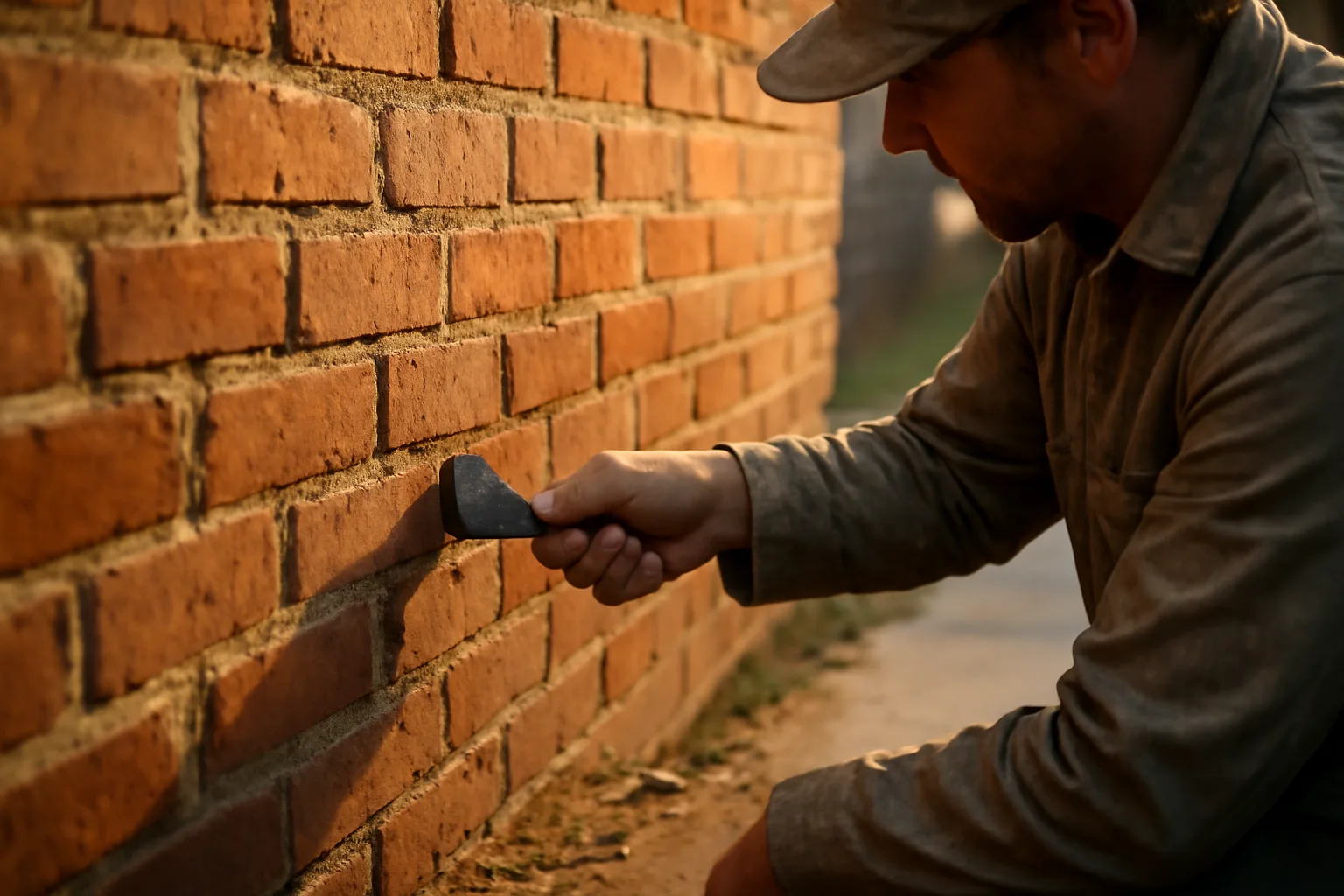
Tuckpointing is cutting failed mortar out of a masonry joint and packing new mortar that can move with the wall. That is the job on almost every U.S. repair bid. You restore the joint so water sheds and the brick or stone stays intact.
Historic preservation writers often call the same work repointing. They save the older phrase tuck pointing for a thin decorative lime line set over a colored joint. On a modern estimate, owners still say tuckpointing when they mean joint repair. Learn both words. Bid the work, not the vocabulary fight.
The National Park Service states the process in Preservation Brief 2: "Repointing is the process of removing deteriorated mortar from the joints of a masonry wall and replacing it with new mortar." [1]
You are not painting brick. You are not rolling a clear sealer on the face and calling it done. A sound joint is tooled or slightly recessed so rain runs off. Hard gray high-portland mortar on soft historic brick is a common failure. It looks crisp for a season. Then the faces pop because the joint is stronger than the unit. Brief 2 exists because that mismatch wrecks walls. [1]
Typical clay brick joints run about 3/8 inch. Later cavity walls can be tighter. Stone rubble can be anything. Depth and mix keep the wall standing. Color is what the owner sees first. If you are new, learn to read a joint before you learn a square-foot price. Cracked, sandy, or missing mortar is the tell. White salts often mean water is moving. A hollow hit under a hammer can mean the collar is gone. None of that is a license to grind every joint on the elevation. Cut what has failed, unless a written spec says otherwise.
How do you start tuckpointing?
You start on a wall, under someone who still points by hand, and you add paper, silica controls, and a business file only after you can finish a small elevation without callbacks. The clean training path is a registered masonry apprenticeship. Community college masonry works too, and so does a helper seat on a pointing crew, as long as the lead mason lets you rake joints instead of only hauling mud. [9]
I would not buy a full diamond kit in week one. Learn a plugging chisel, a joint raker, a hawk, and a pointing trowel on a sample panel first. Grinders are fast. They also chew arrises and throw silica. OSHA names handheld grinders for mortar removal as tuckpointing in Table 1. That is not a hobby tool rule. [2]
Paper comes next, and it is local. There is no federal tuckpointing card. If you bid as a contractor, confirm classification, bond, and exam with the board that covers the job. City registration can stack on top of a state license. Confirm every fee and form with that board. Do not trust a blog for a dollar amount.
Safety training starts the first week you hold a grinder or climb a frame. Silica and fall protection are the two hazards that end careers. OSHA’s construction fall trigger is 6 feet. [8] Respirable crystalline silica has a 50 μg/m³ PEL as an 8-hour TWA. [2]
If you hire anyone, get an EIN from the IRS and set workers compensation where your state requires it. [11] Write a one-page silica plan before the first paid grind. Fit-test the respirator. Keep mix logs. Owners forget color talk. They remember a stained sill.
Union halls and open-shop crews both produce good pointers. Pick the shop that still rejects hard mortar on soft brick. Speed-only shops teach you to wreck historic stock.
Is tuckpointing the same thing as repointing?
In trade use, yes, for most bids. In preservation writing, no. Repointing is the repair. Historic tuck pointing is a finish with a narrow lime ribbon that fakes fine joints. NPS Brief 2 notes the naming mix-up and still describes the repair method you will actually sell. [1]
If a spec writer says tuckpointing on a courthouse, read the whole spec. They may want colored bedding mortar plus a white putty line. That is slower, and it is not a Type S smear with a grinder wing. If a homeowner says tuckpointing, they usually want failed joints cut and filled so the wall stops leaking.
Use the owner’s word in the meeting. Use the spec’s word in the submittal. Put both on the contract scope so nobody argues after the scaffold comes down.
I treat decorative tuck pointing as a separate line item. It needs a sample board, a steady hand, and time the square-foot grind price does not cover. If a GC wants that finish at raker rates, walk or rewrite the number.
What licenses and paper do you need to start?
You need whatever your state and city require for the contract size you want, plus federal rules that attach to the task, not to the trade name. There is no national tuckpointing license. Contractor exams, specialty masonry classifications, and home-improvement registrations vary by state. Confirm the current class, bond, and application with the board. Never copy a fee from an old article.
If you work in California, read the tuckpointing board in california notes first. Florida jobs run through a different stack. Start with the tuckpointing board in florida page and then call the city. Arizona and Georgia are not copies of each other. Use the tuckpointing board in arizona and tuckpointing board in georgia writeups as map pins, not as permits.
Federal paper still shows up on small brick jobs. Pre-1978 housing and child-occupied facilities can trigger the EPA Renovation, Repair, and Painting rule when you disturb painted surfaces. Firm certification and renovator training are the two pieces. Confirm status on EPA’s program pages before you scrape painted mortar off a window brick mold. [6][7][12]
Business paper is boring, and it is what keeps you paid. Register the entity the way your state wants. [14] Get an EIN if you hire or need vendor accounts. [11] General liability before the first invoice. Workers compensation when you have employees, and in some states even when you think you are all 1099. Confirm that with the state fund, not a forum.
TuckpointPath is an independent publisher. The $149 Mortar-Match + District Kit is optional paper for mix notes and board contacts. It is not a license and it does not file anything for you.
What OSHA silica rules apply to tuckpointing?
OSHA sets the respirable crystalline silica PEL at 50 micrograms per cubic meter as an 8-hour TWA under 29 CFR 1926.1153. Tuckpointing with a handheld grinder sits on Table 1 by name. [2]
The standard says: "For each employee engaged in a task identified on Table 1, the employer shall fully and properly implement the engineering controls, work practices, and respiratory protection specified for the task on Table 1, unless the employer assesses and limits the exposure of the employee to respirable crystalline silica in accordance with paragraph (d) of this section." [2]
Table 1 for mortar removal is specific. Use a grinder with a commercial shroud and dust collection. The collector must move 25 cfm or more per inch of wheel diameter, use a filter at 99 percent or greater efficiency, and have a filter-cleaning mechanism. Clean up with a HEPA vacuum. [2][3][13]
Respirators are not optional on that task when you follow Table 1. Four hours or less on the tool needs APF 10. More than four hours needs APF 25. [2] That is why the chart below matters on a long elevation. A paper dust mask is not an APF 10 respirator.
NIOSH has warned for decades that construction silica causes silicosis and death when shops skip wet methods and vacuums. [10] I would not run a dry wheel on a sidewalk without the shroud, the vac, and a fit-tested respirator. Cheap speed is how people wreck their lungs.
If you skip Table 1, you owe exposure assessment under paragraph (d). That means sampling, a competent person, and a written program. Most small pointing shops are better off buying the right shroud and following Table 1 than playing industrial hygienist.
How deep should you cut the old mortar?
NPS Preservation Brief 2 says mortar should be removed to a minimum depth of 2 to 2-1/2 times the joint width, and in no case less than 3/4 inch. That depth gives the new mortar a bond shoulder. [1]
On a 3/8 inch joint, 2 to 2-1/2 times is roughly 3/4 to about 1 inch. The 3/4 inch floor still applies on skinny joints. If you only skim the face, the patch pops. If you punch through into the backup and blow the collar, you can loosen units. Stop when you hit sound mortar or the specified depth.
Hand tools first on historic arrises. A thin diamond blade on a shrouded grinder is fine on hard later mortar if you can keep the wheel off the brick. I still finish the bed with a chisel so the back of the cut is square, not a V. A V joint is a weak pocket.
Do not grind head joints the way you rip beds unless the spec allows it. Heads are easy to overcut. Overcuts show as bright saw marks in raking light. Owners notice. So do preservation officers.
Rinse dust out of the joint and let the masonry take a dampness that matches the mix. Bone-dry units suck water out of fresh mortar and you get a weak, sandy cure. Soaking wet units bleed and stain. Damp is the target.
How do you match mortar so brick does not spall?
Match strength and vapor behavior first, color second. New mortar should be softer and more permeable than the masonry units, and no harder than the surviving historic mortar. That is the Brief 2 rule in plain language. [1]
High portland content on a 19th century soft brick is how you buy spalls. Type S has a place on hard modern brick and some structural work. It is a poor default on lime-era walls. Type O or a lime-forward Type N is where I start on older clay, then I adjust after a sample panel cures.
Pull a loose piece of old mortar and look at it. Grit size, color layers, and how easily it crumbles tell you more than a sales sheet. Sand is most of the color. Cement and lime shift the binder tone. Pigment is a last tweak, not the mix.
Make a sample board on the same wall, same sun, and wait. Fresh mortar dries lighter. A same-day color match is how you get a stripe six weeks later. Photograph the sample wet and dry. Write the recipe in parts by volume, not “a bit of buff.”
I keep a mix log with date, wall, sand source, lime, cement, water, and weather. That log saves you when the owner wants the west elevation to match the south six months later. If you want a printed sheet for those notes, use whatever notebook you will actually fill out.
What tools are worth buying in year one?
Buy a pointing trowel you can control, a hawk, a plugging chisel, a hand raker, a margin trowel, a stiff brush, and a spray bottle before you buy a second grinder. That kit does real work on small elevations and sample panels.
The first grinder should take a commercial tuckpointing shroud that actually seals to the wall. Pair it with a vac that can hit the 25 cfm per inch rule in Table 1. [2] A $40 dry-cut blade and no vac is a waste of money and a lung problem. I would rather rent a proper extractor for the first month than own a screaming open wheel.
Scaffold or a rated lift beats a leaning ladder on anything above a porch. OSHA’s 6-foot construction fall rule is not a suggestion. [8] Pump jacks and frames need base plates, ties, and a person who has built them before. If you cannot name the ties, hire the scaffold.
Skip barrel-of-the-month pigment sets and “historic” bagged mixes that read like Type S on the data sheet. Buy clean sand you can reorder. Buy lime from a supplier that can name the product. Cheap premix that scratches the brick is how you get callbacks.
PPE is a tool. Fit-tested respirator at the APF Table 1 asks for, hearing protection, gloves that still let you feel the trowel, and glasses that you will actually wear. [2][13]
How long does it take to get good at the work?
You can learn to fill a joint in a week. Reading a wall takes a couple of seasons. Registered masonry apprenticeships commonly run about three to four years, with on-the-job hours plus related classroom time. That is the structured path DOL describes for registered programs. Confirm the local standard with the program sponsor. [9]
A sharp helper can rake clean joints in a month if someone checks their depth. Tooling that matches an 1890 struck joint takes longer. Color control takes longer than that. Nobody has good public data on hours-to-competence for pointing alone. The closest honest proxy is the full bricklayer apprenticeship clock, and even that mixes laying and repair.
I would not let a new pointer run a street facade solo after one garage job. Give them alley walls, sample panels, and chimney bases first. Historic fronts and terra cotta are not training stock.
Winter work in a cold climate stretches the learning year. Mortar has temperature limits. If you cannot keep the wall and the mix in a safe range, you wait. Pushing frozen joints is how you redo the elevation in April.
What does first-year pay and work look like?
First-year work is raking, mixing, masking, cleanup, and short runs of pointing under a lead. You will spend more hours on dust control and protection than on the pretty joint. That is normal.
BLS publishes current median wages for brickmasons and blockmasons (SOC 47-2021) on the Occupational Outlook Handbook and OEWS tables. Recent national medians sit near $60,000 a year, and the exact dollar figure moves each release. Read the current table before you quote a wage in a business plan. [4][5]
Helpers and first-year apprentices land well below that median. Piece rates on pointing look fat until you price blades, vac filters, dump fees, and the hour you spend matching sand. I would rather take a fair hourly seat on a careful crew than chase a low square-foot bid that assumes no silica controls.
Production numbers online are mostly folklore. Joint width, mortar hardness, access, and whether you hand-cut heads will swing output hard. If a bid sheet assumes a fixed square-foot day for every wall in the county, treat it as fiction.
Keep a personal log anyway. Hours, elevation, joint size, method, and callbacks. After a year you will know your real pace. That log is worth more than a national average.
When does lead-safe work kick in on old masonry?
EPA’s Renovation, Repair, and Painting program applies to paid work that disturbs lead-based paint in pre-1978 housing and child-occupied facilities. Painted brick, painted mortar, window brick molds, and painted sills can all trip it. Bare, never-painted clay is a different fact pattern. Confirm the surface and the building age before you assume you are clear. [6][12]
Firms need EPA certification (or an authorized state program) and a certified renovator on the job when the rule applies. [7] Containment, cleaning verification, and required pamphlets are part of the rule, not extras you add if the owner asks. Read 40 CFR 745 and the current EPA firm pages. Do not invent a processing time. File and wait for the confirmation you actually receive. [12]
Lead and silica stack. You can owe both on the same elevation. A HEPA vac and a shroud help both problems. They do not replace the RRP file.
If you only work on never-painted warehouse brick from 1965, write that assumption into the contract. If you guess wrong about paint layers in a joint, you own the mistake.
What first-year mistakes waste the most money?
Open-wheel grinding is the expensive one. You pay in blades, in ruined arrises, in cleanup, and in the respirator program you should have had anyway. [2][13] The second is hard mortar on soft brick. You may get paid. You may also get a callback when faces start popping after the first winter. [1]
The third is bidding a whole house from the sidewalk. You cannot see joint depth from the curb. You cannot see prior portland smears. Pay yourself for a test panel or a lift day before you lock a lump sum.
Buying every blade diameter and three color kits before you have a sand supplier is a waste. So is skipping sample boards. A $12 board and a week of cure is cheaper than a striped facade.
Paper mistakes cost too. No written scope. No photo set. No mix log. No silica plan. An owner dispute without photos is just two memories. Take the pictures.
I also see new shops skip fall gear on “just a one-story porch.” Six feet is still six feet. [8]
Where do you check your state board before you bid?
Check the contractor board, the city building department, and any lead program that state runs in place of EPA. Then confirm the class that covers masonry repair for your contract size. Rules change. The board’s current application is the source, not this page.
If your first jobs sit in Colorado, start with the tuckpointing board in colorado notes and call the division that actually issues the card. Alabama work is not the same file. Use the tuckpointing board in alabama page as a pointer, then confirm. Connecticut and Arkansas belong on the same habit: tuckpointing board in connecticut and tuckpointing board in arkansas.
Apprenticeship sponsors are a separate desk from the contractor board. Registered programs live under apprenticeship.gov and the state apprenticeship agency. [9] You can be an apprentice without a contractor license. You generally cannot take a prime contract above your state’s threshold without the contractor paper. Confirm the threshold. I will not invent it.
Keep a folder for each state you cross: license printout, bond, insurance, lead firm card, city registration, and the silica plan. That folder is the first-year operation. The trowel is second.
If you want a single checklist packet for mortar notes and district contacts, use /start. TuckpointPath is an independent publisher, not a law firm and not a service company. No kit files your board paperwork or guarantees an approval.
Frequently asked questions
What is tuckpointing?
Tuckpointing is cutting deteriorated mortar from masonry joints and packing new mortar that is softer than the units. U.S. crews use the word for everyday joint repair. Preservation writers often call that repair repointing and reserve historic tuck pointing for a thin decorative lime line. NPS Preservation Brief 2 describes the repair process in detail.
How do you start tuckpointing?
Get on a crew as a helper or registered masonry apprentice and learn hand raking before you live on a grinder. Add OSHA Table 1 dust controls the first day you cut mortar with a wheel. Form the business and confirm contractor paper only when you can finish a small wall without callbacks. Licensing is local. Confirm forms with your board.
Do I need a contractor license to tuckpoint?
Often yes if you contract with owners above your state’s threshold, and sometimes even on small home-improvement jobs. There is no federal tuckpointing license. City registration can stack on a state card. Confirm classification, bond, and exam with the board that covers the site. Do not copy a fee from an old article.
Is a dust mask enough for a tuckpointing grinder?
No. OSHA Table 1 for handheld mortar removal requires a shrouded grinder, a dust collector at 25 cfm per inch of wheel diameter, HEPA cleanup, and a respirator. Four hours or less needs APF 10. More than four hours needs APF 25. A drugstore dust mask is not APF 10. Read 29 CFR 1926.1153.
How deep do you grind mortar joints?
NPS Preservation Brief 2 says remove mortar to a depth of 2 to 2-1/2 times the joint width, and never less than 3/4 inch. On a 3/8 inch joint that is about 3/4 to 1 inch. Stop at sound mortar. Square the back of the cut. A shallow face smear will pop.
What mortar type should a beginner use?
Match the surviving historic mortar and stay softer than the brick. Lime-forward Type O or N is the usual start on older soft clay. Type S belongs on harder modern masonry, not as a default on an 1890 wall. Make a sample panel and wait for it to dry before you lock a color or a bag.
Can I teach myself tuckpointing on my own house?
You can practice on a low, non-historic sample if you control dust and do not overcut the arrises. A street facade, a chimney, or a listed building is a poor first canvas. Silica rules still apply when the work is construction. If the house is pre-1978 and paint is in the joint, EPA RRP can apply even on your rental property when you hire it out.
How much do brickmasons make?
BLS posts current median wages for brickmasons and blockmasons (SOC 47-2021) on the OOH and OEWS tables. Recent national medians sit near $60,000 a year, and the figure changes with each release. First-year helpers and apprentices earn less. Confirm the latest table before you write a business plan.
Do I need EPA lead certification to point brick?
You do when the job is paid work that disturbs lead-based paint in pre-1978 housing or a child-occupied facility. Painted mortar and painted brick molds can trip the RRP rule. Bare never-painted clay may not. Confirm building age, coatings, and whether your state runs an authorized program. Firm certification and a certified renovator are the usual pieces.
What tools should I buy first?
A pointing trowel, hawk, plugging chisel, hand raker, brush, and spray bottle. Add a grinder only with a real tuckpointing shroud and a vac that can meet OSHA’s 25 cfm per inch rule. Skip bargain open wheels. Scaffold that meets the 6-foot fall rule beats a leaning ladder. Fit-test the respirator before the first cut.
How many square feet can you tuckpoint in a day?
Nobody has a solid national study that holds up across joint sizes. Hard portland, tight heads, historic arrises, and third-story access all slash output. Treat internet square-foot-per-day claims as sales talk. Log your own elevations for a year. Bid from that log, not from a forum number.
Is a union apprenticeship required?
No. A registered program, union or not, is the cleanest paper path and the one I would take if a seat is open. Open-shop helpers learn the same joints if the lead mason still rejects hard mortar on soft brick. Confirm hours and related instruction with the sponsor on apprenticeship.gov. A contractor license is a separate board.
What paper should I keep in year one?
Photos before and after, a mix log, the silica plan, respirator fit tests, SDS sheets, insurance certificates, and every board card that applies. Add EPA firm and renovator files if you touch pre-1978 painted work. Keep contracts that state depth, mix, and what you will not grind. That file wins disputes. The trowel does not.
Sources
- National Park Service, Preservation Brief 2: Repointing Mortar Joints in Historic Masonry Buildings: Defines repointing as removing deteriorated mortar and replacing it; sets 2 to 2-1/2 times joint width and 3/4 inch minimum depth; warns against mortar harder than the masonry.
- OSHA, 29 CFR 1926.1153 Respirable crystalline silica: Sets 50 μg/m³ PEL; Table 1 names handheld grinders for mortar removal (tuckpointing), 25 cfm per inch dust collection, and APF 10 / APF 25 by duration.
- OSHA, Small Entity Compliance Guide for the Respirable Crystalline Silica Standard for Construction (OSHA 3902): Explains how construction employers implement Table 1 controls, including mortar-removal grinders and written silica programs.
- U.S. Bureau of Labor Statistics, Occupational Outlook Handbook: Brickmasons, Blockmasons, and Stonemasons: Publishes current median pay, typical entry path, and outlook for brickmasons and related masons.
- U.S. Bureau of Labor Statistics, OEWS 47-2021 Brickmasons and Blockmasons: National wage table for SOC 47-2021 used as the pay benchmark near $60,000 median in recent releases.
- U.S. EPA, Lead Renovation, Repair and Painting Program: RRP applies to paid renovations disturbing lead-based paint in pre-1978 housing and child-occupied facilities.
- OSHA, 29 CFR 1926.501 Duty to have fall protection: Construction fall protection is generally required at 6 feet or more above a lower level.
- U.S. Department of Labor, Registered Apprenticeship Program: Registered apprenticeship is the structured on-the-job plus related-instruction path used for masonry trades.
- NIOSH, Preventing Silicosis and Deaths in Construction Workers (Publication 96-112): Documents silica disease risk in construction tasks and the need for dust controls.
- IRS, Apply for an Employer Identification Number (EIN) Online: Employers and many new firms obtain an EIN from the IRS when they hire or open business accounts.
- eCFR, 40 CFR Part 745 Lead-based paint poisoning prevention: Federal regulatory text for lead-based paint renovation, repair, and painting requirements.
- OSHA, Controlling Silica Dust in Construction (OSHA 3681): Summarizes construction silica controls, including dust collection and respirators for high-dust tasks.
- U.S. Small Business Administration, Register your business: New firms register the entity with state and local agencies as part of launch paperwork.