Last updated 2026-08-19
TL;DR
Tuckpointing means cutting out failed mortar and packing new mortar into the joints. Historic agencies often call that repointing and reserve tuckpointing for a two-color finish. Nobody issues a national tuckpointing card. You start as a helper or apprentice, buy dust-controlled tools, and confirm license, insurance, tax, and lead rules with the board that covers your jobs.
What is tuckpointing?
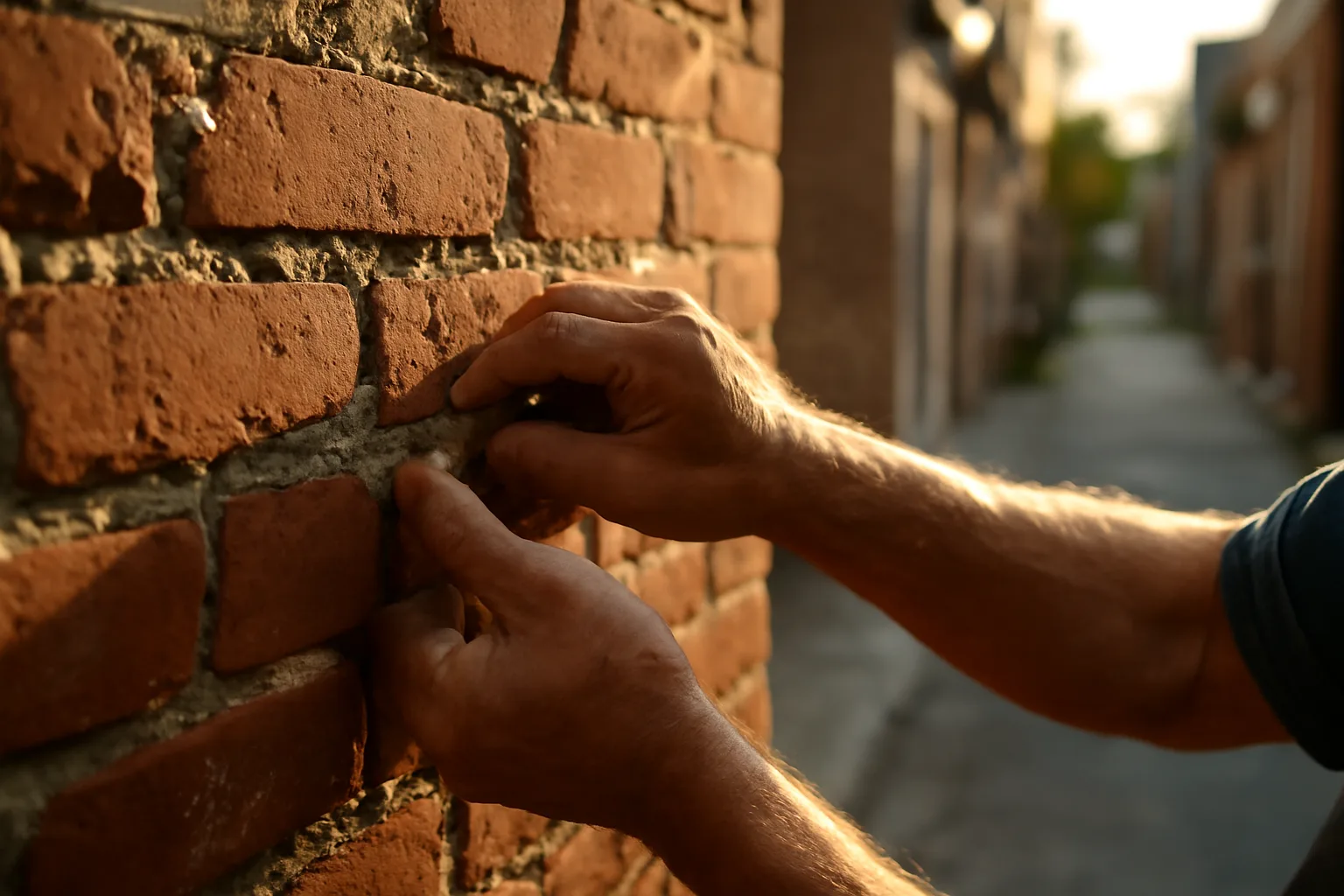
Tuckpointing is cutting deteriorated mortar out of brick or stone joints and packing new mortar back in so the wall sheds water again. On ordinary buildings people use the word for almost any joint repair. On historic work, agencies treat classic tuckpointing as a two-color decorative finish and call structural joint repair repointing.
The job is simple to say and easy to botch. You grind or chisel the old joint to a sound depth, clean the dust, wet the masonry if the mix needs it, then press mortar in lifts and tool the face so it matches the wall. Water is the reason the work exists. Open joints let rain in. Frozen water pops brick faces. Soft historic brick dies faster if you stuff a hard portland mix into a wall that was laid in lime.
Most customers found the word on a neighbor's invoice. They are not asking for a museum finish. They want the leaking parapet to stop staining the hallway. That is still tuckpointing in the trade sense. It is still masonry. It is not a paint job with a fancy name.
The National Park Service is the source you should read before you touch an old wall. Preservation Brief 2 walks through mortar removal, mix design, and why a strong new mortar can crack the units around it [1]. If you only memorize one sentence from that brief, make it this one: incompatible mortar can damage the masonry even when the color looks right.
You will hear pointing, repointing, and tuckpointing used as if they were one word. They are not, and the next section sorts that out. For paid work on a regular house, the customer cares that joints are dense, tooled, and color-close. For a courthouse or a protected facade, the spec writer cares about the word on the page. Read the spec. Do not argue vocabulary on the scaffold.
Is tuckpointing the same as repointing?
No. Crews often use tuckpointing to mean any mortar joint repair, while historic specs usually treat repointing as the structural replacement of mortar and tuckpointing as a decorative two-color joint. If a bid or a historic review uses one word, follow that document, not the slang on the truck.
Preservation Brief 2 is blunt about language and method. The Park Service wrote the brief to stop well-meaning crews from grinding joints into trenches and packing them with cement that is harder than the brick [1]. Color match is not enough. Strength match and vapor behavior matter more on old walls.
Here is the practical split I use on paper.
| Term | What most customers mean | What a historic spec usually means |
|---|---|---|
| Tuckpointing | Cut out bad joints and refill them | A lime-putty line set in a contrasting joint for a thin-joint look |
| Repointing | Same work as above | Remove failed mortar and replace it in kind |
| Pointing | The finish pass | The tooled profile on new or repaired joints |
If you are new, do not market "historic tuckpointing" until you can hand-cut joints without chewing brick edges and you can make a lime mix that does not flash off in sun. Fake heritage language is how people get thrown off historic jobs.
On a 1950s ranch, the customer is buying water control and a neat joint. On an 1890s storefront, the reviewer may want a sample panel, a mortar analysis, and a written mix. Those are different products. Price them that way.
How do you start tuckpointing?
You start by working under someone who already cuts joints for a living, then you add the paper your city actually asks for. There is no federal tuckpointing license and no national card that lets you skip local contractor rules. Most people begin as a mason tender or a registered bricklayer apprentice and take the grinding and mixing first.
The craft path is slower than social media makes it look. You need to cut a joint to depth without widening it, keep silica dust down, pack mortar so it bonds, and tool it before it burns. That takes weeks of dirty practice, not a weekend. I would take a helper seat on a real wall over any online certificate that does not put a grinder in your hands.
The paper path runs beside the craft path. You register the business if you will invoice, get an EIN if you need one, buy insurance a GC will accept, and ask the contractor board whether masonry work in your city needs a license [7][8]. Confirm every fee and form with that board. Do not copy a number you saw on a forum.
BLS does not track "tuckpointer" as its own job. The work sits inside brickmasons, blockmasons, and stonemasons on the Occupational Outlook Handbook page [4]. That is the honest labor-market box. If someone sells you a national tuckpointing registry, walk away.
State rules split hard. California puts masonry contracting in class C-29 at the Contractors State License Board [12]. Texas does not run a single statewide masonry card the same way, so you still check cities and the pages that track tuckpointing license in Texas. Start with the state that matches your first jobs, not a map of all 50.
What paper do you need before you take paid work?
You need whatever your city and state require for masonry contracting, plus tax ID, insurance, and extra federal rules if you disturb paint on pre-1978 housing. There is no one folder that works everywhere. Confirm the license class, bond, and exam with the board that will actually fine you.
Start with the boring federal pieces that do not care what you call the trade. The IRS lets you apply online for an Employer Identification Number if you hire or if a bank or client wants one [7]. The Small Business Administration's 10-step start guide is a decent checklist for registration, tax setup, and banking, even if it will not tell you how to tool a joint [8].
Then ask the contractor board a direct question: does tuckpointing or masonry repair above a dollar threshold need a license here? In California the masonry classification is written down as C-29 [12]. Other states leave it to cities or fold it into a general contractor card. Our state pages for how to start tuckpointing in California and how to start tuckpointing in Tennessee exist because the answer is local.
Housing built before 1978 adds the EPA Renovation, Repair and Painting rule when you disturb paint in target housing or child-occupied facilities. EPA states that firms doing those projects must be certified, use certified renovators, and follow lead-safe work practices [5]. Residential lead-containing paint was banned under 16 CFR 1303, with the commission's long-standing 1978 line still the date crews use on intake forms [6]. Confirm current firm filing steps on EPA's certification page rather than memorizing a fee from a blog [5].
If you want a district-level paper checklist assembled in one place, TuckpointPath sells a $149 Mortar-Match + District Kit at /start. The kit does not replace the board. You still file what the board names.
Insurance is not optional if you want commercial work. General liability is the minimum GCs ask for. Workers' comp rules depend on whether you have employees. I would not spend money on logo wrap or a custom website before those policies bind. Pretty trucks do not cover a cracked windshield from a chip of brick.
Do you need an apprenticeship to start tuckpointing?
No, a registered apprenticeship is not legally required in most places to hold a grinder, but it is the cleanest way to learn joints, scaffolding, and mix behavior without wrecking a client's wall. Plenty of solid tuckpointers came up as tenders on non-union crews. The registered route just makes the hours and related instruction easier to prove.
The Department of Labor's apprenticeship site is where you look up bricklayer and masonry programs that are actually registered, not branded workshops [10]. Hours and related classroom time sit with the sponsor. I will not invent a national hour count. Ask the program.
I like apprenticeship when you want commercial sites and prevailing-wage work later. I like a small-shop tender job when you want to see residential facades and color matching this month. Both beat buying a $3,000 "certification" from a marketer who has never been turned down by a preservation commission.
If you go helper first, pick a shop that already uses water-fed or shrouded grinders and that will let you pack joints after you prove you can cut them. If they hand you a dry wheel and a paper mask, leave. Silica rules are not optional flavor.
Union or not, keep a photo log of sample panels. Future GCs care what your joints look like in year two more than they care about a certificate PDF.
What tools do you actually need on day one?
You need a dust-controlled grinder or hand chisels, a way to mix small batches, pointing tools, a hawk or board, joint rakers, and a respirator that fits. You do not need a trailer full of logoed gadgets. A cheap unguarded grinder used dry is a waste of money and a fast way to meet an inspector.
OSHA's construction silica standard sets the exposure limit at 50 μg/m3 as an 8-hour time-weighted average. The regulation says, in plain text, "The employer shall ensure that no employee is exposed to an airborne concentration of respirable crystalline silica in excess of 50 μg/m3, calculated as an 8-hour TWA" [2]. Table 1 in that same standard lists specified methods for handheld grinders used on mortar, including integrated water or vacuum shrouds. Read the table before you buy the tool [2][9].
NIOSH has been writing about silicosis in construction for decades. Their construction guidance is the reason serious shops stopped treating dust like a housekeeping issue [11]. If a vendor tells you a cloth bandana is fine for grinding lime-cement mortar, they are selling you a hospital visit.
Hand tools still win on historic brick. A grinder is faster and meaner. I would rather you raked a soft joint by hand on an 1880s face brick than prove how straight your diamond wheel is. New hard brick with fat cement joints is a different animal. Match the tool to the unit, not to your impatience.
Skip the imported "tuckpointing kit" that is a plastic tray and three stamped irons. Buy a few jointers that match the joint width you actually see, a margin trowel you like, and a mixer you can wash. Scaffold and fall gear cost more than all of that. Budget there first.
How do you match mortar so you do not wreck the wall?
You match mortar by binder type, sand color and grain, joint profile, and strength, not by grabbing the closest bag at the big-box store. A wall laid in lime wants a softer, more vapor-open mix. A late-century cement wall can take a cement-lime mix closer to what is already there. Wrong strength is how brick faces spall the next winter.
NPS Preservation Brief 2 is the free document I would make every new finisher read. It tells you to remove mortar to a depth of about 2 to 2.5 times the width of the joint so the new mortar has enough bite, and it warns against shallow smears that pop out [1]. It also explains why a high portland content mix can be harder than the historic units around it.
Do a sample panel in an ugly spot. Let it cure. Look at it wet and dry. Owners approve color in sun and then hate it in rain. That is normal. Build the approval into the contract so you are not grinding yesterday's work for free.
Lab analysis is worth it on protected or institutional walls. It is often a waste on a 1970s garage that just needs the copings sealed. I would spend the lab money when a reviewer can reject the job, not to impress a homeowner who chose the color from a text message.
Keep sand consistent. Changing pits mid-elevation is how you get a stripe you will see from the street. Buy enough sand for the elevation you can finish in one campaign.
What safety rules hit first-year tuckpointing crews first?
Silica dust, falls, and lead paint are the three rules that shut first-year crews down. Everything else is details. If you grind mortar dry with no controls, you are already outside the silica standard. If you work off a roof or a scaffold face six feet up without a system, you are already outside the fall rule.
OSHA's construction fall protection rule requires protection at unprotected sides and edges six feet or more above a lower level [3]. Tuckpointing lives on elevations. Ladders get used for "just this bay" and that is how people fall. I would rent a proper frame or a pump jack and price it into the job before I would free-climb a gable with a grinder.
Silica is not a maybe. Mortar and brick contain crystalline silica. The construction PEL is 50 μg/m3 as an 8-hour TWA, with an action level of 25 μg/m3 in the same standard [2][9]. Water or a shrouded vacuum is the ordinary control for handheld grinding. Medical surveillance and a written exposure plan show up once you leave Table 1 or you have employees on the tools.
Lead shows up when you grind painted masonry on housing or child-occupied space built before 1978. EPA's RRP program is the rule set, and 16 CFR 1303 is why 1978 is the year on every intake form [5][6]. Confirm whether your project is target housing before you score the first joint.
Eye protection and hearing protection are not heroic. Grinders throw grit and scream. I have no patience for the person who skips glasses to "see the joint better."
How much does first-year tuckpointing setup actually cost?
Nobody publishes a clean national number for a tuckpointing startup, and anyone who gives you one fee for "the license" is guessing. Your real outlay is tools with dust control, access equipment, insurance, and whatever license or registration your board names. Confirm those board fees on the current form. I will not invent them.
An honest first kit is a shrouded or water-fed grinder, extra wheels, a decent respirator with the right cartridges, hand irons, tubs, a small mixer, drop cloths, and a way to get off the ground. Used scaffold from a rental house beats a brand-new consumer tower that walks in the wind. I would rent until you know you will keep the work.
Insurance often costs more than tools in year one if you want commercial certificates. Ask a broker who already writes masonry, not your auto agent. Workers' comp, if you have employees, is its own line. Sole proprietors sometimes skip it and then cannot get on a site. Ask the GC what the certificate must say before you buy the wrong policy.
License costs vary by state and city. California's C-29 path has its own exam and filing process [12]. Other states are lighter or leave it local. Read tuckpointing license in California or tuckpointing license in Tennessee for the paper sequence, then still open the live board page.
Waste-of-money list, from me: vinyl wrap, embroidered hoodies, a second truck, and any course that promises you can skip silica controls. Spend on dust collection and a sample-panel habit instead.
How do you bid the first tuckpointing jobs without guessing?
You bid by measuring linear feet of joint, not by squinting at a wall from the driveway. Joint width, depth of failure, access, color matching, and whether the brick is soft all change production. A north parapet with failed wash joints is a different day than a sunny veneer with 10 percent open joints.
Walk the wall with a tape and a joint gauge. Probe. If the mortar sands out two inches in, your removal time doubles. If the units are glazed or historic, hand work replaces the grinder and your feet per day drop. Write that in the proposal so the owner sees why your number is not the cheap smear quote.
I price sample panels as their own line on anything picky. I price protection and cleanup as their own line because brick dust finds every windowsill. I do not give a "per house" number. Houses are not the unit. Joints and access are the unit.
Production rates are a shop secret because walls lie. A crew that did 200 linear feet yesterday on a clean cement joint may do 60 on a lime wall that wants hand cutting. Track your own feet after the first paid week and throw out the YouTube numbers.
Change orders exist because owners discover the chimney after you start the front. Put a unit price for extra joint in the contract. You will need it.
Where do tuckpointing rules change by state?
Almost everywhere that involves a license, a business tax, or a local permit. The craft is national. The paper is not. Silica, falls, and lead rules are federal. Contractor cards, city masonry permits, and historic district reviews are not.
California is the usual example people quote because the Contractors State License Board publishes a masonry classification, C-29, with a written scope [12]. That still does not make C-29 a "tuckpointing license." It is a masonry contractor class that can include this work. Read how to start tuckpointing in California and then open CSLB, not a summary blog.
Texas is the usual counterexample. There is no single statewide masonry ticket that works like California's class system, so cities and project owners set more of the bar. Start with how to start tuckpointing in Texas and tuckpointing license in Texas, then call the city that will issue the permit.
Tennessee, Arizona, Alabama, and the rest each have their own mix of state boards and city cards. Use how to start tuckpointing in Arizona or tuckpointing license in Alabama as a map, then confirm live. Processing times and fees move. I will not pretend they sit still.
Historic districts add a second boss. A certificate of appropriateness can demand a sample and a mix even when the contractor board never heard the word tuckpointing. Ask planning before you grind a visible elevation.
What should a new tuckpointer skip, and what is worth doing next?
Skip national myths, skip dry grinding, and skip buying a brand before you have a sample wall you are proud of. Do the apprenticeship or tender months, read Preservation Brief 2, put dust controls on the tools, and call the board that covers your first city. That is the whole starter plan.
TuckpointPath is an independent publisher, not a law firm and not a contractor. Nothing here approves a license or assigns a wait time. If you want the district kit after you have read the primary pages, it lives at /start. You can do this trade without it.
Next reading should be the OSHA silica standard, the EPA RRP overview if you will touch pre-1978 housing, and the contractor board for the state where you will invoice [2][5][12]. Then look at a state start guide that matches your actual address, not the state with the loudest Facebook group.
The work is good if you like walls more than you like talking. Joints do not care about your branding. They care whether water stays out.
Frequently asked questions
What is tuckpointing?
Tuckpointing is removing failed mortar from masonry joints and packing new mortar so the wall sheds water. On everyday jobs it means joint repair. On historic jobs, tuckpointing can mean a two-color decorative finish, while repointing means replacing mortar in kind. Read the spec you were handed.
How do you start tuckpointing?
Work under a mason who already cuts joints, then add the paper your city requires. There is no federal tuckpointing license. Start as a tender or registered bricklayer apprentice, buy dust-controlled tools, and confirm contractor, tax, insurance, and lead rules with the local board before you invoice.
Is a license required to tuckpoint?
Sometimes. It depends on the state and city, the contract value, and whether you are a prime contractor. California publishes a masonry class (C-29). Other states leave more to cities. Confirm the class and threshold with the board that would issue a citation. Do not trust a national rumor.
Is tuckpointing different from repointing?
Yes in historic language, often no on a residential invoice. Repointing is the Park Service's usual word for replacing mortar. Classic tuckpointing is a decorative two-color joint. Customers still say tuckpointing for both. Follow the written spec when one exists.
Do I need EPA RRP certification to tuckpoint a house?
You may, if the house or child-occupied facility was built before 1978 and your work disturbs paint. EPA's Renovation, Repair and Painting program requires a certified firm, a certified renovator, and lead-safe practices on covered projects. Confirm the current filing steps on EPA's firm certification page.
What silica rule applies when grinding mortar?
OSHA's construction standard 29 CFR 1926.1153 applies. The PEL is 50 μg/m3 as an 8-hour TWA. Table 1 lists specified controls for handheld grinders, usually water or a vacuum shroud. A paper dust mask and a dry wheel do not meet that standard.
How deep should you cut a mortar joint?
NPS Preservation Brief 2 tells you to remove mortar to a depth of about 2 to 2.5 times the joint width so the new mortar can key in, and it warns against shallow cuts that fail. Stop if you are chewing the brick. Soft historic units often want hand tools, not a wide wheel.
Can I teach myself tuckpointing from videos?
You can learn vocabulary that way. You cannot learn pressure, timing, and when a mix has gone off. I would take a helper wage on a real elevation before I would sell a facade I only practiced on a spare brick in the driveway. Videos skip the failed joints.
What does BLS say tuckpointers earn?
BLS does not publish a tuckpointer line. The work is counted with brickmasons, blockmasons, and stonemasons in the Occupational Outlook Handbook. Use that profile for current wage tables and outlook, and treat any "average tuckpointing salary" on a marketing site as unverified.
Do I need fall protection to tuckpoint a second story?
Construction fall rules generally require protection at unprotected sides and edges six feet or more above a lower level (29 CFR 1926.501). A second-story wall usually clears that. Price scaffold or another system into the job. A leaning ladder and a grinder is how people get hurt.
What mortar should a beginner buy?
Do not default to the hardest bag on the shelf. Match binder and strength to the wall. Lime-rich historic brick wants a softer mix. Newer cement masonry can take a cement-lime mortar closer to what is already there. Sample first. A wrong hard mix can spall brick.
Is tuckpointing a good first business?
It can be if you already have the craft and you only take work you can reach safely. It is a poor first business if you plan to learn grinding on a client's protected facade. Year-one costs sit in dust control, access, and insurance, not in a logo. Confirm every license locally.
Sources
- National Park Service, Preservation Brief 2: Repointing Mortar Joints in Historic Masonry Buildings: NPS guidance on repointing versus decorative tuckpointing, mortar removal depth of about 2 to 2.5 times joint width, and harm from incompatible high-portland mortars
- OSHA 29 CFR 1926.1153 Respirable crystalline silica: Construction silica PEL of 50 μg/m3 as an 8-hour TWA, action level of 25 μg/m3, and Table 1 specified exposure control methods for grinders
- OSHA 29 CFR 1926.501 Duty to have fall protection: Unprotected sides and edges six feet or more above a lower level require fall protection in construction
- BLS Occupational Outlook Handbook, Brickmasons, Blockmasons, and Stonemasons: Tuckpointing work is counted inside the brickmason, blockmason, and stonemason occupation, not as a separate BLS line
- U.S. EPA, Lead Renovation, Repair and Painting Program: Firms disturbing lead-based paint in pre-1978 housing and child-occupied facilities must be certified and follow lead-safe work practices
- 16 CFR Part 1303 Ban of Lead-Containing Paint: Federal ban on lead-containing paint that is why crews treat 1978 as the housing cutoff year
- IRS, Apply for an Employer Identification Number (EIN) Online: Businesses can apply online for an EIN when they hire or when banks and clients require one
- U.S. Small Business Administration, 10 steps to start your business: Federal checklist covering business registration, tax setup, and banking for new firms
- OSHA, Small Entity Compliance Guide for OSHA's Respirable Crystalline Silica Standard for Construction: Plain-language construction silica compliance guide including specified controls for mortar grinding
- U.S. Department of Labor, Apprenticeship.gov occupation and program finder: Registered bricklayer and masonry apprenticeship programs are listed with sponsors rather than as a national tuckpointing card
- NIOSH, Preventing Silicosis and Deaths in Construction Workers (Publication 96-112): NIOSH documents silicosis risk for construction trades that cut or grind silica-containing materials including mortar
- California Contractors State License Board, C-29 Masonry classification: California publishes a masonry contractor classification (C-29) that covers masonry contracting including related repair work