Last updated 2026-08-19
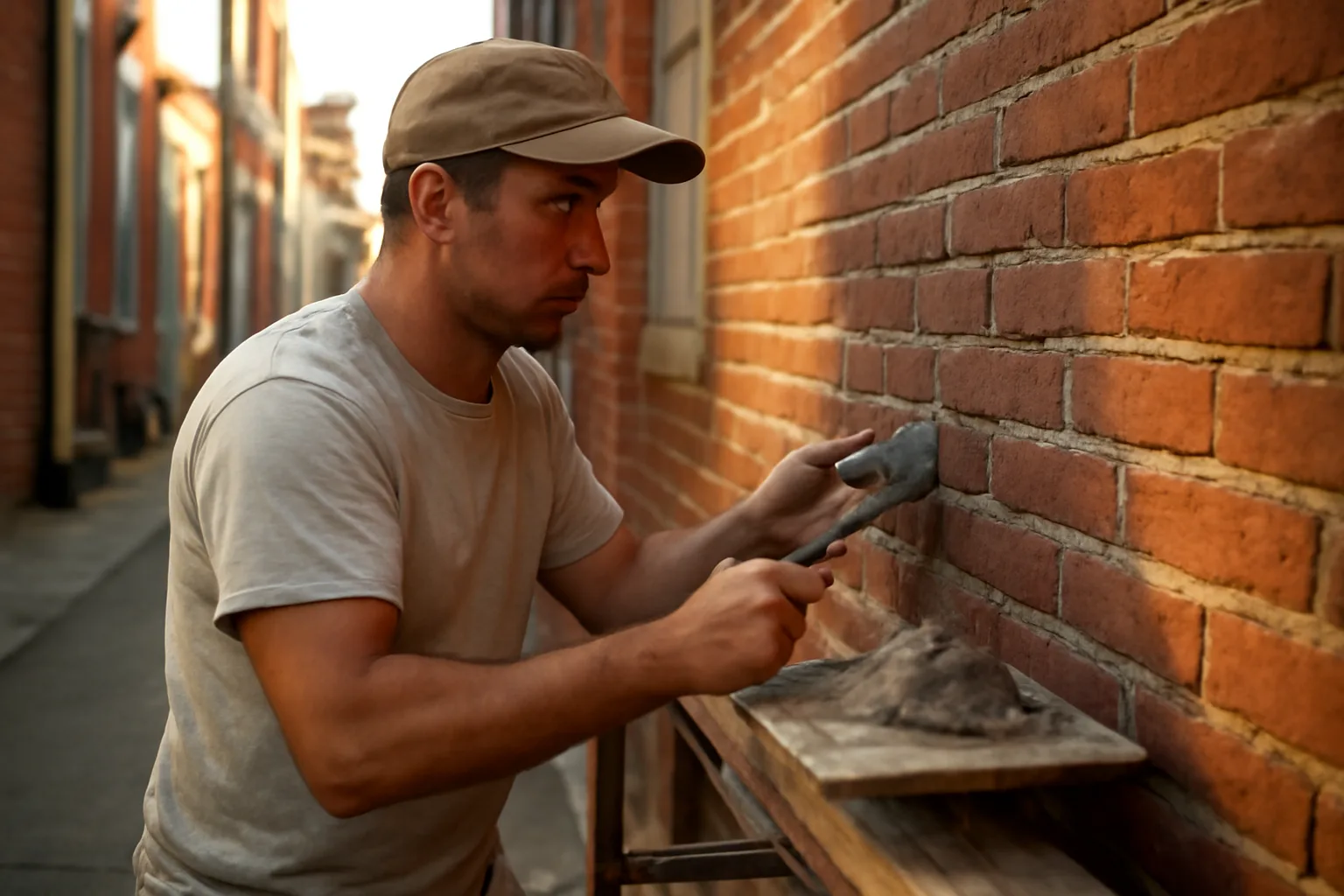
TL;DR
Tuckpointing is cutting failed mortar out of brick or stone and packing a matched mix so the joint sheds water. US crews usually mean repointing. Historic work can mean a thin lime fillet in a contrasting joint. Start with HEPA dust control, a practice panel, and a license check at your local board. OSHA's construction silica PEL is 50 μg/m3. NPS wants joints cut 2 to 2-1/2 times their width. Confirm every fee locally.
What is tuckpointing?
Tuckpointing is cutting deteriorated mortar out of a masonry joint and packing a new mix so the wall sheds water and the joint line looks even. That is the whole job in plain terms. US crews use the word for almost any repointing. Historic specialists use it for a two-color joint with a thin lime fillet.
The National Park Service treats this family of work as repointing historic mortar joints. Preservation Brief 2 is still the document boards and spec writers reach for. It says the replacement mortar has to match the old mix in strength, color, and texture, and it has to stay softer than the brick or stone. Hard portland cement on a soft historic wall is how you crack faces. [1]
True British tuckpointing is fussy. You fill the joint with a colored stopping mortar, then cut a thin groove and lay a lime putty ribbon that looks like a tight joint. Most American residential work is not that. If a homeowner asks for tuckpointing, they usually want failed joints cut back and filled. Ask what they want to see before you bid.
Failed joints look sandy, receded, or cracked. Water sits in the recess and the freeze cycle pries more mortar out. You stop that by getting depth, a clean shoulder, and a tooled face that sheds water. NPS says, "Mortar should be removed to a minimum depth of 2 to 2-1/2 times the width of the joint to ensure an adequate bond and to prevent mortar "popouts."" [1]
Do not confuse this with a full rebuild. If the wythe is moving, you have a structural problem. Pointing will not fix that. For a side-by-side of this trade against nearby work, see tuckpointing vs nearby career.
How do you start tuckpointing?
You start with dust control, a practice wall, and a check of local contractor rules. Get a grinder with a vacuum port and a HEPA vac before you cut a joint on a client's house. Then pack a sample panel until the color and the joint profile match. Licensing is local. Confirm it with the board that issues the card.
Here is the path I would take if I were entering now. First, read Preservation Brief 2 and the OSHA silica rule so you know the two documents that show up in specs and inspections. [1][2] Second, get on a crew or a registered bricklayer apprenticeship if you can. Speed comes from watching someone who already has the wrist memory. Third, if you go out on your own, ask the city or county whether masonry repair needs a contractor license, a home improvement registration, or just a permit on the address. California's Contractors State License Board describes masonry as its own C-29 class. Plenty of other places do not. [3]
Do not spend your first cash on a branded tool set you saw in a video. Spend it on hearing protection and a respirator your fit test actually covers. Buy dust collection that works on a 4.5 inch grinder. Practice on a leftover pallet of brick. Your first 200 linear feet will look uneven. That is normal.
Paper comes early. You will want a written scope, a mortar formula, photos of the sample panel the owner signed, and proof of general liability. If the building is older and you disturb painted surfaces, the EPA renovation, repair and painting rule can apply. Confirm that trigger before you grind near painted brick or trim. [4]
A notebook and the NPS brief will get you further than any kit if you actually use them. More starter detail sits in tuckpointing guide 12.
How is tuckpointing different from repointing?
On most US residential bids, tuckpointing and repointing are the same line item. Historic specs still split them. Repointing means cut out the failed joint and refill it. Tuckpointing, in the older British sense, means a two-color joint with a thin lime fillet. Ask which one the owner wants.
Preservation Brief 2 uses the word repointing for the conservation method. Historic England's guidance on repointing brick and stone walls does the same and warns against hard, dense mortars that trap moisture. [1][5] If you put a Type S portland mix into a 19th century lime wall, the brick can spall. That failure is common. A true fillet job is not common on US houses.
When a restoration architect writes the spec, they will name the joint profile, the sand color, and often a lime to sand ratio. When a homeowner calls, they want the dark lines gone and the wall to stop leaking. Price those as different jobs. A fillet job is slower. A production grind-and-fill on a 1960s ranch is faster and still has to respect silica rules. [2]
If you need the vocabulary without the fluff, tuckpointing guide 18 walks the terms.
What tools do you need to start tuckpointing?
You need a way to cut the joint, a way to control dust, and a way to pack and tool the new mortar. That means a grinder or chisel, a HEPA vacuum, a hawk or board, pointing tools, and a jointer that matches the profile. Everything else is optional in year one.
For cutting, an angle grinder with a thin masonry blade and a shroud that actually seals to the wall is the common setup. OSHA's construction silica rule lets you follow Table 1 specified controls for many grinders if you use the listed vacuum method and keep the pad on the surface. Read the table. Do not assume a cheap shop vac counts. [2][6] A hand chisel and a plugging chisel still win on historic brick that would chip under a blade.
Packing tools are cheap. A narrow tuck pointer, a hawk, a margin trowel, and a few jointers cover most houses. Buy extra profiles as you meet them. A slicker for thin joints. A convex jointer for the 1920s bungalow down the street.
Dust gear is not optional. NIOSH has been documenting silicosis in construction workers for decades, including in publication 96-112. [7] A half-face elastomer respirator with P100 filters, a fit test, and a vac with a HEPA filter is the baseline I would not skip. OSHA's construction PPE rule in 29 CFR 1926.95 still expects you to provide and require the gear the hazard calls for. [9]
Scaffold or a stable plank setup comes next if you go above a step ladder. OSHA's fall protection rule in 29 CFR 1926.501 is the one inspectors know. [8] Confirm the trigger height for your situation. I would not cheap out on planks.
Skip the big electric mixer in month one if you are doing sample panels. A tub and a hoe work. Upgrade when volume pays for it.
What mortar mix should you use for tuckpointing?
Use a mortar that is weaker and more vapor-open than the masonry units, and as close as you can get to the original in color and sand. That is the NPS rule of thumb, and it is the one that keeps you from wrecking soft brick. Type N or a lime-heavy mix is the usual modern starting point. Type S is often too strong for older walls. [1]
NPS is blunt about matching. Their brief tells you to analyze the historic mortar when the building matters, then design a mix that does not out-strength the units. Historic England says the same in different words. New mortar should not be stronger or denser than what was there. [5] I would not guess on a high-value historic wall.
Sand is the color. Cement and lime are the glue. If the sand is wrong, no oxide pigment will save you in raking light. Pull a sample, crush it, look at the aggregate. Make three small cups with slightly different lime or pigment loads. Let them cure a week, then wet them. Owners pick a dry sample and hate it after rain. Show them both.
ASTM C270 is the US spec family most data sheets point at (Types M, S, N, O). You do not need to buy the full ASTM in week one. Read the type descriptions and match the wall, not the bag art.
| Mix family | Typical use | Risk on soft historic brick |
|---|---|---|
| Type O or lime-heavy | Soft old walls | Lower if the sand matches |
| Type N | Common 20th century brick | Moderate, often acceptable |
| Type S | Hard modern or below grade | High on soft units |
| Type M | High strength work | Usually wrong for old pointing |
Those rows are field convention, not a lab report. Historic fronts still deserve a real mortar read. [1][5]
Preblended bags are fine for a 1970s utility brick. They are a poor match on a cream 1880s front. Budget time for a custom sand. The $149 one-time Mortar-Match + District Kit from TuckpointPath (see /start) is one way to organize color trials and the local paper stack. A muffin tin and a labeled bag of sand also work.
What safety rules apply when you tuckpoint?
Silica and falls are the two rules that can shut you down. OSHA sets the respirable crystalline silica PEL for construction at 50 μg/m3 as an 8-hour TWA. The action level is 25 μg/m3. That is in 29 CFR 1926.1153. [2]
The regulation says, "The employer shall ensure that no employee is exposed to an airborne concentration of respirable crystalline silica in excess of 50 μg/m3, calculated as an 8-hour TWA." [2] If you are a one-person shop, you are still the employer of you. Table 1 is the simpler path for listed tasks. Follow the tool, the shroud, and the vac specs. Keep a written exposure plan if you are not fully under Table 1. OSHA's construction silica fact sheet (OSHA 3681) is the plain-language companion to the rule. [6]
NIOSH publication 96-112 laid out silicosis deaths in construction workers and the controls that cut dust. The disease is not theoretical. [7] The NIOSH Pocket Guide entry for quartz lists the same 50 μg/m3 REL neighborhood you will see on safety data sheets. [12] Wet methods and local exhaust beat a paper mask. A filtering facepiece is not a plan if you are dry cutting all day.
Falls sit under 29 CFR 1926.501. Unprotected sides and edges have a 6 foot trigger in construction for many situations. [8] A porch roof is still a roof. I would rather spend money on a simple scaffold than argue after a short drop.
Lead can show up on painted masonry and on windows next to the joints you grind. EPA's RRP program covers renovation, repair, and painting on pre-1978 housing and child-occupied facilities when you disturb painted surfaces. [4] Confirm whether your scope hits that rule. If it does, you need the firm certification and the individual renovator training the rule names. I am not going to invent a current application fee. Look at the EPA page.
Hearing and eye injuries are the quiet ones. Grinders throw grit. Wear the glasses.
Do you need a license to tuckpoint?
Sometimes. It depends on the city, the county, and whether you are a W-2 mason or a person taking money from a homeowner. There is no single federal tuckpointing license. Confirm the rule with the board that would fine you.
California's Contractors State License Board describes masonry as classification C-29 in its Description of Classifications. That class covers brick, stone, and similar work. [3] Other states fold this into a general contractor card, a home improvement registration, or nothing until you hit a contract dollar threshold. Some cities add their own registration on top of the state card. I will not quote a fee or a processing time. Those change, and the live board page is the only number that matters.
| Situation | What to confirm |
|---|---|
| Employee on a crew | Who holds the contractor card, plus your OSHA duties |
| Solo bid to a homeowner | City or county license or registration rule |
| California masonry work | Whether C-29 (or another class) applies to your scope |
| Historic district front | Sample panel, mortar recipe, and any permit |
If you work as an employee, the contractor holds the license. You still need to follow OSHA rules on that site. If you bid the house yourself, you are in contractor territory even if you only do joints.
Permits are a separate question. A historic district may want a sample panel and a written mortar formula before you touch the front elevation. A regular suburb may want nothing. Call the building department with the address. Ask if masonry repair needs a permit. Get the name of the person who told you.
Insurance is not a license, but owners and GCs will ask. General liability is the common ask. Workers' comp if you have help. Bonding if the contract requires it. Prices vary by state and claims history. Get quotes. Do not copy a number from a blog.
More on the paper path is in tuckpointing guide 24.
How long does it take to learn tuckpointing?
You can pack a decent joint in a weekend of practice. You cannot run a clean elevation, match color in changing light, and keep production up in a few weekends. Most people look acceptable on simple utility brick after a few hundred feet. Historic fronts take longer.
Registered apprenticeships operate under federal standards that include on-the-job training and related instruction. [10] Bricklayer programs usually run about three years. Hour totals often sit near 6,000, but the sponsor sets the number. Check the live listing with the local joint apprenticeship committee rather than trusting a blog. I would take a paid apprenticeship over a weekend course if I could get in. You get wages, silica habits, and someone who will tell you when the joint is ugly.
If you cannot get into a program, hire yourself out as a tender or a cutter for a pointing crew. Carry the vac. Mix. Watch the person on the wall. That is a real start.
BLS groups this work with brickmasons, blockmasons, and stonemasons. The handbook is the place to read typical entry education (high school or equivalent) and the note that many learn through apprenticeship. [11] Nobody has clean public data on how many hours it takes a pointing-only specialist to hit journeyman speed. The closest official picture is that mason apprenticeship track.
A short class can teach you to hold the tool. It will not teach you when to stop grinding because the brick arris is about to chip. That comes from wrecking a few practice bricks. Wreck them on your own pile, not on a client's header course.
See tuckpointing guide 30 for more on early skill building.
What does first-year tuckpointing work look like?
First-year work is sample panels, side walls, chimneys you can reach, and a lot of cleanup. You will spend more time on setup, dust, and matching than on the pretty face joint. That is the job.
Expect to bid small. A rear elevation on a bungalow. A failed chimney cap joint. A short garden wall. Production pointing on a three-story front with traffic control is not a first-year solo job. Take it as a helper if you want the hours.
Days start with staging and end with washing film off the brick before it sets. If you leave smear, you own a cleaning problem. Historic England warns that the wrong mortar and the wrong cleanup can stain or trap moisture in the wall. [5] Gentle and early beats a later acid wash you do not understand.
You will underbid. Everyone does. Track linear feet per day after setup. Track bag count. After ten jobs you will know if your number was fantasy. I would rather price a sample panel as its own line than give away a day of matching.
Weather runs you. Hot sun skins the mortar. Freezing nights kill a late pack. NPS and Historic England both tell you not to point into conditions that keep the mortar from curing. [1][5] If the overnight low is going below freezing, stop.
Keep a photo log. Before, open joint, packed, tooled, and thirty-day follow-up. That file saves arguments.
How much do tuckpointers make?
Pay follows mason pay, and mason pay follows the local union scale or the open-shop rate, not a national myth. The BLS Occupational Outlook Handbook listed a 2023 median annual wage of $60,650 for brickmasons, blockmasons, and stonemasons. Confirm the current figure on the handbook page because BLS revises it. [11]
That median mixes bricklayers who lay new wall with people who mostly point. Union commercial scale in a large city can sit well above that median. Rural open-shop repair work can sit under it. Nobody has a clean federal series that isolates tuckpointing as its own occupation. The closest study population is the BLS mason group.
If you sell the work yourself, your revenue is not your wage. Blades, vac filters, dump fees, insurance, and unpaid matching time come out first. Online chatter floats wide per-square-foot numbers. That chatter is not a sourced national rate. Price from your feet per day and your real costs, then check two local competitors.
An employee on a pointing crew gets an hourly rate and overtime rules. Ask. Do not assume piece rate is legal in your state without checking.
For nearby trades and whether the pay gap is real, read tuckpointing vs nearby career and tuckpointing guide 42.
What paper should you keep on a tuckpointing job?
Keep a signed scope, a mortar formula, a sample-panel photo the owner accepted, insurance proof, and the address permit if one exists. That stack settles most fights. Add silica paperwork if you have employees.
Write the scope in feet and in walls, not in vibes. South elevation, all bed and head joints receded more than 1/4 inch, cut to 3/4 inch minimum, Type N custom sand, concave tool. Put exclusions on the same page. Structural rebuilds, lintel replacement, and brick swaps are not pointing.
If you have workers, 1926.1153 expects an exposure control plan unless you stay inside the Table 1 box the way the rule allows. [2] Keep fit-test records and a tool list that matches Table 1. OSHA will ask for paper, not for a speech.
Historic districts often want the mortar recipe and a cured sample before the public face. Take the letter with you. A city can make you grind out a wrong color. That is an expensive lesson.
Invoices, change orders, and before photos belong in the same folder. If a client later claims you caused a leak that was already there, your date-stamped photos are the defense.
TuckpointPath is an independent publisher, not a law firm and not a service company. Use the board's forms, not a blog template, when a statute names a form.
What is a waste of money in year one?
A full van wrap, a giant mixer, and a pile of specialty jointers you have not met on a wall yet are a waste. So is a national certification that no building department asked for. Spend on dust control, a stable way to get off the ground, and insurance.
I would not buy a dedicated pointing machine in month one unless you already have a commercial contract that pays for it. I would not pay for lead-generation apps that sell the same homeowner to four crews. I would not stock five colors of preblended historic mortar that all look gray from the sidewalk.
Training that puts a tool in your hand for two days can be worth it if the instructor actually points for a living. A slide deck about entrepreneurship is not. An apprenticeship wage is training you get paid for. [10]
Cheap blades that wander and cheap vacs that clog will cost you more than the mid-grade versions. That is the boring truth.
If a course promises a quota of jobs or a sure thing on a license, walk away. Boards do not work that way. No school can promise a board will approve you. Confirm every fee and every wait with the board.
tuckpointing guide 60 covers more early cost traps.
Where should you practice tuckpointing first?
Practice on a sample panel you built, then on a wall nobody photographs. A leftover brick pallet and a simple pine frame is enough. Cut, pack, tool, and let it cure. Then hit it with water and look at the color. Do that three times before you touch a street facade.
A garage side, a basement interior brick wall, or a low garden wall is the right second step. You will learn how joints run out of level and how a header course chips. You will also learn how long a bag actually goes.
Skip the ornate 1880s bay window until you can hold a consistent concave joint for 50 feet. Historic fabric is not a classroom. NPS wrote the brief to stop people from loving old buildings to death with hard mortar and deep grinding. [1]
If you can get onto a crew, ask to run the vac and mix for a week, then ask for a low wall. That sequence has trained more decent pointers than any video.
When you are ready for more field habits, tuckpointing guide 72 keeps going.
Frequently asked questions
What is tuckpointing?
Tuckpointing is cutting failed mortar out of brick or stone and packing a new mix so the joint sheds water and looks even. In the US the word usually means ordinary repointing. Historic specialists still use it for a two-color joint with a thin lime fillet. Ask the owner which look they want before you bid.
How do you start tuckpointing?
Start with a shrouded grinder, a HEPA vac, a respirator you have been fit-tested on, and a practice panel. Read NPS Preservation Brief 2 and OSHA 1926.1153. Then check whether your city treats paid masonry repair as licensed contractor work. Confirm fees and forms with that board. Get on a crew or a registered apprenticeship if you can.
Is tuckpointing the same as repointing?
On most US residential jobs, yes. Crews use the words as synonyms. Historic specs still split them. Repointing is cut and refill. Traditional tuckpointing is a contrasting stopping mortar plus a thin lime putty line. If the spec cites NPS Brief 2, they mean the conservation repointing method, not the decorative fillet.
How deep should you cut mortar joints?
NPS Preservation Brief 2 says remove mortar to a minimum depth of 2 to 2-1/2 times the width of the joint so the new mortar can bond and not pop out. On a 3/8 inch joint that is roughly 3/4 to 1 inch. Stop if you are chewing the brick arris. Depth without a clean shoulder still fails.
What mortar type is safest on old brick?
A mix weaker and more vapor-open than the units. Lime-heavy or Type O on very soft historic brick, Type N on a lot of 20th century work. Type S and Type M are often too strong and can spall soft faces. Match sand color from a crushed sample. Confirm with analysis on a high-value historic wall.
Do I need OSHA silica training to tuckpoint?
If you have employees, 29 CFR 1926.1153 requires communication, controls, and often a written exposure plan. Table 1 can simplify listed grinder tasks if you follow it exactly. A one-person shop is still on the hook for the PEL of 50 μg/m3. A paper dust mask is not a control plan for all-day dry cutting.
Can I tuckpoint my own house without a license?
Owner-occupant work is often exempt from contractor licensing, but that is a local rule, not a national one. Historic districts can still demand a permit, a sample, and a mortar recipe. If you take money from someone else, you may have crossed into contractor territory. Confirm with the building department for that address.
How much does tuckpointing cost per square foot?
There is no honest national per-square-foot number in federal data. Access, joint size, color matching, and scaffolding change the day rate more than a blog average will admit. Price from your real feet per day after setup, plus blades, filters, and insurance. Then check two local competitors. Online ranges are chatter, not a study.
What is the silica limit for masonry grinding?
OSHA's construction PEL for respirable crystalline silica is 50 μg/m3 as an 8-hour TWA. The action level is 25 μg/m3. Both sit in 29 CFR 1926.1153. Use Table 1 controls when they fit the tool, or measure and plan. NIOSH 96-112 documents why construction dust control is not optional.
How long before I can bid historic fronts?
After you can hold a consistent joint, match color wet and dry, and stop a blade before it chips an arris. That is usually well after a few hundred feet on simple brick. Historic fabric is a poor classroom. Use a sample panel and a low, non-public wall first. Take a helper spot on a restoration crew if you can.
Does the EPA lead rule apply to brick joints?
It can, if you disturb painted surfaces on pre-1978 housing or a child-occupied facility. Bare unpainted mortar often is not the trigger. Painted brick, windows, and trim next to your cut line can be. Confirm the RRP scope on EPA's renovation, repair and painting program page before you grind. Fees and firm certification live on that page.
What should a tuckpointing sample panel show?
The cut depth, the sand color, the joint profile, and the tooled face after a cure, plus a wetted view. Have the owner initial a photo. Historic districts often want that panel on the least visible elevation before you touch the street face. A rejected color on a whole front is a grind-out you will pay for.
Is an apprenticeship required to tuckpoint?
No federal rule says you must finish an apprenticeship to pack a joint. Many capable pointers learned on a crew. A registered bricklayer program is still the cleanest paid path, usually about three years under 29 CFR part 29 standards. BLS lists apprenticeship as the common way masons learn. Confirm local contractor licensing separately.
What insurance do I need to start?
Owners and GCs usually ask for general liability. Add workers' comp if anyone helps you. A bond only if the contract or the board requires it. There is no honest national premium I can quote. Rates move with state, claims, and payroll. Get local quotes. Insurance is not a substitute for the license your city actually requires.
Sources
- National Park Service, Preservation Brief 2: Repointing Mortar Joints in Historic Masonry Buildings: Repointing guidance including mortar matching and removing mortar to a minimum depth of 2 to 2-1/2 times joint width
- OSHA, 29 CFR 1926.1153 Respirable crystalline silica: Construction silica PEL of 50 μg/m3 as an 8-hour TWA, 25 μg/m3 action level, and Table 1 controls
- California Contractors State License Board, Description of Classifications: California lists masonry as contractor classification C-29 covering brick, stone, and similar work
- U.S. EPA, Lead Renovation, Repair and Painting Program: RRP rule can apply to renovation and repair that disturbs painted surfaces in pre-1978 housing and child-occupied facilities
- Historic England, Repointing Brick and Stone Walls (HEAG144): New pointing mortar should not be stronger or denser than the historic mortar and poor mixes can trap moisture
- OSHA, OSHA's Crystalline Silica Rule: Construction (OSHA 3681): Plain-language summary of the construction silica rule, PEL, and specified exposure control methods
- NIOSH, Publication 96-112 Preventing Silicosis and Deaths in Construction Workers: Documents silicosis risk in construction trades and dust-control methods including local exhaust
- OSHA, 29 CFR 1926.501 Duty to have fall protection: Construction fall-protection duties, including the common 6-foot trigger for unprotected sides and edges
- OSHA, 29 CFR 1926.95 Criteria for personal protective equipment: Employers must provide and require PPE that is necessary for the hazards of the work
- eCFR, 29 CFR 29.5 Standards of apprenticeship: Registered apprenticeship programs must include organized instruction and on-the-job training under federal standards
- U.S. BLS, Occupational Outlook Handbook: Brickmasons, Blockmasons, and Stonemasons: 2023 median annual wage of $60,650 and apprenticeship as a common training path for masons
- NIOSH Pocket Guide to Chemical Hazards, Silica, crystalline (as respirable dust): NIOSH exposure information for crystalline silica (quartz) used on masonry safety data sheets