Last updated 2026-08-19
TL;DR
Tuckpointing is cutting failed mortar out of a masonry joint and packing new mortar so the wall sheds water again. In US yards that word usually means repointing. Historic British tuck pointing is a thin ribbon finish. There is no federal tuckpointing license. You start with masonry skill, silica and fall rules, and whatever contractor card your state board issues. Confirm every class and fee with that board.
What is tuckpointing?
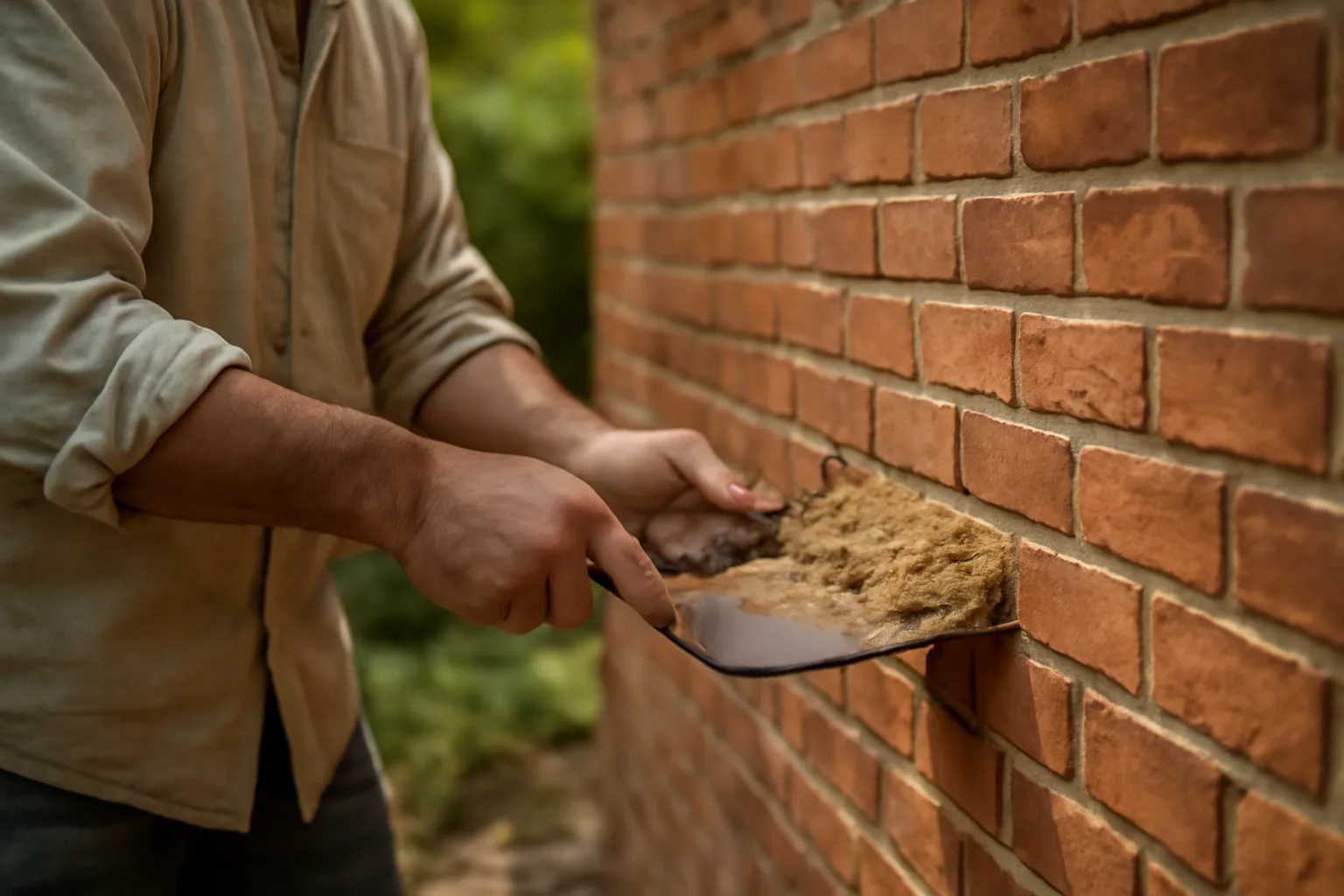
Tuckpointing is cutting deteriorated mortar out of a masonry joint and packing new mortar so the wall sheds water and stays locked together. That is the job. On US estimates the word almost always means joint repair on brick, stone, or block. It is not paint. It is not a full rebuild.
It is mortar work.
In older British practice, tuck pointing is a decorative finish. A mortar close to the brick color fills the joint, then a thin lime putty ribbon sits on the face so the masonry looks like it has very fine joints. Historic England keeps that ribbon work separate from ordinary repointing [7]. Most American repair work is not the ribbon. It is removal and replacement.
The National Park Service files the repair method under repointing. Preservation Brief 2 is the federal conservation baseline for mortar joint repair on historic masonry in the United States [1]. Read it before you put a grinder on a 1910 wall. Soft units and a hard, Portland-heavy joint is a common way to break brick faces over a few winters. The mortar is supposed to be the sacrificial layer.
You will hear pointing, repointing, and tuckpointing tossed around as one word. On a driveway bid they often are. On a historic spec they are not. Ask whether the owner wants sound joints or a decorative line. Write that down. Photograph a sample panel and get a signature.
If the wall is moving, or soaked from a failed gutter, joint work alone will not save it. Fix the water path first. Then point.
Is tuckpointing the same thing as repointing?
In US contractor talk, yes, most of the time. In conservation writing, no. That split is why bids go sideways.
Repointing means taking failed mortar out and putting sound mortar back. Traditional tuck pointing is a two-color finish that fakes thin joints. Historic England's repointing guidance treats the decorative finish as its own method [7]. American slang flattened the terms. OSHA's silica rule even lists "Handheld grinders for mortar removal (i.e., tuckpointing)" which is the trade usage, not the ribbon usage [2].
If an architect writes tuck pointing on a courthouse, ask for a detail. If a property manager writes it on a 1980s condo, they want the joints redone. Put a small mock-up in the contract. Color after cure, joint profile, and tool marks should match the surviving original work, not a hardware-store picture.
For method splits written for people choosing a path, see tuckpointing guide 11 and tuckpointing guide 17.
Do not grind decorative tuck pointing off a protected wall because a blog called it old caulk. That ribbon may be the historic finish.
How do you start tuckpointing?
You start by learning joints on a real wall, then you sort the paper your state actually asks for. There is no federal tuckpointing license and no national starter card.
The cleanest skill path is still employment under a mason who already points well. You see mix feel, joint timing, and what a hairline crack is telling you. Registered apprenticeship in bricklaying or masonry is the formal version of that path. The Bureau of Labor Statistics describes apprenticeship as a standard route into brickmason work on the Occupational Outlook Handbook page for the trade [5]. O*NET occupation 47-2021 (Brickmasons and Blockmasons) is the federal occupation code that covers this crew [11]. Search apprenticeship listings near you, then confirm the sponsor, wage steps, and related instruction with that program. Those details change. I will not invent a term length.
If you cannot get hired, a masonry night program beats watching grinders on your phone. Then you still need supervised hours. Grinding a joint is the easy part. Reading which joints have failed, and which mortar will not blow the edge off a soft brick, is the work.
Going independent is a different start. That is a contractor problem: registration, insurance, written contracts, tax IDs, and whatever license class your state board lists for masonry. Confirm the class name and any exam with the board. Do not trust a forum screenshot of a fee.
A waste of money in year one is a full truck wrap and a fancy laser before you own a vacuum that actually seals to a shroud. Buy dust control and jointing tools first.
Side-by-side path notes live in tuckpointing guide 23.
Do you need a license to tuckpoint?
Maybe. It depends on the state, the city, the contract size, and whether you are the person named on the contract. There is no US tuckpointing license issued from Washington.
If you are an employee, you work under the employer's contractor license and safety program. If you take the check, you are in contractor territory. California's Contractors State License Board lists C-29 Masonry as the classification that covers masonry construction, including work on masonry structures [10]. Other states use general contractor tiers, specialty masonry cards, or no statewide masonry class at all. Some cities pile on a registration. Handyman exemptions, where they exist, sit on a dollar cap that legislatures change. Confirm the current cap and the classification with the board that would fine you. I am not going to print a fee or a processing time. Those go stale.
Historic work can add another layer. A preservation commission may require a permit and a mortar spec even when the state contractor office does not care. Ask the building department and the preservation office, not a comment thread.
Working without the card that your board requires is how you lose lien rights and insurance coverage. That is not a marketing problem. That is a collection problem.
Compare how states split masonry classes in tuckpointing guide 29. Then still call your own board.
What tools do you need to start tuckpointing?
You need a way to cut mortar, a way to control dust, and a way to pack and tool the new joint. That is the starter set.
A variable-speed angle grinder with a thin diamond tuckpointing blade is the common cutter. A plugging chisel and a hammer still matter on soft historic joints where a grinder will chew brick. OSHA's construction silica standard calls out handheld grinders used for mortar removal. Table 1 expects a commercially available shroud and a dust collection system with a specified flow and filter, plus a respirator in that row [2][9]. NIOSH documented how much dust tuckpointing throws when the shroud leaks or the vac is undersized [8]. A bargain shroud that does not seal is junk. Spend on the vac.
Hand tools: pointing trowels, a hawk or board, jointers that match the original profile (concave, grapevine, flush, weathered), a margin trowel, buckets, a drill and paddle, sponges, and bristle brushes. For access, frame scaffold beats standing on the top step of a ladder for a full elevation. Fall rules still apply [4].
PPE is not optional theater. Eye protection, hearing protection, gloves, and the respirator the silica row requires. If the building is pre-1978 housing or a child-occupied facility, lead paint on adjacent trim can pull you into EPA's RRP rule [6][12].
Skip the engraved heritage jointer set until you know the profiles in your town. Two or three jointers that match local 1920s work will do more.
More gear comparisons sit in tuckpointing guide 35.
How deep should you cut the old mortar?
To a minimum of 2 to 2-1/2 times the joint width, unless a project spec says otherwise. That depth is the National Park Service rule of thumb for getting a bond and avoiding popouts [1].
Preservation Brief 2 states, "Old mortar should be removed to a minimum depth of 2 to 2-1/2 times the width of the joint to ensure an adequate bond and to prevent mortar 'popouts.'" [1] On a 3/8 inch joint, that is roughly 3/4 inch to a bit under an inch. Do more than scratch the face and smear new mortar on.
That skin fails.
Stop when you reach sound mortar. If the joint is empty back to the wythe, you have a different wall problem. Do not chase dust into a cavity and call it a day. Square the back of the cut if you can so the new mortar has a key. Avoid widening the joint. The brick edges are easy to chip with a grinder. A slip means a permanent scar.
Rake by hand on very soft units. Power removal is faster and dirtier. Both still have to hit depth. Vacuum as you go. Photograph a tape in the joint on the mock-up so the owner sees depth, more than color.
If someone tells you a quarter inch is plenty, they are selling a wash, not a repair.
What mortar should you use for tuckpointing?
Use a mortar weaker than the masonry units and close to the original mix, color, and texture after it cures. On historic soft brick that usually means a lime-rich Type O or Type N, not a bag of Type S because the store had it [1].
Portland-heavy mixes gain strength and shrink in ways old brick does not like. NPS walks through why matching composition matters more than matching a wet sample in a bucket [1]. Type M belongs on hard modern units and some below-grade work, not on sand-struck 1890 face brick. Type S shows up on higher lateral load and harder units. Type N is the general above-grade workhorse on newer brick. Type O is often the historic choice. Those type letters come from ASTM C270. The letters are not a personality test. They are strength and mix families.
| Mortar type | Where it usually belongs | Relative strength |
|---|---|---|
| Type O | Soft historic brick, low stress | Low |
| Type N | General above-grade work | Medium |
| Type S | Harder units, higher load | High |
| Type M | Hard modern units, some below-grade | Very high |
Sand color and grain size do more for the final look than a squirt of oxide. Mix small batches. Tool at the same stiffness every time. Wait for the cure before you judge color. Morning wet mortar always looks darker.
If you want a pre-sorted packet of mortar-match notes and district board links, TuckpointPath sells a $149 one-time Mortar-Match + District Kit from /start. You can do this work without that packet. Read the board site and Brief 2 either way.
Do not add bonding admixtures because a clerk recommended them. Do not retemper until the mix is soup. Dump it.
See tuckpointing guide 41 for mix family comparisons.
What safety rules apply to tuckpointing first?
Silica, falls, falling brick, and sometimes lead. Those hit before marketing does.
OSHA says, "The employer shall ensure that no employee is exposed to an airborne concentration of respirable crystalline silica in excess of 50 μg/m3, calculated as an 8-hour TWA." [2] The action level is 25 μg/m3. Table 1 of 29 CFR 1926.1153 has a dedicated row for handheld grinders used for mortar removal, written as tuckpointing [2][9]. Follow that row or do air monitoring and a full exposure control plan. NIOSH's tuckpointing control sheet is still worth printing and putting in the truck [8].
Read the row.
Construction fall protection generally triggers at 6 feet [4]. Pointing a second story off a wobbly plank is how people get hurt. OSHA also has masonry construction rules, including a limited access zone when you are building or taking down masonry walls [3]. Demo of a loose parapet is more than pointing. Treat loose wythes as a structural problem.
Pre-1978 housing and child-occupied facilities can bring EPA's Renovation, Repair, and Painting rule if you disturb lead coatings [6][12]. Joint grinding next to painted wood trim is a classic way to create lead dust. Confirm whether RRP applies before you start. Firm and renovator credentials are EPA's process, not mine to restate as a fee.
Heat, hydration, and eye injuries are the unglamorous rest. A grinder disk lasts until it does not. Guards stay on.
What does first-year setup actually involve?
Skill, dust control, access, insurance, and whatever license your board requires. That is the real setup. There is no honest national starter price I can print without lying to you.
A contractor-grade grinder, blades, a sealed shroud, and a HEPA vac that meets the silica row will take a visible bite. Scaffold or a lift on a two-story elevation often costs more than the hand tools. I will not invent a kit total. Prices move by city and season. Get current quotes.
Insurance is not optional if you want to get paid by anyone serious. General liability is the usual ask. Workers' compensation applies when you have employees. A certificate that names the general contractor is how you get on many sites. Premiums depend on payroll, class codes, and claims. Ask a licensed agent. Confirm license class with the board, not with me.
BLS keeps current wage tables for brickmasons and blockmasons on the Occupational Outlook Handbook. Use the live median if you are pricing your own hours. Do not copy a blog's 2019 number [5].
The waste: custom logos on every bucket, a second truck, and a drone before you have a written contract template and a silica plan. Paper first.
For cost-shaped comparisons, tuckpointing guide 53 is the next stop.
How do you match mortar so the wall does not look patched?
You match after the mortar cures, on a sample panel, in the same light the wall lives in. Wet mix matching is how walls look patched.
Pull a sound sample of original mortar if the owner and any preservation office allow it. Note sand color, grain, and whether you see lime lumps or a very dark Portland matrix. NPS wants compatibility, not a harder upgrade [1]. Pigment is a last trim, not the whole match. Local sand is often the match.
Tool the sample with the same jointer and the same timing you will use on the wall. Wait. Sun fades some pigments. Take the owner to the wall in afternoon light, not in a garage under LEDs.
Repoint only the failed joints if the rest is sound. A whole-wall grind on a building that only failed at the chimneys and sills is a good way to make a uniform, wrong color.
tuckpointing guide 65 is useful if you are weighing full-elevation work against targeted repair.
What paperwork belongs on a tuckpointing job?
Keep the contract, the mix recipe, photos, safety docs, and any permit. That is the job file.
Write scope in joints and elevations, not "point as needed." State the rake depth, the mortar type or custom mix, the joint profile, and who owns scaffolding. Photograph before, the open joint with a tape, the sample panel, and the finished face. Keep SDS sheets for bagged mortar and any pigment. If you follow Table 1, keep the silica paperwork your competent person would expect to show an inspector [2]. If RRP applies, EPA has record and pamphlet duties under 40 CFR 745 [12]. I am not restating those as a checklist you can skip reading.
Change orders for hidden rotten lintels and soaked backup masonry should be in writing before you open the wall further. Verbal "just fix it" is how you donate a weekend.
Put your license number on the contract if your state requires it. Make the invoice match the contract. Confirm forms with your board and, if the job is large, with an attorney who actually practices in that state. This site is a reference, not counsel.
What advice should you ignore online?
Ignore anyone selling a national tuckpointing license. It does not exist. Ignore "just use Type S, it is stronger." Stronger is often worse on old brick [1]. Ignore grinding without extraction. The silica PEL is not a suggestion [2]. Ignore pressure washing a historic face to prep the joints. You will blow out lime mortar and drive water in.
Ignore production claims like a fixed square-foot-per-day number that never names access, joint width, or whether the rake is already done. Time your own first 20 sq ft.
Ignore before photos shot with a saturated filter and after photos shot in golden hour. Look at joints at arm's length.
TuckpointPath is an independent publisher, not a law firm and not a service company. If you still want the $149 Mortar-Match + District Kit after you have read the primary rules, it is on /start. The public board pages and Preservation Brief 2 remain free. Use those first.
Frequently asked questions
What is tuckpointing?
Tuckpointing is removing failed mortar from masonry joints and packing new mortar so the wall sheds water. In US trade talk it usually means repointing brick, stone, or block. Historic British tuck pointing is a thin decorative ribbon that fakes fine joints. Ask which one the spec wants before you bid or grind.
How do you start tuckpointing?
Get on a wall under a mason if you can, or into a registered masonry apprenticeship, then sort your state's contractor paper if you go independent. There is no federal tuckpointing card. Learn silica controls and joint reading before you print business cards. Confirm any license class and fee with your state board. Do not copy a forum number.
Is tuckpointing the same as repointing?
On most US jobs, people use the words as synonyms. Conservation specs often do not. Repointing is the repair. Traditional tuck pointing is a two-color finish. OSHA uses tuckpointing to mean mortar removal with a grinder. Get a written detail when the building is historic.
Do I need a license to tuckpoint?
Only if your state or city requires a contractor license for the work and you are the contracting party. Employees work under the employer's license. California's C-29 is one masonry classification example. Confirm class, exemptions, and current fees with the board that would enforce them. No one in Washington issues a tuckpointing card.
Can I use Type S mortar on old soft brick?
Usually you should not. Historic soft brick wants a weaker, more vapor-open joint, often Type O or a lime-rich Type N. A hard Type S or Type M joint can damage the units. Preservation Brief 2 is the document to read before you upgrade an old wall with a stronger bag mix.
How deep do you cut mortar joints?
NPS guidance is a minimum of 2 to 2-1/2 times the joint width, down to sound mortar, without widening the joint. A 3/8 inch joint needs about 3/4 to 1 inch of depth. Face smears fail. Stop if the joint is empty into the core and treat that as a wall problem, not a pointing problem.
Do silica rules apply to a one-person shop?
Yes if you are an employer covering yourself and anyone you hire under OSHA, and many public jobs will ask for the same controls anyway. Table 1 has a tuckpointing row. A sealed shroud, a proper vac, and the respirator that row requires are the baseline. Read 29 CFR 1926.1153. Do not treat that dust as just dirt.
Does the EPA RRP rule apply to tuckpointing?
It can, when you disturb lead-based paint on pre-1978 housing or child-occupied facilities. Grinding joints next to painted wood trim is a common trigger. Confirm applicability and firm or renovator credentials with EPA's RRP pages. I will not invent a current certification fee or processing time.
How much does tuckpointing cost per square foot?
There is no federal unit-price series I trust for a national number. Height, access, joint condition, brick hardness, and whether you are matching a historic mix all move the price. Get three local written bids on the same scope. Be suspicious of a number that ignores scaffold and dust control.
Can you tuckpoint in freezing weather?
Not as a casual outdoor job. Mortar needs temperatures that let it hydrate. Frozen units and frozen mix fail. Follow the mortar data sheet and the project spec for cold weather procedures. If you cannot protect the wall, wait. A pretty joint that dusts out in March is not a save.
Should you tuckpoint from a ladder or from scaffold?
For a short punch list, a proper ladder setup may be enough. For a full elevation of grinding, use scaffold or a lift and follow the 6 foot construction fall trigger. Standing on a top cap is not a method. Access gear often costs more than the trowels. Budget it before you bid.
How do you match tuckpointing mortar color?
Build a sample panel with the same sand, pigment, water, and tooling you will use on the wall. Judge it after it cures, in daylight, next to original joints. Wet buckets lie. Local sand usually gets you closer than a catalog oxide. Photograph the approved panel and keep that photo in the job file.
What blade do you use for tuckpointing?
A thin diamond tuckpointing blade sized to the joint, run in a grinder with a sealed shroud and a vac that meets the silica row. Too wide a blade eats brick. Too aggressive a grit on soft lime mortar is sloppy. Hand tools still win on fragile historic edges. Replace glazed blades. They wander.
Sources
- National Park Service, Preservation Brief 2: Repointing Mortar Joints in Historic Masonry Buildings: NPS sets the 2 to 2-1/2 times joint-width removal depth and is the federal conservation baseline for historic mortar joint repair.
- OSHA, 29 CFR 1926.1153 Respirable crystalline silica: Construction silica PEL is 50 μg/m3 as an 8-hour TWA; Table 1 includes handheld grinders for mortar removal (tuckpointing).
- OSHA, 29 CFR 1926.706 Requirements for masonry construction: OSHA masonry construction rules include a limited access zone for certain masonry wall work.
- OSHA, 29 CFR 1926.501 Duty to have fall protection: Unprotected sides and edges in construction generally require fall protection at 6 feet.
- U.S. Bureau of Labor Statistics, Occupational Outlook Handbook: Brickmasons, Blockmasons, and Stonemasons: BLS describes apprenticeship as a standard entry route and publishes the live wage table for the trade.
- Historic England, HEAG144 Repointing Brick and Stone Walls: Historic England treats decorative tuck pointing as distinct from ordinary repointing of brick and stone walls.
- NIOSH, Workplace Solutions 2008-127 Control of Hazardous Dust During Tuckpointing: NIOSH documented hazardous dust from tuckpointing and control methods when shrouds and vacuums are used correctly.
- OSHA Fact Sheet OSHA3681, OSHA's Crystalline Silica Rule for Construction: OSHA's construction silica fact sheet restates the 50 μg/m3 PEL and points employers to Table 1 specified exposure control methods.
- California Contractors State License Board, Description of Classifications (C-29 Masonry): CSLB C-29 Masonry is the California contractor classification covering masonry construction, including work on masonry structures.
- O*NET OnLine, 47-2021.00 Brickmasons and Blockmasons: Federal occupation 47-2021 covers brickmasons and blockmasons, the crew that performs pointing and related masonry joint work.
- eCFR, 40 CFR Part 745 Subpart E Residential Property Renovation: 40 CFR 745 Subpart E sets EPA RRP work practice, training, and record duties for covered renovations that disturb lead-based paint.