Last updated 2026-08-18
TL;DR
Alabama doesn't require a state contractor license for small tuckpointing jobs. Residential work under $10,000 or commercial under $50,000 needs no license from the Home Builders Licensure Board or the General Contractors Board. You still need business registration, a city license, and liability insurance. Typical costs run $8 to $15 per square foot, and a chimney job takes 1 to 3 days.
Do you need a license for tuckpointing in Alabama?
No state license is required for tuckpointing that stays under Alabama's dollar thresholds. The Home Builders Licensure Board (HBLB) requires a home builder license only when residential construction, repair, or improvement costs $10,000 or more in combined labor and materials [1]. Tuckpointing a chimney, repairing a brick porch, or repointing a foundation wall almost always lands below that number. So as a standalone tuckpointer, you skip the HBLB entirely.
Commercial work runs on a higher number. The State Licensing Board for General Contractors requires a license for projects of $50,000 or more [2]. Most tuckpointing won't crack that ceiling, even on a commercial building, unless you're repointing an entire multistory facade. Cross it and you either hold a general contractor license or subcontract to someone who does.
That leaves local rules, and they bite regardless of job size. Birmingham, Huntsville, Mobile, and Montgomery all require a business license for trade work no matter what the project costs. Birmingham's business license office issues a license to anyone conducting a business, trade, or profession within the city [3]. You'll pay a small annual fee (often $50 to $150) and may need to show proof of insurance. That's next.
Working as a subcontractor for a general contractor? The prime contractor's license usually covers the job itself. It does not cover your city license. Get that anyway. For the paperwork specifics, read our guide on the tuckpointing license in Alabama.
How much does tuckpointing cost in Alabama?
Expect $8 to $15 per square foot for standard tuckpointing in Alabama, though the real spread is wider. National masonry cost data puts the range at roughly $5 to $25 per square foot, driven by brick condition, mortar type, and access. In lower-cost Alabama markets, contractors often quote toward the bottom. A small chimney repair (25 square feet) might run $200 to $375. Repointing a 10-foot by 10-foot brick wall could cost $800 to $1,500.
A few things push the price up. Historic brick needs softer lime-based mortar mixed by hand, which eats time. Scaffolding or a lift rental adds $200 to $500 per day. Near the Gulf, high humidity may call for a faster-setting mortar that costs a few dollars more per bag. Always get itemized quotes that split out materials, labor, and equipment.
Starting out, price jobs by the square foot plus a daily labor rate. Many Alabama contractors target $400 to $600 a day for a crew of two. Tennessee runs a bit higher on similar work because licensing costs more there. See how to start tuckpointing in Tennessee for the contrast.
How long does tuckpointing take in Alabama?
Most small tuckpointing jobs in Alabama finish in one to three days. A single chimney with moderate mortar loss takes two people about a full day. A 50-square-foot section of foundation or wall usually needs two to three days including cleanup. Weather is the wild card.
Mortar cures best between 40°F and 80°F. Alabama summers are hot enough that you often have to wet the wall daily for a week so the mortar doesn't dry too fast and crack. A cold snap or a heavy rain costs you days.
Larger commercial jobs like a full building facade can stretch to two weeks or more. Set expectations upfront. Tell the client the likely timeline and build in a three-day buffer for weather. Nobody has published a clean average for Alabama specifically, so treat the one-to-three-day figure as a working baseline, not a guarantee. Rain delays are the single biggest reason winter jobs run slower than spring and summer work.
How do you set up a tuckpointing business legally in Alabama?
Four steps get you legal in Alabama without a state contractor license.
First, pick a business structure. A sole proprietorship is the simplest. An LLC costs about $200 to file with the Alabama Secretary of State and keeps your personal assets separate. You can file online through the Secretary of State [5].
Second, get a city or county business license. Work in multiple cities and you'll need one from each. Birmingham's business license division takes applications in person or by mail, and you'll bring your driver's license plus proof of insurance [3]. Huntsville runs a similar process with an application form on the city's business license page [6].
Third, buy liability insurance. Most municipalities want a certificate of general liability coverage between $500,000 and $1 million. Even where they don't, one brick falling off a scaffold can top that fast. Many tuckpointers carry $1 million and add tools and equipment coverage.
Fourth, if you hire anyone, sort out workers' comp. Alabama law requires it once you reach five employees, but don't wait for the fifth [7]. Get coverage the day you take on your first helper. A single ladder fall without it can end the business.
Don't forget sales tax. Tuckpointing is a service, so you don't charge sales tax on labor, but you do pay sales tax on the materials you buy. Alabama doesn't require a seller's permit for service-only contractors. If you start selling materials directly to clients, register for a tax account with the Alabama Department of Revenue and ask your accountant to confirm the details for your setup.
City-level requirements you can't ignore
State thresholds mean nothing when the city wants its permit fee. Even under $10,000, some Alabama cities require a building permit for masonry repairs that change how an exterior wall looks. Huntsville's Inspection Department, for example, wants a permit for masonry restoration on a historic district property no matter the cost [8]. The application asks for a scope of work, and if the brick work counts as a structural alteration, a permit is mandatory.
Mobile's historic districts run similar rules. Check with the city's building official before you start. Fees are usually modest, $25 to $75, but working without a permit can trigger a stop-work order and a fine starting around $250. This is where Alabama splits from states like Texas, where the tuckpointing license in Texas can be a bigger hurdle but city-level patches are less common.
Tools, mortar, and the matching problem
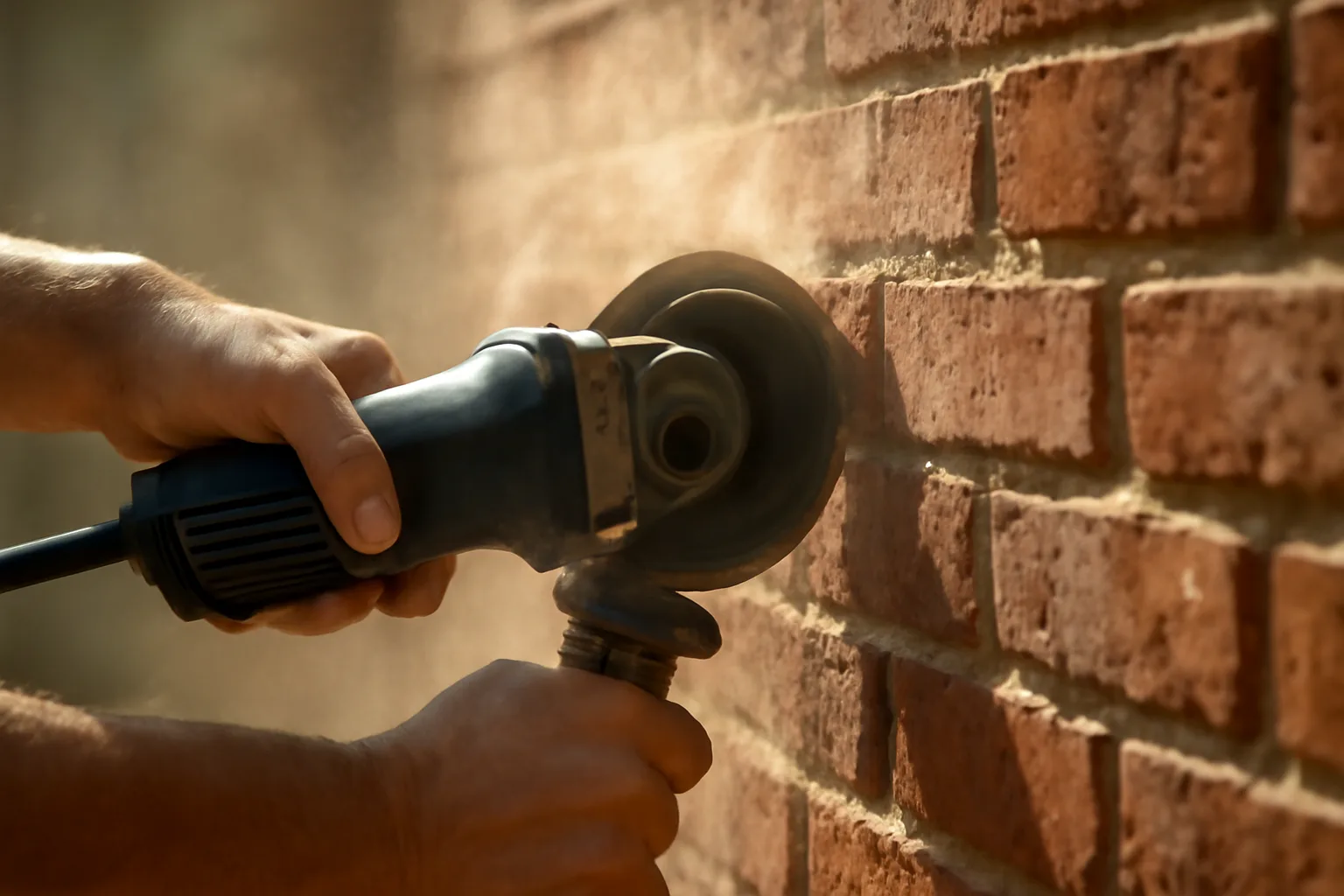
You can start with a tuckpointing grinder, a pointing trowel, a margin trowel, a mortar gun or hawk, a stiff-bristle brush, and safety gear. That set runs about $400 to $700 and fits in a pickup. The hard part isn't the tools. It's matching mortar color and texture.
Old mortar carries decades of weathering. A bag of pre-mixed Type N from the big box store will look wrong most of the time. Some contractors send a sample to a lab, which costs $150 to $300 and takes about a week. Another route is the Mortar-Match kit from TuckpointPath, a one-time $149 purchase that helps you match color on-site without the lab wait. Neither is required. A bad color match can also cost you the whole job's profit when the client refuses to pay.
On mortar type, Alabama's climate calls for Type N in most above-grade brick work. Below grade or in high-wind coastal zones, Type S is stronger, but it can crack softer brick, so use it carefully. Talk to the counter at a local masonry supplier (Birmingham's Oldcastle yard or a Huntsville concrete supplier) about what they stock for your area.
Pricing your first jobs and finding clients
Figure your cost per day, then add a material markup. A common method: charge $400 to $600 a day for you plus a helper, mark materials up 20%, and add any scaffold rental or permit fees. A 30-square-foot chimney repointing with $150 in materials and one day of labor lands around $550 to $750.
Property managers and real estate agents are your fastest first clients. They need tuckpointing for listing repairs and they come back. Call 20 property management firms in your city and offer a free inspection. Print simple flyers with a before-and-after pointing photo and leave them with the office manager. In smaller Alabama towns, word of mouth moves fast after one clean job.
Looking at nearby states? How to start tuckpointing in Arkansas has a similar light-licensing setup but a different local market rhythm, so it's worth comparing.
Common mistakes that cost new tuckpointers money
The top money-loser is ignoring lead paint. Any home built before 1978 likely has lead paint on the brick or mortar, and the EPA's Renovation, Repair and Painting (RRP) rule applies. You must be certified to disturb lead paint beyond a tiny area. EPA lists a maximum civil penalty of $37,500 per violation per day for RRP breaches [10]. The lead-safe certification is online, takes about a day, and costs roughly $200. Cheap insurance against a five-figure fine.
Second, grinding joints too deep or using mortar that's too hard. Tuckpointing is surgical. You remove only the damaged mortar to a depth of about ¾ inch. Gouge the brick and you create a bigger repair you can't bill for.
Third, skipping the weather forecast. Mortar that dries too fast cracks within hours. In a July heat wave, you might start at 6 a.m. and cover the wall with wet burlap until sunset just to keep the cure slow enough.
Getting insured and bonded the right way
General liability isn't optional if you want real work. Alabama clients will ask for a certificate before you set foot on the property. Expect $500 to $1,200 a year for $1 million in coverage, depending on your revenue and claims history. Some carriers bundle in tools and commercial auto.
A surety bond is rarely required for small tuckpointing jobs. Win a municipal contract or work on a school, though, and you may need one. Bonds are priced as a percentage of the contract amount and lean on your credit. Ask your insurance agent to quote a bond line early so you're not scrambling when a bid deadline hits.
When do you actually need a contractor license?
Cross the residential $10,000 mark or the commercial $50,000 mark and Alabama law requires a license. The HBLB path includes a trade exam, a business law exam, and proof of experience for residential licenses [1][9]. The General Contractors Board runs a comparable path for commercial work [2]. Plan on several months and a few hundred dollars in fees.
Land a big job that tips over the line and you have three options: subcontract under a licensed contractor, get your own license, or turn the work down. Plenty of Alabama tuckpointers never hold a state license because they stay in that sub-$10,000 range on purpose. For the full licensing breakdown, see our tuckpointing license in Alabama page.
Tennessee runs a different system entirely. Tuckpointing license in Tennessee walks through how theirs works.
Frequently asked questions
Do you need a license for tuckpointing in Alabama?
No state license for jobs under $10,000 residential or $50,000 commercial. You need a city business license in most municipalities and general liability insurance. Cross either dollar threshold and a residential home builder license (HBLB) or commercial general contractor license becomes mandatory.
How much does tuckpointing cost in Alabama?
Typical costs run $8 to $15 per square foot. A small chimney repair averages $200 to $375, while a full wall repointing might run $800 to $1,500. Scaffold rental, historic mortar, and coastal humidity can each add 15 to 25% to the base price.
How long does tuckpointing take in Alabama?
Most residential jobs take one to three days. A single chimney with two workers may be done in a day. Larger wall sections need two to three days. Weather drives the timeline: Alabama summers require slow curing, and rain can halt work for days. Commercial facades can take two weeks or longer.
What insurance do I need for tuckpointing in Alabama?
General liability with $1 million coverage is standard, and cities often demand proof before issuing a business license. Workers' comp is required once you have employees. Builder's risk or tool coverage is optional but worth carrying.
Do I need a business license in every city I work in Alabama?
Yes, if the city licenses trades. Birmingham, Huntsville, Mobile, and Montgomery all require a separate license for each place you perform work. Fees are typically $50 to $150 per year.
Is tuckpointing subject to sales tax in Alabama?
Tuckpointing labor is not subject to sales tax, but you must pay sales tax on the materials you buy. If you resell materials separately to the client, you may need to register for a tax account with the Alabama Department of Revenue.
Does Alabama have lead paint rules that affect tuckpointing?
Yes. Federal EPA RRP rules apply to any home built before 1978. You need lead-safe certification to disturb more than a minimal amount of painted brick or mortar. The certification costs about $200 and takes one day.
What mortar type should I use for tuckpointing in Alabama?
Type N mortar works for most above-grade brick in Alabama. Type S is stronger but can damage older soft brick. Historic buildings often need a lime-based mortar mixed on site. Ask a local masonry supplier based on the brick's age.
How do I match mortar color for historic brick?
Lab color matching costs $150 to $300 and takes about a week. A mortar-matching kit like TuckpointPath's gives you a field match for $149. Either way, test a small, hidden area first before you commit to a batch.
Can I do tuckpointing as a side job in Alabama without a license?
Yes, as long as you stay under the $10,000 residential threshold per project, carry the required city license, and hold liability insurance. Many start part-time and go full-time once they've built a client base.
What happens if I do a tuckpointing job over $10,000 without a license?
The Alabama HBLB can fine you and issue a cease-and-desist order. You also lose the right to file a mechanic's lien for unpaid work, which means a client can refuse to pay and you have little recourse. It isn't worth the risk.
How do I get a contractor license if I want to take bigger tuckpointing jobs in Alabama?
Apply through the HBLB (residential) or the General Contractors Board (commercial). You'll pass a trade exam and a business law exam and prove experience. The process takes several months and costs roughly $300 to $500 in fees plus exam prep.
Sources
- Alabama Home Builders Licensure Board: Residential construction or repair projects costing $10,000 or more require a license from the HBLB.
- City of Birmingham: Every person or firm doing business in Birmingham must obtain a business license.
- U.S. Bureau of Labor Statistics: Masonry and building trade labor cost data used to frame per-square-foot ranges.
- City of Huntsville Business Licenses: Huntsville requires a business license for trades, with an application on its business license page.
- Alabama Department of Labor Workers' Compensation: Alabama workers' comp requirements apply to businesses with five or more employees.
- City of Huntsville Inspection Department: Masonry restoration in historic districts requires a building permit, regardless of cost.
- Alabama Home Builders Licensure Board License Requirements: HB license requires passing a trade exam, business law exam, and proving experience.
- U.S. EPA Renovation, Repair and Painting Program: EPA RRP rule applies to pre-1978 homes; civil penalties can reach $37,500 per violation per day.