Last updated 2026-08-19
TL;DR
Colorado does not issue a statewide masonry contractor license. File a business with the Secretary of State, open a tax account, then get contractor paper in each city where you work. Add insurance. Add EPA lead certification for pre-1978 buildings. Job price and duration swing with height, mortar failure, and freeze risk. Confirm fees with the board that collects them.
Do you need a license for tuckpointing in Colorado?
No statewide masonry or tuckpointing license exists in Colorado. The state licenses electricians and plumbers through the Department of Regulatory Agencies. It does not license masons.[14] You still need a legal business, tax paper, and whatever contractor card the city or regional building department requires where you bid.
People mess this up because they copy a coastal story. California runs a state contractor board. Texas has its own board path. Colorado does not. If a course sells you a "Colorado tuckpointing license" as a state card, that is a myth. The deeper local-board version lives in our tuckpointing license in Colorado guide.
What you actually hold is a stack. An LLC or other entity from the Secretary of State. A tax account from Revenue. A contractor classification in Denver, or a card from the Pikes Peak Regional Building Department if you work the Springs, or Boulder's process, or Fort Collins, or whoever has the inspection desk. Unincorporated work can look quieter on paper. A city inspector can still ask who signed the contract.
I would not run ads in a city before I read that city's contractor page. A logo is not a license. A state business filing is not a license either. If you only grind and point as a W-2 employee, the employer's card and policy carry the job. The minute you bid under your own name, you are the contractor.
Confirm every classification and exam rule with the building department that will stand on your scaffold. I will not invent a current fee or a processing clock. Those numbers move, and the board that cashes the check is the only source that counts.
What paper do you file first to start a tuckpointing business?
File the business with the Colorado Secretary of State, then get a free EIN from IRS, then open the state tax account. That order keeps bank, insurance, and city applications from bouncing. Articles of organization create a Colorado LLC when you file them with the Secretary of State under Title 7.[5]
Pick an entity on purpose. A lot of first-year masons use an LLC because it is familiar to insurers and GCs. A sole prop is legal. It also mixes your truck and your house in a way I would not accept after the first five-figure job. I am not your lawyer. Read Title 7 and pay a Colorado business attorney for an hour if the ownership is more than you.
IRS lets you apply for an EIN online at no charge. Do not pay a reseller.[4] Use the EIN on the bank account and on the CDLE and city forms that ask for a federal number.
Then hit Revenue. Colorado expects a sales tax license application when you make taxable sales, and contractors still need a clean tax story for materials and any employees.[6] Construction tax is picky. In many cases you pay sales or use tax on materials you install, and you do not get to invent a retail markup rule from a forum. Read the Department of Revenue contractor material guidance and ask them if your mix of repair versus improvement is unclear.
Only after that stack would I touch a city contractor application. Denver publishes the apply steps for contractor licensing.[8] Bring the entity docs, the EIN, and insurance certificates that match the name on the bid. Mismatched names are how applications stall. Confirm the current filing fee on the Secretary of State fee schedule. I will not quote a number that the board can change next month.
How much does it cost to start tuckpointing in Colorado?
The cheap paper is the state filing and the EIN. The real checks are insurance, dust control, access equipment, and the first month you work slower than you bid. Nobody publishes a clean statewide startup total for tuckpointing in Colorado. Anyone who gives you one number is guessing.
State formation and the IRS number are small next to a general liability policy that a GC will actually accept. Ask for the certificate limits in the subcontract before you bind coverage. A $1 million occurrence form is a common ask. Confirm what the GC wants. Do not buy a policy in a trade name that does not match your SOS record.
Tools matter more than a wrap on the van. A shrouded grinder and a vacuum that can handle silica are not optional if you cut joints with power tools.[1] Pointing irons, hawk, mixer, mortar boards, joinable scaffolding or a scissor lift rental, fall gear, water, and tarps add up. I would rent the lift for the first tall wall. I would not lease a shop in month one. Mix on the driveway. Keep every receipt.
City contractor cards, exam seats, and bonds are local. Denver and PPRBD post their own fee lists.[8][9] Confirm those figures on the page you will pay. Same for workers' comp if you hire. Premiums follow class code and payroll, not a blog chart.
Skip the brand-new dump trailer until you have repeat work. Skip the embroidered hoodies. Buy dust control and a written contract template from a Colorado construction lawyer. That is the grown-up spend.
How much does tuckpointing cost in Colorado?
There is no official Colorado price list for tuckpointing. Bids move with joint condition, matching colored mortar, height, paint, lead rules, historic review, and whether you can work in January. I have not found a state index I trust. Treat national square-foot ranges on consumer sites as entertainment.
Labor is the floor. BLS publishes occupational wages for brickmasons and blockmasons under SOC 47-2021. Pull the current Colorado line on the OEWS table instead of memorizing a blog number. The national and state figures change each release.[12] Your loaded cost is wages plus FAMLI, unemployment, workers' comp if you have staff, fuel, lift rental, and the hours you spend matching sand.
Access changes everything. A single-story bungalow in Arvada is one job. A three-story painted walk-up near downtown Denver is another. Scaffold and lift days can outrun the mortar. Historic districts add sample panels and review time you cannot bill like a production wall.
I price from measured linear feet of joint, a test bay, and a written allowance for hidden unsound brick. I do not bid a whole facade from a phone photo. If a homeowner wants a single number by text, I walk. Change orders exist because raked joints lie.
Give three comparable local bids if you are the buyer. If you are the contractor, write what is included (rake depth, mortar type, joint profile, cleanup, protection) and what is not (brick replacement, flashing, paint). Vague scope is how Colorado freeze-thaw turns a cheap bid into a callback.
How long does tuckpointing take in Colorado?
A small chimney can be a day. A full elevation can run days to weeks. Time follows linear feet, how dead the mortar is, whether you cut by hand or grinder, cure time, and weather. I will not invent a statewide average. Measure, then sample a bay.
Raking is the clock most new crews underestimate. NPS Preservation Brief 2 is blunt about depth. "The old mortar should be removed to a minimum depth of 2 to 2-1/2 times the width of the joint to ensure an adequate bond and to prevent mortar 'popouts.'"[2] Shallow raking is fast and fails. Deep raking on hard 1920s joints is slow and dusty.
Colorado weather is the other clock. Hot, dry wind skins a joint before you can tool it. High country and Front Range afternoons pull water out of lime-heavy mixes. You mist and cover, or you redo it. I stop ordinary pointing when the wall is heading below about 40 F unless I have a heated enclosure. Frozen mortar is scrap.
Historic review adds calendar time, more than hours. Sample panels sit while a preservation staffer looks at color and joint profile. Build that wait into the contract. Do not promise a finish Friday if the district has not signed off on the mortar.
Cure is not optional. Clients want the scaffolding gone. The wall wants to stay damp enough to hydrate. Write the protection days into the schedule so you are not fighting a property manager on day two.
Which Colorado cities actually license masonry contractors?
The cities and regional building departments license contractors. The state does not hand you a mason card. Denver Community Planning and Development runs a contractor licensing process with published apply steps and classifications.[8] The Pikes Peak Regional Building Department covers contractor licensing for the Colorado Springs region.[9] Boulder, Fort Collins, Aurora, and Lakewood keep their own desks.
You do not carry one Colorado card from Grand Junction to Sterling. Plan on a new read, and maybe a new application, each time you cross a building-department line. Reciprocity chatter on forums is not a filing. Ask the receiving city if they honor another Colorado card. Then get the answer in writing.
A simple comparison helps, then you still confirm the live page.
| Paper | Who issues it | When it shows up |
|---|---|---|
| State masonry contractor license | Nobody in Colorado | It does not |
| Articles of organization | Colorado Secretary of State | If you form an LLC |
| Tax account | Colorado Department of Revenue | Sales, use tax, or payroll |
| Contractor card | Denver, PPRBD, Boulder, others | Before you contract in that jurisdiction |
| EPA firm certification | U.S. EPA | Pre-1978 target housing and similar work |
| Workers' comp policy | Insurer, overseen by CDLE DWC | When you have employees |
I would map the first six cities I actually intend to work, print each contractor page, and highlight the classification that matches masonry or specialty building. If the list is fuzzy, call the licensing tech and ask which class covers tuckpointing on an existing brick wall. Write down the name of the person who answered.
County land outside a city can look easy. The minute the wall sits in a municipal historic district, you are back in local paper. Budget the admin hours. They are part of tuckpointing in Colorado, not a side quest.
Do you need EPA lead certification for Colorado tuckpointing?
Yes, when the job is EPA target housing or a child-occupied facility and your work can disturb lead-based paint. Housing built before 1978 is the usual trigger.[3] Colorado generally runs under the federal renovation, repair, and painting program, not a separate state RRP board. Confirm authorization status on EPA's program page before you assume a state shortcut.
Tuckpointing looks like mortar only. Painted window staff beads, painted brick, and adjacent trim turn a grinder day into a lead day. If RRP applies, the firm needs EPA certification and a certified renovator has to run the job the way the rule describes.[3] Skipping that to save a week is how you buy an enforcement file.
I would get the firm filing done before I bid pre-1978 work, not after the walkthrough. Use EPA's own certification path. Do not pay a random site that "registers" you. Confirm the current firm fee on EPA's fee page. I will not lock a dollar figure here.
Lead-safe work is also just good masonry. Containment keeps brick dust out of a crib and out of your lungs. The same plastic and sign-in habits help on silica days. If the building is commercial and not target housing, RRP may not fit. OSHA and the contract still do. Read the rule. Do not guess from a group chat.
What insurance and payroll taxes hit you in year one?
General liability is the policy that lets you on a GC's site. Workers' comp is the policy the state cares about once you have employees. CDLE's Division of Workers' Compensation tells employers when coverage is required and how to report.[7] A true solo owner-operator is often outside automatic coverage. The second you hire, the analysis changes. Confirm with DWC and the carrier. Officer elections are a form, not a vibe.
Unemployment insurance registration lives at CDLE too. So does Colorado FAMLI. Employers remit FAMLI premiums. Confirm the current rate on the FAMLI employer page. I will not invent it.[11] The Healthy Families and Workplaces Act is separate. CDLE states that employees accrue paid sick leave at one hour per 30 hours worked under HFWA.[10] Build that into your labor unit. Ignoring it does not make the statute go away.
Withholding and wage paper sit with Revenue and CDLE. New-hire reporting is not optional. I-9 is federal. If you try to call every helper a 1099 mason, read Colorado's independent contractor rules first. CDLE and Title 8 do not treat a pointing iron and a handshake as a subcontract.[13] Misclassification is a boring way to blow up a first year.
I would stay solo or use one W-2 helper until the books are clean. I would not run a crew of "subs" who only work for me, drive my mixer, and wear my shirts. That is not clever. That is a future audit.
What safety rules apply to grinding mortar in Colorado?
Federal OSHA construction silica rules apply on Colorado jobsites. 29 CFR 1926.1153 sets the respirable crystalline silica PEL at 50 ug/m3 as an 8-hour TWA and an action level at 25 ug/m3.[1] OSHA's text is not subtle. "The employer shall ensure that no employee is exposed to an airborne concentration of respirable crystalline silica in excess of 50 μg/m3, calculated as an 8-hour TWA."[1]
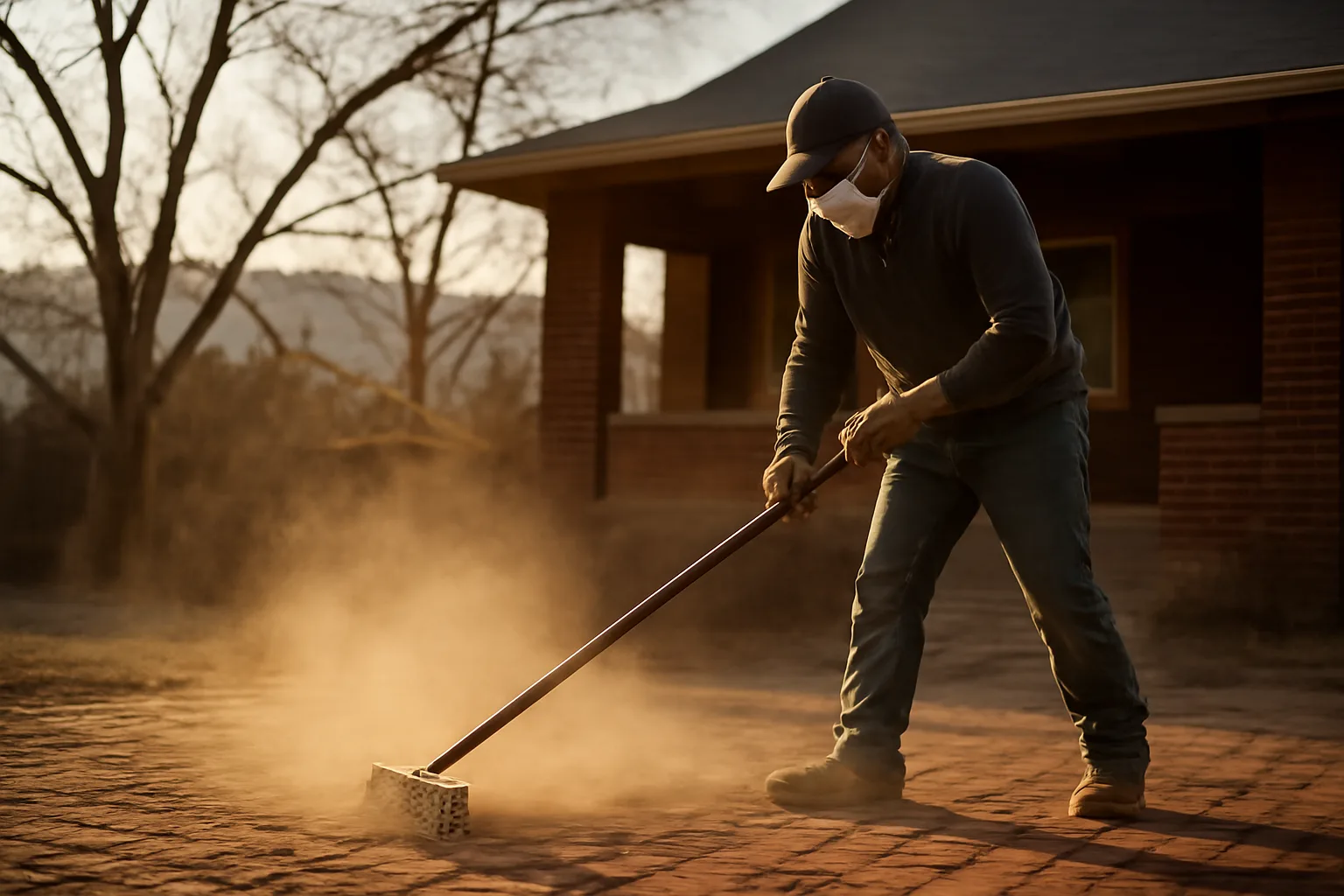
Tuckpointing with a handheld grinder is a known high-dust task. Table 1 in the standard lists specified controls (shroud, vac, sometimes water, sometimes respirator) if you want that compliance path. I would follow Table 1 on day one instead of pretending a paper mask is a program. Buy the shroud and a vac rated for the dust. Learn how to change filters without smoking the jobsite.
You still need a competent person, housecleaning that does not include compressed-air blowdowns, and medical surveillance when the standard triggers it. Thirty or more days a year at or above the action level is the surveillance hook in the rule. Read the section. Do not outsource the read to a vendor slide deck.
Fall protection on a Denver two-story is still fall protection. Silica does not cancel scaffolds. I see new masons obsess over mortar color and ignore the plank. The wall can wait. A fall cannot.
OSHA's construction silica fact sheet is a short companion to the regulation if you want a plain walkthrough after you read the rule itself.[15] Train whoever holds a grinder. A weekend helper is still your employee problem if you direct the work.
How do you match mortar and stay out of historic trouble?
Match the historic mortar. Do not "upgrade" a soft brick wall with a hard Portland mix because a bag store clerk smiled. NPS Preservation Brief 2 is the document reviewers actually know. The point of a compatible mortar is that it can coexist with the old work and fail first if something has to give.[2]
Colorado freeze-thaw punishes arrogant mixes. Soft brick in older Denver, Boulder, and mountain-town stock will spall if the joint is stronger than the unit. You get a pretty year, then face loss. I would pull a sample, look at sand color and grain, and cut a test panel in an inconspicuous bay. If the job sits in a designated historic district, wait for staff sign-off before you point the street elevation.
Joint profile matters as much as color. A smeared, ironed joint on a wall that was always slightly recessed reads fake from the sidewalk. Photograph the surviving original joints in raking light before you touch them. Then tool to that, not to a YouTube "clean look."
If you want a paper checklist by district, TuckpointPath sells a $149 one-time Mortar-Match + District Kit at /start. You do not need it to follow this guide. The NPS brief is free, and the city preservation page is free. Use those first.
Painted masonry is a different fight. Do not assume you can grind paint off a historic face and call it restoration. Ask the district. Sometimes the paint stays. Sometimes a test clean is required. Guessing is how you fund someone else's consultant.
Should you hire employees or stay solo your first year?
Stay solo until the paper and the pipeline are real. A helper looks cheap until workers' comp, HFWA sick leave, FAMLI, unemployment, and overtime land in the same month as a slow-pay GC.[7][10][11] One person with a shrouded grinder and honest scheduling beats a three-person crew you cannot document.
If you hire, hire as employees unless a true separate trade shows up with its own entity, tools, and other customers. Colorado's independent contractor tests are not a suggestion.[13] A pointing laborer who only works your walls is not a business. CDLE can do math.
I would not open with an apprentice promise you cannot fund. Registered apprenticeship is real and useful later. It is not a year-one requirement to rake joints on a bungalow. If a public prevailing-wage job asks for apprenticeship language, read that bid twice or skip it until you have payroll muscle.
Training still happens when you are solo. You train yourself on silica, lead, and the city card. You train a future hire on your written method, not on folklore. Write the rake depth, the mix, and the cleanup down. If it only lives in your head, you do not have a company. You have a hustle.
What does a realistic first-year tuckpointing path look like?
Month one is paper and tools, not Instagram. Entity, EIN, tax account, insurance quote, city card for the one market you can actually drive, silica kit, sample sands. Bid small, close walls you can finish without a lift if you can. Collect deposits against a written scope. Do not start a three-story painted building as job one.
Month two to six is repetition. One good chimney photo is worth less than three finished walls with owners who will pick up the phone. Keep mortar cups from each job. Keep the mix recipe. Colorado light makes yesterday's "match" look wrong at 4 p.m. Your cups keep you honest.
If work spills into Arizona or another state, stop and read that state's path. Arizona is not Colorado. Start with how to start tuckpointing in Arizona and the tuckpointing license in Arizona page before you trailer the mixer south. California and Texas are their own board worlds. Use how to start tuckpointing in California, tuckpointing license in California, and tuckpointing license in Texas when those bids appear. Do not export a Denver card and hope.
I would keep a simple job cost sheet from day one. Hours, mix, lift, dump fees, callbacks. First-year masons go broke on the callback, not on the grinder. Price the winter shutdown. The Front Range will give you weeks you cannot point. That is not a personal failure.
TuckpointPath is an independent publisher, not a law firm and not a service company. This page is a map. Confirm fees, classifications, and timelines with the board that collects the money. If you want the kit after you have read the free rules, it is at /start. You can do the whole path without it.
Frequently asked questions
Do you need a license for tuckpointing in Colorado?
No state masonry or tuckpointing license exists. DORA licenses trades such as electrical work, not masons. You still need SOS business paper, a tax account, insurance, and the contractor card required by Denver, PPRBD, or whichever city will inspect the wall. Confirm the classification with that building department before you bid.
How much does tuckpointing cost in Colorado?
There is no official state price index. Homeowner cost follows linear feet of joint, height, mortar match, paint, lead rules, and access equipment. Labor tracks BLS mason wages plus your loaded burden. Get three written local bids with rake depth and mortar type spelled out. Ignore a single national square-foot number.
How long does tuckpointing take in Colorado?
A chimney can take a day. A full elevation can take days to weeks plus cure time. Raking to NPS depth is slow on hard joints. Wind, sun, and cold stop or stretch the calendar. Historic sample approval adds wait time. Measure linear feet and do a test bay. Do not promise a weekend finish from a photo.
Does Denver require a contractor license for masonry?
Denver Community Planning and Development runs its own contractor licensing process with published classifications and apply steps. Masonry and tuckpointing work you contract in the city generally falls under that system. Read Denver's current classification list and ask licensing staff which class covers repointing. Confirm fees and exams with Denver. Do not rely on a forum summary.
Do I need a Colorado sales tax license to tuckpoint?
Apply through the Department of Revenue when you make taxable sales or need the account for contractor materials and payroll. Many contractors pay sales or use tax on materials they install. The labor versus materials split is easy to get wrong. Use Revenue's contractor guidance and ask them if your repair work is unclear.
Is a Colorado LLC required to start tuckpointing?
No. You can operate as a sole proprietor. An LLC is still what I would file, because insurers and GCs recognize it and it keeps the job off your personal checking account. Articles of organization are filed with the Secretary of State under Title 7. Confirm the current filing fee on the SOS schedule. EIN from IRS is free.
Do I need workers' comp as a solo Colorado mason?
A true owner-operator without employees is often outside automatic coverage. The analysis changes when you hire. CDLE's Division of Workers' Compensation publishes employer duties. Confirm your status with DWC and a Colorado agent before you put a helper on a wall. Corporate officer elections are paperwork, not a verbal shrug.
Does tuckpointing need a building permit in Colorado?
It depends on the building department and whether the work is ordinary repair or something structural. Many cities treat simple repointing differently from rebuilding a lintel or a chimney. Historic districts add review even when the permit desk is quiet. Ask the local building and preservation staff about that address. Get the answer in writing.
Do I need EPA RRP certification to tuckpoint in Colorado?
Yes when the job is pre-1978 target housing or a child-occupied facility and you may disturb lead-based paint. Colorado generally uses the federal EPA program. The firm needs EPA certification and a certified renovator on the job as the rule requires. Painted masonry and adjacent trim are the usual traps. Confirm current firm fees on EPA's page.
Can I work multiple Colorado cities on one license?
Not on a single statewide mason card, because that card does not exist. Each city or regional building department sets contractor rules. Denver paper is not automatically PPRBD paper. Ask the receiving city if they honor another Colorado classification. Until they say yes in writing, budget another application.
What happens if I tuckpoint in a Denver historic district?
Expect mortar color, joint profile, and sometimes method review. Cut a sample panel and wait. NPS Preservation Brief 2 is the technical language staff already know. Do not switch in a hard modern mix on soft brick. Do not grind decorative faces without written approval. Build the review wait into the contract so you are not paying for idle scaffold.
Is a masonry apprenticeship required to start in Colorado?
No statewide apprentice card is required to form a business and seek local contractor paper. Apprenticeship helps later, especially on public or prevailing-wage work. Year one is still entity, tax, city card, insurance, and silica controls. Do not promise a registered program you cannot fund just to look established.
What insurance limits do Colorado GCs usually ask for?
Many general contractors ask for a $1 million occurrence general liability limit and additional insured language that matches the subcontract. That is a market habit, not a state statute. Read the exhibit before you bind. Match the named insured to your SOS entity. Umbrella coverage shows up on taller or multi-crew jobs. Confirm with the GC and your agent.
How do I handle sales tax on tuckpointing materials?
Colorado often treats contractors as the consumer of installed materials, which means you pay tax when you buy or you accrue use tax. You do not get to invent a retail resale story because someone on a video did. Read Department of Revenue contractor publications and ask them about your exact contract type. Keep vendor invoices.
Sources
- OSHA 29 CFR 1926.1153 Respirable crystalline silica: Construction silica PEL is 50 ug/m3 as an 8-hour TWA and the action level is 25 ug/m3, with Table 1 specified controls for tasks such as grinding.
- NPS Preservation Brief 2, Repointing Mortar Joints in Historic Masonry Buildings: Old mortar should be removed to a minimum depth of 2 to 2-1/2 times the joint width, and repointing mortar should be compatible with the historic masonry.
- U.S. EPA Lead Renovation, Repair and Painting Program: EPA RRP applies to renovation work that disturbs lead-based paint in pre-1978 target housing and child-occupied facilities, and firms must be certified.
- IRS Apply for an Employer Identification Number (EIN) Online: Businesses can apply for an EIN online directly from IRS at no charge.
- Colorado Revised Statutes Title 7 (2023 compilation PDF): Colorado LLCs are formed by filing articles of organization with the Secretary of State under Title 7, Article 80.
- Colorado Department of Revenue, How to apply for a sales tax license: Colorado businesses apply to the Department of Revenue for a sales tax license when they make taxable sales.
- CDLE Division of Workers' Compensation, Employers: CDLE DWC publishes employer duties for obtaining and maintaining workers' compensation coverage in Colorado.
- Pikes Peak Regional Building Department, Contractor Licensing: PPRBD runs contractor licensing for the Colorado Springs regional building jurisdiction.
- CDLE, Paid Sick Leave under the Healthy Families and Workplaces Act: Colorado HFWA requires paid sick leave accrual at one hour per 30 hours worked.
- Colorado FAMLI, Employers: Colorado employers remit FAMLI premiums and must follow current FAMLI employer rules.
- BLS Occupational Employment and Wage Statistics, SOC 47-2021 Brickmasons and Blockmasons: BLS publishes current occupational wage estimates for brickmasons and blockmasons under SOC 47-2021.
- Colorado Revised Statutes Title 8 (2023 compilation PDF): Colorado Title 8 includes independent contractor provisions used in unemployment and wage enforcement, including C.R.S. 8-70-115.
- Colorado DPO, Electrical licensing: Colorado state-licenses electricians through DPO, illustrating the trades the state does regulate versus masonry, which it does not.
- OSHA Fact Sheet, OSHA's Respirable Crystalline Silica Standard for Construction (OSHA 3681): OSHA's construction silica fact sheet summarizes the PEL, specified exposure control methods, and related employer duties.