Last updated 2026-08-19
TL;DR
Colorado has no state tuckpointing board. DORA does not license masons. You still file a Colorado entity ($50 LLC articles), open a sales tax account, pick up city contractor credentials where required, carry workers' comp if you have staff, and run OSHA silica controls. Confirm the city that holds the wall. This is not legal advice.
Is there a tuckpointing board in Colorado?
No. Colorado runs no statewide tuckpointing board, no mason board, and no specialty mortar license. The Division of Professions and Occupations licenses electricians and plumbers. It does not run a tuckpointing license program. [1][2]
That is the state-level answer. It still surprises people who moved from a license-heavy state and expect one phone number. There is no exam in the capitol for a pointing trowel. There is no statewide renewal card with tuckpointing printed on it.
You still have paper. It just lives in other buildings. The Secretary of State handles the entity. The Department of Revenue handles the sales tax account. Cities and regional building departments handle contractor cards. Denver Community Planning and Development is one desk. The Pikes Peak Regional Building Department covers Colorado Springs and several El Paso County towns. Boulder and Fort Collins each run their own.
If a group chat tells you to call the Colorado tuckpointing board, there is no number. Call the city that will see the scaffold. Write the person's name down. Class names change. I would treat any search result that promises a single tuckpointing colorado state card as noise.
Other states really do centralize contractor paper. California is the comparison people bring up first. California's contractor desk is a different machine. Colorado chose local control instead.
Do you need a license for tuckpointing in Colorado?
You do not need a state tuckpointing license. You may need a local contractor license, and you need a legal way to get paid if the work is for someone else.
Paid work inside Denver is the clean example. Denver requires contractor licensing through Community Planning and Development for the building work it regulates. Masonry repair gets pulled into a building contractor class, not a magic tuckpointing endorsement. Confirm the current class list on Denver's how-to page before you bid. [3]
Colorado Springs and several neighboring towns route contractor licensing through the Pikes Peak Regional Building Department. The City of Colorado Springs points that work to PPRBD. [4]
Unincorporated counties can be thinner. Some rural jobs have no contractor card at all. That does not waive OSHA, sales tax, or workers' comp. A quiet county is not a permission slip.
I would not send a paid crew out on a truck and a handshake. File the entity. Get the city credential where the city asks. Ask, in writing, whether grinding and replacing mortar joints sits inside that license class.
A comparison keeps the desks straight.
| Desk | What you actually get | Statewide tuckpointing license? |
|---|---|---|
| Colorado DPO | Electrician and plumber licenses, other listed professions | No |
| Colorado Secretary of State | Entity and trade name filings | No |
| Denver CPD | City contractor license classes | No, city only |
| Pikes Peak Regional Building Department | Regional contractor licensing | No, regional only |
Homeowners doing their own house are a different fact pattern. The minute you take money from a neighbor, you left that pattern.
How much does tuckpointing cost in Colorado?
There is no official Colorado tuckpointing price. No board publishes a consumer rate. The job costs labor, access, mortar matching, disposal, and silica controls. Anyone selling you a single statewide square-foot statute made it up.
Labor is the heavy line. The Bureau of Labor Statistics tracks brickmasons and blockmasons under SOC 47-2021 and posts mean wages on the OEWS occupation page. [5] Recent national means have sat in the low $30s per hour. Colorado metro tables print their own numbers, and mountain towns do not follow Denver. Read the current release. Do not build a burden from a number you remember from a podcast.
Access can outrun mortar. A one-story bungalow in Wheat Ridge is not a five-story face on Capitol Hill. Scaffold, lifts, street occupancy, and winter enclosures move the bid more than the sand. A GC who has already staged the elevation will pay you differently than a homeowner who wants you to include the lift.
Silica controls are a real cost. A shrouded grinder and a HEPA vac are how you stay inside the federal rule. OSHA sets the respirable crystalline silica PEL for construction at 50 μg/m³ as an 8-hour TWA (29 CFR 1926.1153). [6] That number is not a suggestion.
I will not print a fake average Colorado tuckpointing cost and dress it up as research. Consumer estimate sites float wide per-square-foot bands. Those bands are not a statute and they are not a Colorado study. Nobody has good public data on private residential pointing prices in this state. Price the wall in hours, joint condition, matching samples, and how you will get off the ground.
A chimney with a sound crown can be a small residential invoice. A full elevation with historic lime and occupied interiors is not. If a bid cannot cover a paid cutter, a working vac, and a dumpster, it is not a bid. It is a callback you will fund yourself.
How long does tuckpointing take in Colorado?
It takes as long as the joint feet, the access, and the weather allow. There is no state duration table and no board clock.
A two-person crew on a one-story residential wall with decent joints can often cut and fill a visible elevation in two to five working days, including setup and cleanup. That is a field range, not a promise. Soft brick, paint in the joints, and a fussy color match stretch it. So does a homeowner who wants to approve every sample in evening light.
Chimneys are often one or two days if you are not rebuilding the crown. Full buildings with swing stage run into weeks. Cure time is part of the job, not a pause after the job. Lime wants moisture and time. A hot, dry Front Range afternoon will fight you.
Colorado weather is the clock people forget. Wind along the Front Range pulls water out of a joint. A late-day pack on a north wall in Fort Collins in March can freeze. Preservation Brief 2 is the document historic staff will hand you if you rush a historic joint. [7]
Write weather holds into the contract. Write square footage and joint width too. If a client wants a locked date in January on an exposed wall, talk hydration and freeze risk. Or decline the date. A pretty schedule that ruins the mortar is not a favor.
What paper do you file to work legally in Colorado?
Start with the Secretary of State. Articles of Organization for a Colorado LLC cost $50 on the published business fee schedule. [8] A Statement of Trade Name is listed at $20 if you work under a name that is not the entity name. Confirm both on the live fee page before you pay. The legislature can amend a fee, and I will not pretend a printed article is the cashier.
Get an EIN from IRS once the entity exists. Open a bank account in the entity name. Mixing job deposits into a personal account is how people make cheap work expensive later.
Then open a Colorado sales tax account with the Department of Revenue. Apply through the Department's sales and use tax process. [9] Confirm the current fee on that page. Recent practice has been no state charge for the license itself, but your mix of labor and materials may still be taxable. Construction tax in Colorado is easy to get wrong. Use a Colorado CPA. I am not one.
If you want mortar-matching notes and district desks in one packet, TuckpointPath sells a $149 one-time Mortar-Match + District Kit at /start. Skip it if you already know your cities. The public desks are the path that counts.
Employees trigger more paper the week they start, not the week you feel established. Workers' compensation and unemployment insurance are CDLE problems. General liability is not a state license, but owners will ask for a certificate and many cities want proof with the contractor application.
Do this before the first invoice. Cleaning up an unregistered year costs more than a $50 filing.
Does Denver require a contractor license for masonry and tuckpointing?
Yes, plan on it for paid work. Denver runs contractor licensing through Community Planning and Development. The city's how-to page is the instructions, not a forum thread. [3]
Tuckpointing and masonry repair usually sit inside a building contractor class. Denver does not hand out a card that only says tuckpointing. Confirm which class matches grinding and replacing mortar, whether an exam applies to that class, and what insurance they want to see.
Permits are a separate yes or no. A few joints on a private, non-historic house may not trip a permit. Chimney rebuilds, structural work, and historic properties often do. Ask the permit desk about the actual scope, not about "tuckpointing" as a slogan.
I will not invent Denver's current application fee or a processing time. Those figures move. Pull the live fee schedule from denvergov.org and treat that printout as the number.
A Denver card does not automatically cover Aurora, Lakewood, or unincorporated Jefferson County. Each city is its own yes. I have watched crews assume the opposite and lose a Monday to a stop-work conversation.
What do Colorado Springs, Boulder, and other cities require?
Colorado Springs routes contractor licensing through the Pikes Peak Regional Building Department. The city's PPRBD page is the pointer. [4] That regional desk is the closest thing the southern Front Range has to a board. It is still not a tuckpointing board. Confirm current classes, exams, and insurance with PPRBD. Do not copy a Denver class name onto a Springs bid and hope.
Boulder publishes its own contractor licensing service page. [10] Fort Collins, Aurora, and Lakewood write their own rules. Some suburbs honor another city's license. Plenty do not. Unincorporated Adams, Weld, and Larimer County can be quieter than the home-rule cities, then surprise you with a right-of-way or floodplain rule.
Mountain towns can be stricter on historic fabric than on your out-of-state wallet. Call Aspen, Vail, Telluride, or Steamboat before you haul a mixer over the pass. A historic-district condition can cost more than the license.
Arizona and Idaho sit closer to this local-control model than people think, each with their own twists. Arizona's desks and Idaho's desks are useful if you already work those states. Illinois and Florida run different paper stacks. Georgia is another mix of local desks.
I would keep a folder per city. One insurance certificate with every city named as certificate holder saves a Friday afternoon.
Do you need workers' comp and unemployment insurance in Colorado?
If you have employees, yes. Plan on workers' compensation. The Division of Workers' Compensation tells employers that Colorado law requires coverage for employees. [11] A sole proprietor with no staff has a different analysis. Hire one cutter and the analysis flips.
I will not invent your premium. Masonry and grinding sit in higher-risk class codes. Get a quote from a carrier that writes Colorado construction. Some cities want the certificate before they finish your contractor application. A binder that excludes silica or heights is a waste of money if that is the work.
Unemployment insurance registration sits at CDLE once you have covered wages. Withholding and new-hire reporting start when pay starts. "We only have one guy" is not a category the state uses.
If you use 1099 cutters who look like employees, you are building a different problem. That is a fact pattern for a Colorado employment lawyer, not a slogan on an invoice.
What OSHA silica rules apply to tuckpointing in Colorado?
The federal silica standard applies on private sector construction here. Table 1 of 29 CFR 1926.1153 lists "Handheld grinders for mortar removal (i.e., tuckpointing)" and sets the control method. [6]
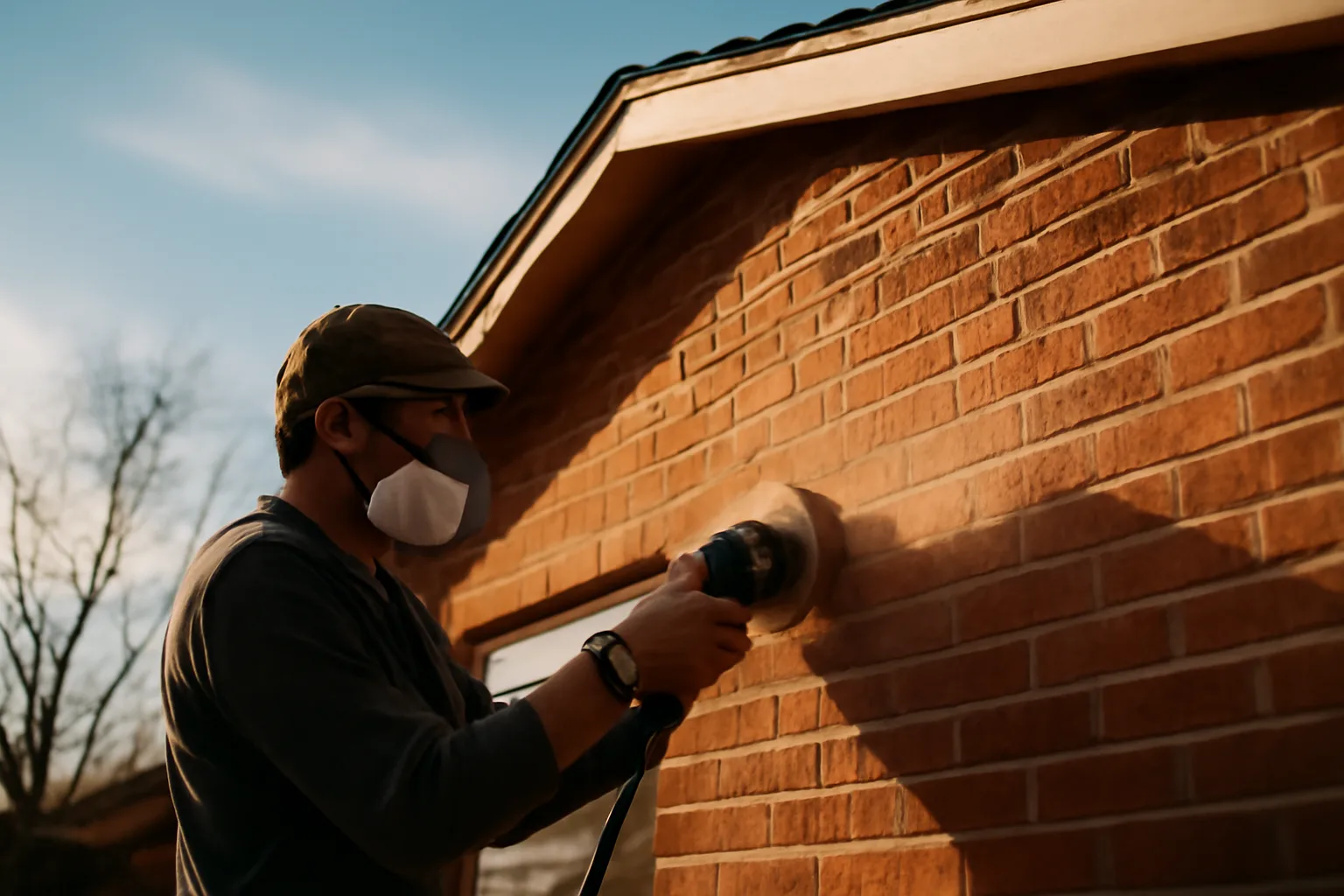
OSHA publication 3681 tells employers to use a grinder equipped with a commercially available shroud and dust collection system, and to operate and maintain the tool in accordance with the manufacturer's instructions to minimize dust emissions. [12] That is the practical sentence. If the vac is in the truck and the shroud is in a drawer, you are not on Table 1.
OSHA sets the respirable crystalline silica PEL for construction at 50 μg/m³ as an 8-hour TWA (29 CFR 1926.1153). [6] Colorado does not write a friendlier number for brick work.
A two-person crew is not exempt because the company is small. Federal OSHA still has the job. If you stay inside Table 1 and the vac is working, you have a defined path. If you step outside Table 1, you owe exposure assessment and the rest of the standard. Read it. A sticker on the case is not a written program.
I would buy the vac before I bought a second truck wrap. The citation and the medical file will cost more than the tool.
Do historic Colorado buildings change the mortar rules?
Yes. On a historic wall the desk that matters is the historic preservation commission, not DORA.
Denver historic preservation staff, Boulder's historic board, and town historic commissions can condition mix, color, joint profile, and whether you may cut a joint at all. They have all read National Park Service Preservation Brief 2. You should too. [7]
Brief 2 is the practical text on matching historic mortar and on the damage a hard, high-portland mix can do to soft brick. Sample panels in real light beat a phone photo. Lime takes time. Budget the sample, and budget a second sample if the first one dries the wrong color, because it will.
History Colorado is the State Historic Preservation Office. Tax credit talk starts there. Local design guidelines still win on the scaffold. A credit is extra paper, not a license to ignore the city.
I would not "upgrade" an 1890 Denver wall to Type S because the lumberyard had a pallet. That is how you blow faces off brick two winters later. Match what is in the joint, then prove it on a panel the historic staff can walk up to.
When do you need EPA lead-safe certification in Colorado?
When you disturb painted surfaces in pre-1978 housing or child-occupied facilities for compensation, the EPA Renovation, Repair, and Painting Rule applies.
EPA states, "The rule requires that firms performing renovation, repair, and painting projects that disturb lead-based paint in homes, child care facilities and pre-schools built before 1978 have their firm certified by EPA (or an EPA authorized state), use certified renovators who are trained by EPA-approved training providers and follow lead-safe work practices." [13]
EPA lists renovation firm certification at $300 on its lead program fee page. [14] Confirm the live amount and term before you pay. Do not treat that figure as locked for the life of this page.
Painted brick, painted window-adjacent joints, and old oil coatings on a 1922 bungalow are not "just mortar." If you do not know the paint is lead-free, treat the job as RRP or test. A clean mortar color will not save you from a painted reveal you ground through.
Colorado public health pages discuss lead. The federal firm certification is still the usual path unless a desk tells you otherwise in writing. Confirm. I will not invent an approval time.
What about building permits, sales tax, and mechanic's liens?
Permits are local. Ground-level repointing on a non-historic house might need nothing in one town and a permit in the next. Chimneys, structural rebuilds, and sidewalk scaffolds almost always need a call. Right-of-way and occupancy permits are their own pile when you block a Denver sidewalk.
Sales and use tax on materials sneaks up on out-of-state crews. Home-rule cities can stack their own tax. Register where you have a real presence. Ask the CPA whether you are selling a taxable improvement or a non-taxable labor pattern. I will not guess that on a statewide basis because the answer moves with the contract language.
Colorado mechanic's liens live in Title 38, Article 22 of the Colorado Revised Statutes. [15] Deadlines are short. Notice habits from another state do not automatically carry over. If you are unpaid, call a Colorado construction lawyer. This publication is not a law firm.
Keep photos, mix tickets, a signed scope, and daily notes. Those files collect better than a logo on a tailgate. Retainage fights are easier when the joint count is in writing.
How do you confirm the local rules before you bid?
Write the city on the top of the estimate. Call that building department. Ask the license class for masonry repair, whether this scope needs a permit, and what insurance they want. Get a name and a date. If they email you a checklist, keep it with the job.
Then check Secretary of State status, the sales tax account, and, if you have staff, the workers' comp certificate. If the wall is historic, call that commission before you price a Type N shortcut.
TuckpointPath is an independent publisher, not a law firm and not a service company. Nothing here is an approval or a timing guarantee. Confirm every fee and form with the desk that collects it.
I would spend first-year cash on a shrouded grinder, a mortar sample kit, winter protection, and a Colorado construction insurance agent. I would not buy a framed master certificate from a website. Colorado will not stamp it.
If you already work multiple states, clean Colorado first, then compare desks. The other state pages are for contrast, not a substitute for the city that holds this wall.
Frequently asked questions
Do you need a license for tuckpointing in Colorado?
There is no state tuckpointing license. Paid work still needs a Colorado business entity and, in many cities, a local contractor license. Denver and the Pikes Peak region are the usual desks. Confirm the class that covers masonry repair with the city that holds the job. This is not legal advice.
How much does tuckpointing cost in Colorado?
No board publishes a price. Cost is labor, access, matching, and silica controls. BLS posts mason wages under SOC 47-2021. Recent national means have sat in the low $30s per hour. Colorado metros differ. Treat consumer per-square-foot bands as talk, not a statute. Bid the actual wall.
How long does tuckpointing take in Colorado?
A simple one-story residential elevation often takes two to five working days for a two-person crew, including setup. Chimneys can be one or two days. Full elevations with staging take weeks. Weather, lime cure, and historic samples add time. There is no official duration table. Write weather holds into the contract.
Is there a state masonry exam in Colorado?
Not at the state level. DPO licenses electricians and plumbers, not tuckpointers. A city or regional building department may require an exam for a contractor class that includes masonry. Confirm with Denver CPD, PPRBD, or the town that will inspect the work. Do not study for a state mason test that does not exist.
Can I tuckpoint my own Colorado house without a contractor license?
Owner-occupied DIY is a different fact pattern from paid work. Many cities still want permits for chimneys, structural repair, or historic properties. HOA and historic-district rules can bind you even when a contractor card does not. Ask the building department about your exact scope before you rent a grinder.
Does Denver treat tuckpointing as a specialty license?
No separate tuckpointing card. Denver licenses contractors by building classes through Community Planning and Development. Masonry repair usually sits inside those classes. Confirm the current list, exam, insurance, and fee on denvergov.org. A Denver card does not automatically travel to Aurora or Lakewood.
How do I check a contractor for Colorado Springs work?
Use the Pikes Peak Regional Building Department, which the City of Colorado Springs points to for contractor licensing. Ask PPRBD whether the firm holds a current class that covers masonry repair. Then confirm insurance and, if the property is historic, any historic conditions. A Denver license alone is not the answer.
Do small tuckpointing crews still have to follow OSHA silica rules?
Yes. 29 CFR 1926.1153 names handheld grinders for mortar removal (tuckpointing) in Table 1. The construction PEL is 50 μg/m³ as an 8-hour TWA. A two-person shop is not exempt. Use a shrouded grinder and a working dust collection system, or step into the full exposure-assessment path.
Is workers' comp required for a one-employee tuckpointing company?
Once you have employees, Colorado expects workers' compensation coverage. CDLE's Division of Workers' Compensation states that employers must cover employees. A true sole proprietor with no staff is a different analysis. Get a Colorado construction quote. Do not invent a premium from a national blog.
Does pre-1978 paint change a brick job in Colorado?
It can. If you disturb painted surfaces on pre-1978 housing or child-occupied facilities for pay, EPA's RRP rule applies. Firms need EPA certification, certified renovators, and lead-safe work practices. EPA lists firm certification at $300 on its fee page. Confirm the live amount before you pay.
What is the first form to file for a tuckpointing business in Colorado?
File the entity with the Colorado Secretary of State. LLC articles of organization are $50 on the published fee schedule. Confirm that number on the live page. Then get an EIN, a bank account, and a Department of Revenue sales tax account. City contractor paper comes after you know which cities you will work.
Are lime mortars required on historic Denver brick?
Often in practice, even when nobody says "lime" in a statute. Historic commissions follow Preservation Brief 2 and local design guidelines. They can require a matched, softer mortar and a sample panel. A hard portland mix can damage soft historic brick. Ask the historic desk before you price Type S.
Does Colorado have a tuckpointing apprenticeship board?
No specialty tuckpointing apprenticeship board sits at the state level the way people imagine a trade board. Training happens through employers, union masonry programs where they exist, and jobsite practice. City contractor exams, if any, are separate. Confirm any registered apprenticeship questions with the actual program sponsor, not a rumor.
Do I need a sales tax license if I only charge labor?
Open the Department of Revenue conversation anyway. Colorado construction tax depends on how the contract is written and on materials you install. Home-rule cities can add their own tax. Recent practice has treated the state sales tax license itself as no-fee, but taxability is not the same thing as the license fee. Ask a Colorado CPA.
Sources
- Colorado DPO Electrical program: Colorado's Division of Professions and Occupations runs a state electrician license program.
- Colorado DPO Plumbing program: Colorado's Division of Professions and Occupations runs a state plumber license program and does not publish a parallel tuckpointing license program.
- U.S. BLS OEWS, Brickmasons and Blockmasons (47-2021): BLS publishes current occupational employment and wage statistics for brickmasons and blockmasons under SOC 47-2021.
- OSHA 29 CFR 1926.1153 Respirable crystalline silica: Table 1 lists handheld grinders for mortar removal (tuckpointing); the construction PEL is 50 μg/m³ as an 8-hour TWA.
- NPS Preservation Brief 2, Repointing Mortar Joints in Historic Masonry Buildings: National Park Service guidance on matching historic mortar and on damage from inappropriate hard repointing mixes.
- Colorado Secretary of State, Business document fees: Colorado publishes Articles of Organization at $50 and Statement of Trade Name at $20 on its business fee schedule.
- Colorado Department of Revenue, Sales and use tax: Colorado sales and use tax accounts are administered by the Department of Revenue through its sales and use tax program.
- City of Boulder, Contractor licensing: Boulder publishes its own contractor licensing requirements and process.
- Colorado CDLE Division of Workers' Compensation, Employers: Colorado instructs employers that state law requires workers' compensation coverage for employees.
- OSHA 3681, Handheld Grinders for Mortar Removal (Tuckpointing): OSHA's tuckpointing fact sheet specifies a grinder with a commercially available shroud and dust collection system.
- U.S. EPA, Lead Renovation, Repair and Painting Program: Firms that disturb lead-based paint in pre-1978 housing and child-occupied facilities for compensation must be EPA-certified and use certified renovators.
- Colorado Revised Statutes 2023, Title 38 (mechanic's liens, Article 22): Colorado mechanic's lien law is codified in Title 38, Article 22 of the Colorado Revised Statutes.